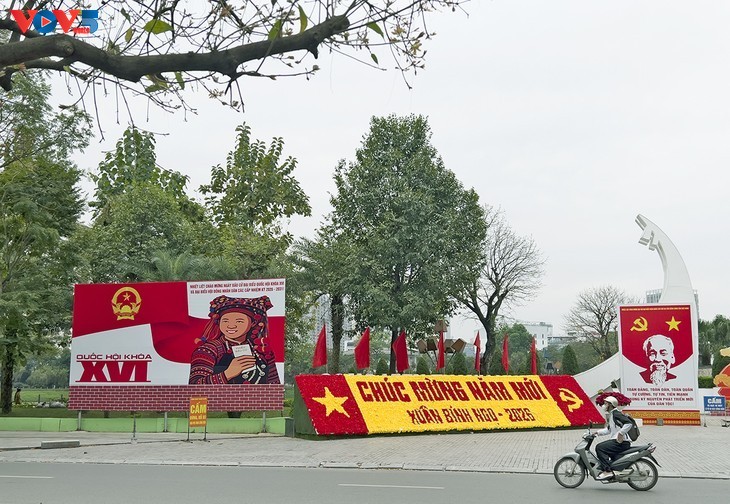
 Streets in Hanoi are decorated with large posters promoting National Assembly and People’s Council elections. (Photo: Le Chi/VOV5) Streets in Hanoi are decorated with large posters promoting National Assembly and People’s Council elections. (Photo: Le Chi/VOV5) |
B: Let’s begin with the messages we received from our Indonesian listeners, many of whom congratulated us on the election of Vietnam’s new National Assembly People’s Councils.
A: Thank you for your good wishes. Every election in Vietnam is an important political event that reflects the people’s right to participate in governance. It’s inspiring to see foreign listeners taking such an interest in Vietnam’s democratic process.
B: More than 76 million Vietnamese voters, 99.68% of the electorate, cast ballots to elect deputies to the 16th National Assembly and People’s Councils at all levels for the 2026-2031 term. The turnout demonstrates public engagement in national governance and hopes for a productive new term for the nation’s elected bodies.
A: Sunday’s successful election demonstrated competent organization, voter enthusiasm, and political and social significance in its impact on the operation of Vietnam’s state apparatus in the coming term.
B: Listener Juan Diez of Spain shared a fascinating reflection on Vietnamese culture, particularly the Ao Dai (traditional long dress) Festival. He wrote: “The Ao Dai Festival celebrates the elegance of both men and women. It reminds me of the Nguyen Dynasty which was a brilliant period of Vietnamese culture and art. For Europeans, it evokes the Renaissance, the era of the great artist Michelangelo, full of humanistic spirit and respect for human values.”
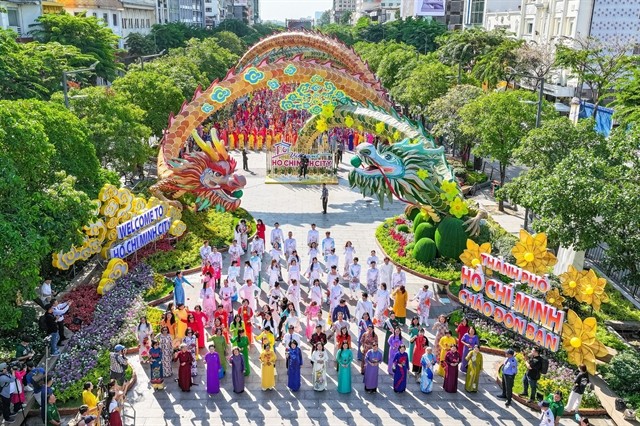 The annual Hồ Chí Minh City Áo Dài Festival is to honour, preserve, and promote the cultural values of Vietnam’s traditional áo dài. (Photo bvhttdl.gov.vn) The annual Hồ Chí Minh City Áo Dài Festival is to honour, preserve, and promote the cultural values of Vietnam’s traditional áo dài. (Photo bvhttdl.gov.vn) |
A: What a beautiful comparison! Juan, your words show how culture can create bridges between civilizations. The Vietnamese ao dai is a symbol of identity, grace, and history and relating it to the Renaissance gives us a fresh, global perspective.
B: This week we received a detailed reception report from Rob den Boer of the Netherlands, who monitored a test broadcast on 9840 kHz from Son Tay, Hanoi, gave it a SINPO rating of 42243, and noted some interference from 9845 kHz.
A: Rob, thank you for your precise technical feedback. Reports like yours are extremely valuable for improving our broadcast quality. We’ll forward your observations to our engineering team and your verification request will be quickly processed.
B: Chris Malboeuf of Canada sent his regular report on our 7220 kHz broadcast, noting: “Signal fair, clear… noise level moderate… SINPO 35333.”
A: Chris, it’s always great to hear from you. Your consistent monitoring helps us understand propagation conditions in North America. Keep those reports coming!
B: Now, here’s an engaging letter from Shivendu Paul of West Bengal, India. Along with his reception report, he asked: “What kinds of sweets are popular in Vietnam? Do Vietnamese people like sweets? Are sweets important at birthdays, weddings, or festivals?”
A: Wonderful question, Shivendu! We’re going to take you on a little culinary journey. In Vietnam, sweets are usually subtle and not overly sugary. Traditional desserts called “chè” include ingredients like mung beans, lotus seeds, coconut milk, and jelly. Imagine you’re sitting on a small stool in an alley in Hanoi, enjoying a bowl of warm sweet soup on a cool evening. That’s a very Vietnamese experience.
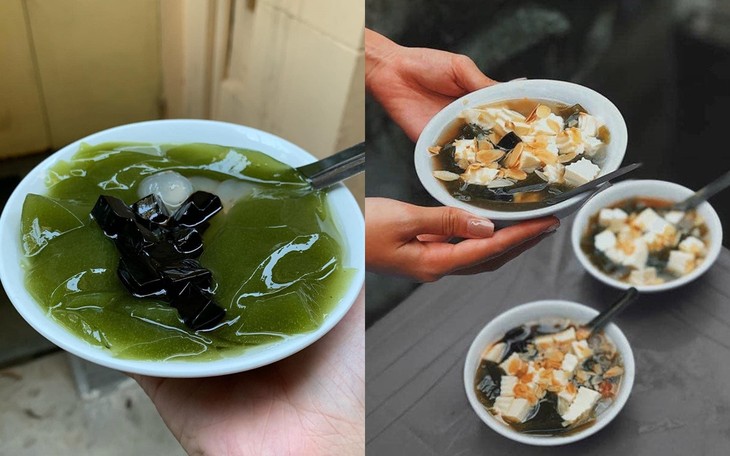 Hanoi is famous with a wide range of sweet soup Hanoi is famous with a wide range of sweet soup |
B: During festivals like Tet, sweets play an important role. Families prepare candied fruits and sesame candies. At weddings, you’ll find beautifully wrapped gift boxes filled with sweets, tea, and other delicacies. For birthdays, cakes have become popular in recent decades, especially among the younger generations. But many Vietnamese people say they’re not fond of candy or desserts that are mostly sugar.
A: So yes, Shivendu. Vietnamese people do like sweets, but in a moderate way.
B: This week many listeners expressed an interest in learning more about Vietnam, its land and people. Listener Sawara Hiroyuki of Japan asked whether Vietnam still has unspoiled mountain villages.
A: The answer is yes, and they’re breathtaking. In Ha Giang, Lao Cai and other northern provinces you’ll find remote villages set in a dramatic mountain landscape where ethnic communities such as the Hmong or Dao people maintain a traditional lifestyle, wear colorful handmade clothing, and follow unique customs. Visiting these places feels like stepping into an older time where nature still holds center stage.
B: Today, let’s explore Lo Lo Chai village, which was recently recognized by UN Tourism as one of the “Best Tourism Villages in the World in 2025”.
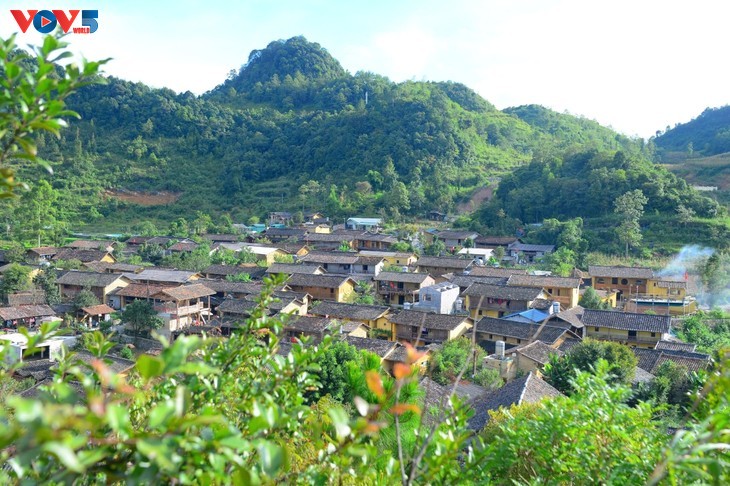 Lo Lo Chai village in Tuyen Quang province is recognized by UN Tourism as the “Best Tourism Village in the World 2025.” (Photo: Do Tuan Anh) Lo Lo Chai village in Tuyen Quang province is recognized by UN Tourism as the “Best Tourism Village in the World 2025.” (Photo: Do Tuan Anh) |
A: Nestled at the foot of Dragon Mountain, in the Dong Van Karst Plateau in Tuyen Quang province, about two kilometers from the Lung Cu Flag Tower, Lo Lo Chai is accessed by a winding path that curves along a jagged rocky ridge. As you enter the village, signs of the traditional Lo Lo culture begin to appear – sturdy earthen houses with yin-yang tile roofs, a scent of roasted corn and wood smoke…
B: Dr. Tran Thi Huong Giang, Vice Rector and Head of the Tourism Faculty at the College of International Industry and Trade, has worked with the Lo Lo Chai villagers since they began to develop community-based tourism. She told us: “From 2007 to 2012, I often brought students here for field studies. We stayed in local houses long before the residents learned how to operate homestays. The value of this village lies in its preserved heritage, such as these ancient houses."
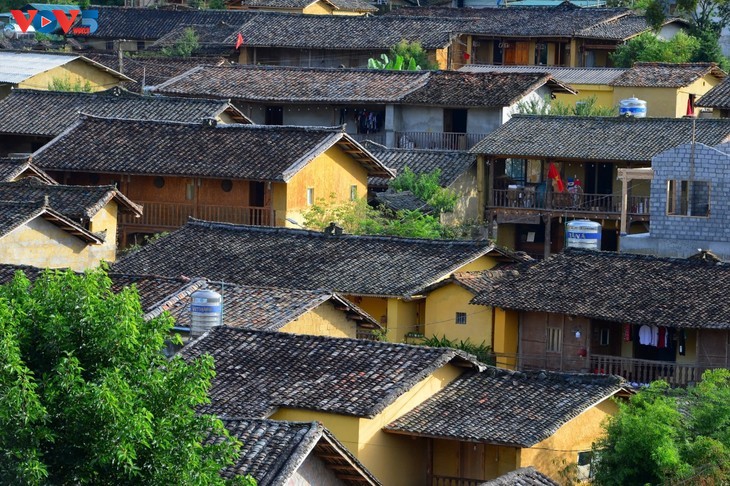 Most of the houses in Lo Lo Chai village have retained their original architecture. (Photo: Do Tuan Anh) Most of the houses in Lo Lo Chai village have retained their original architecture. (Photo: Do Tuan Anh) |
A: Lo Lo Chai village has about 50 houses, most of which have retained their original architecture. In this serene setting, you’ll see Lo Lo women dressed in bright clothing, hand-embroidering intricate patterns on indigo fabric, patiently preserving an important feature of their culture.
B: The Lo Lo Chai villagers have been learning how to turn features of their culture into tourism attractions.
Sinh Di Gai, the head of Lo Lo Chai village, said of his village’s recognition by UN Tourism: “Upon receiving the news that our village had been recognized as one of the world’s best tourism villages, we all felt very proud, happy, and overjoyed.”
A: Lo Lo Chai captivates visitors with its natural beauty and sense of community. Tourists are warmly treated as part of the village, not outsiders. They can join the locals in picking corn, brewing rice wine, playing the panpipe, weaving cloth, and making buckwheat cakes.
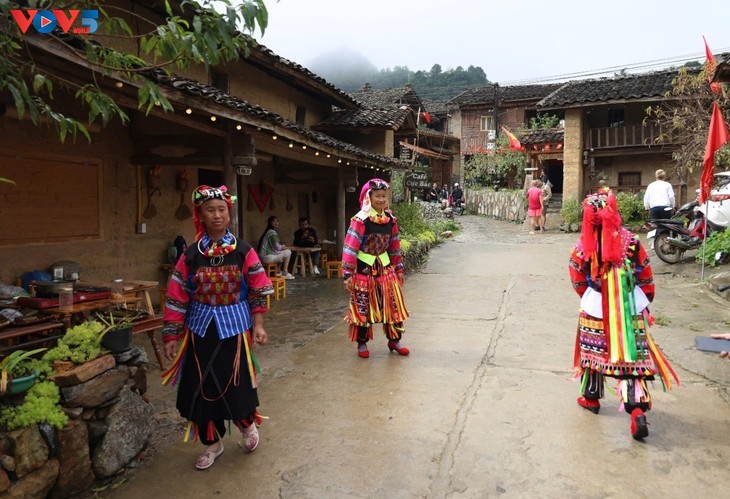 Lo Lo Chai women don their traditional clothes. (Photo: Do Tuan Anh) Lo Lo Chai women don their traditional clothes. (Photo: Do Tuan Anh) |
B: In recent years, to develop community-based tourism, electricity, clean water, sanitation, and roads have been improved and residents have received training in environmental hygiene, hospitality skills, and cultural preservation.
A: Dang Quoc Su, Director of the Tuyen Quang provincial Tourism Promotion Center, said: “With many honors, including the award ‘Best Tourism Village in the World 2025’, I hope that all stakeholders – authorities, tourism promoters, and the business community – will work to help other villages achieve recognition like Lo Lo Chai.”
B: We suggest that you arrange a trip to explore in person Vietnam’s landscape, rich culture, and hospitable people.
B: Before we close, here’s some more about signal reception. Listeners in Latvia, China, Indonesia, Spain, Germany, and France sent reports with SINPO ratings ranging from excellent to weak.
A: We also received feedback on our test frequency of 9840 kHz, with some listeners in Europe reporting no signal detected. Our team is reviewing the data and will continue testing to improve coverage.
B: Dear listeners, your letters, stories, questions, and reports bring us closer together.
A: So, whether you’re in a busy city or a quiet village, thank you for being part of our global community and please keep writing to us and sharing your thoughts.
B: Goodbye for now. We hope you’ll join us again next week!