(VOVWORLD) - Every Saturday morning, the brick road leading to Tu Thi hand embroidery shop in Quat Dong Village in Hanoi comes alive as participants gather for a hands-on embroidery workshop. The workshop reconnects learners with Hanoi’s cultural heritage while introducing local and international visitors to Vietnam’s traditional craft villages.
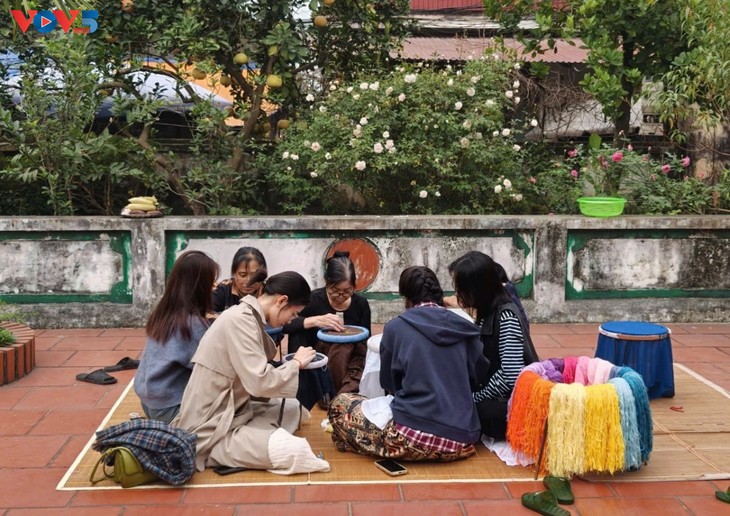 Participants learn traditional hand embroidery at Tu Thi embroidery workshop in Quat Dong Village. Participants learn traditional hand embroidery at Tu Thi embroidery workshop in Quat Dong Village. |
Located more than 20 kilometers south of downtown Hanoi, Quat Dong Village is known for its distinctive hand-embroidered products. Quat Dong native Bui Thi Mai Lan, founder of Tu Thi hand embroidery shop, which runs the workshop, said the craft has been practiced there for more than 300 years. At times, however, the trade has struggled, facing stiff competition from cheaper, mass-produced industrial goods.
"After Tu Thi hand embroidery shop was launched, we worked to bring the craft to a wider audience and create income not just for ourselves, but for other villagers. Interest soon followed," Lan said.
She added that many people, especially young people, wanted to learn so they could embroider their own scarves, clothing and home décor. "So we opened small classes and invited local artisans to teach," she said.
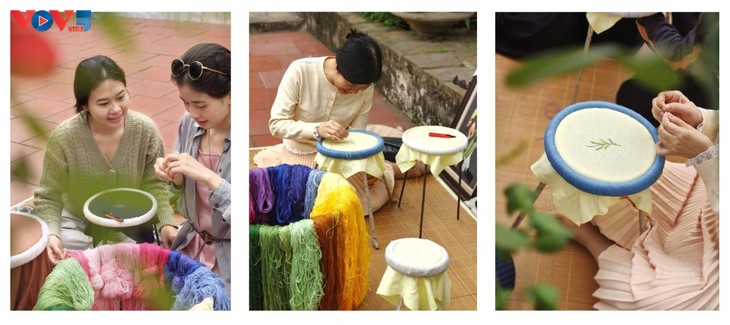 Participants are fully engaged from their very first stitches. Participants are fully engaged from their very first stitches. |
On a cool spring morning, in the courtyard of a traditional house surrounded by flowers, participants gather around local artisans. They learn about fabrics, threads and color choices, then watch each stitch up close.
Nguyen Ha Phuong, the workshop coordinator, said that, "many of our customers said they wanted to learn embroidery here in Quat Dong Village and we felt the same."
"We want participants not only to learn the technique but also to truly return to the village, engaging with its space, its people, and the rhythm of Quat Dong embroidery," she added.
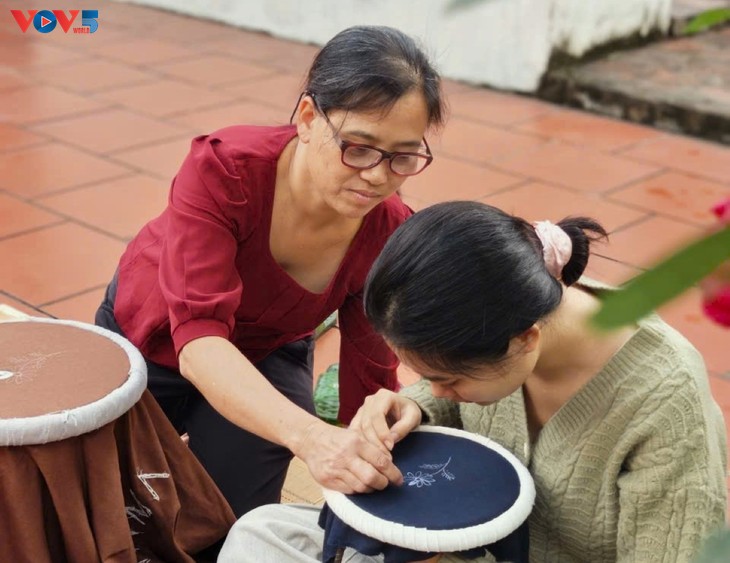 Artisan Pham Thi Huong carefully guides each participant. Artisan Pham Thi Huong carefully guides each participant. |
Villager Pham Thi Huong, manager of Tu Thi hand embroidery shop, has worked in embroidery for more than 40 years. At 56, she still teaches participants herself, alongside her daily work. She said when she was young, she's go to school in the morning and spend the rest of the day embroidering at home with her grandparents and parents.
"There were no classes, we just watched and copied them until our hands got used to it," Huong said. "There are six of us, and we all learned the same way.”
Huong guides each participant step by step on how to move the needle, handle the thread and match colors on the fabric. Participants practice as their work slowly takes shape. Among the learners, Vietnamese American Hong Vo said she discovered the workshop during a recent visit to Quat Dong. She was immediately impressed and signed up right away, making time to attend the class while in Vietnam.
Hong Vo said she learns a lot through the 5-session workshop. "We start with the basics, then move on to stitching flowers, leaves and even butterflies," Vo said, adding that everyone there is so welcoming and Ms. Huong is incredibly skilled and patient.
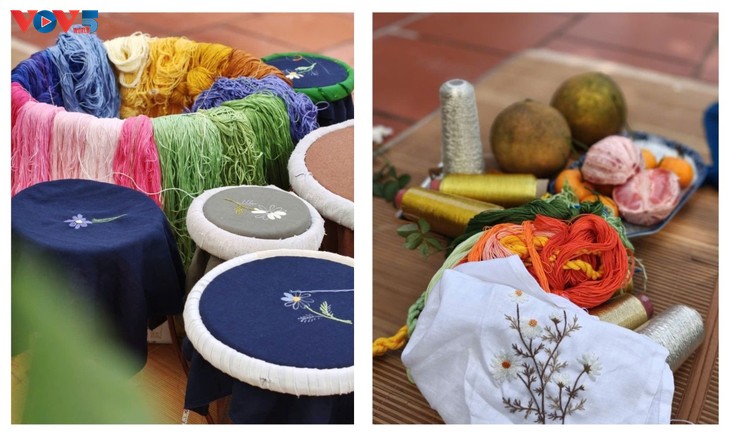 Thread, needles and an embroidery frame are the basic tools for hand embroidery. Thread, needles and an embroidery frame are the basic tools for hand embroidery. |
Vu Anh Tuyet, a resident of Hanoi, said the class offered more than just stitching skills. She said it also helped her better understand the traditional craft and appreciate the beauty of embroidery, from color and design to the patience behind each piece.
She said that she loves embroidery even though she's busy. "I first tried to learn by myself, but I kept making mistakes, so I decided to take a class."
She then read about Tu Thi hand embroidery workshop and signed up. After a few sessions, Tuyet started stitching outside her house in her free time. "People passing by would compliment my work, and that made me really happy."
She has finished all five sessions now and even embroidered flowers on her own clothes. "I’m very happy with the results and really thankful to Tu Thi,” Tuyet added.
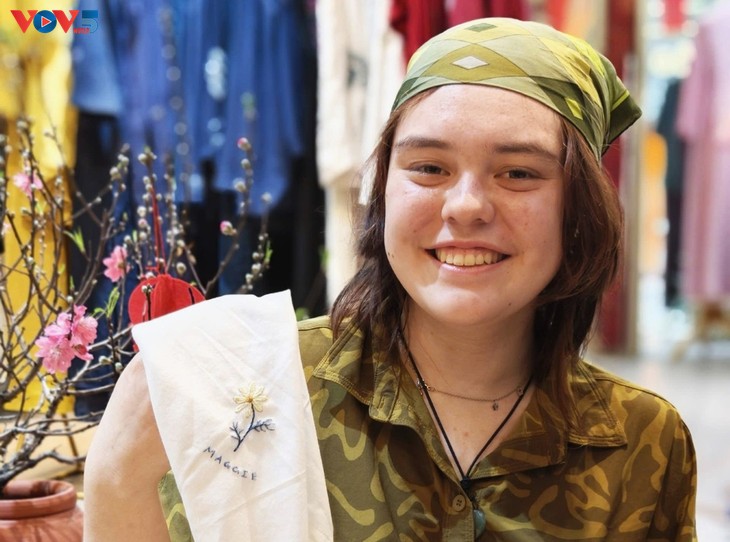 An international visitor with her own hand-embroidered piece. An international visitor with her own hand-embroidered piece. |
To expand the workshop and give visitors a closer look at the craft, Tu Thi plans to partner with travel agencies to offer embroidery tours for international visitors, combining village visits with hands-on experience.
"We want to grow this hands-on tourism model to help preserve the craft and create more income for local artisans," founder Mai Lan said.
When visitors create their own pieces, they see the true value of handmade work, Lan said. “It also allows artisans to share their stories and understand their customers better.”