(VOVWORLD) - Last year, as the US and Vietnam marked 30 years of normalized relations, a new group of “citizen diplomats” arrived in Vietnam. The fourth cohort of US Peace Corps volunteers officially began their two-year journey, working mainly in education and people-to-people exchange. Their presence reflects a growing connection between the two countries, one built not just through policy, but through everyday interactions and shared experiences at the community level.
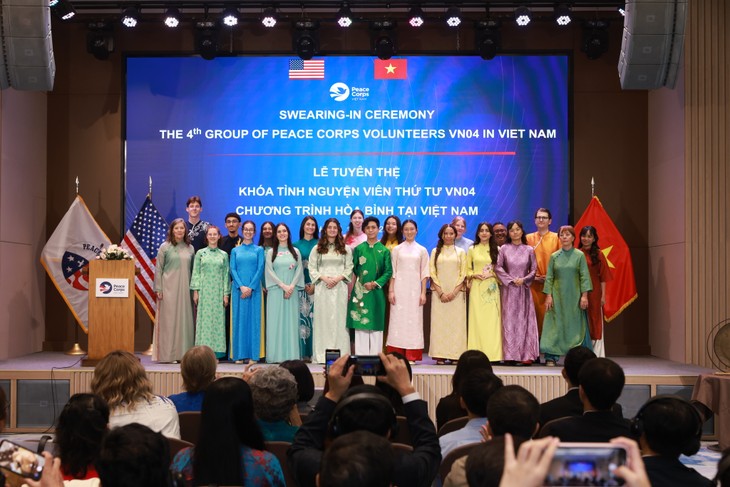 (Photo credit: US Embassy in Vietnam) (Photo credit: US Embassy in Vietnam) |
A Peace Corps volunteer, known simply as Erik from Michigan, laughed happily as he tried to keep pace with the rhythm of the Vietnamese “sap” folk dance. Two long bamboo poles clapped together in quick succession, guided by people sitting on either side, setting the rhythm for the dance.
In the middle, Erik jumped, stumbled slightly, then found his footing in the lively steps of the traditional dance. For him, the dance is more than a cultural activity. It is a sign that he is no longer just a visitor, but part of a community.
“For these two years, I expect to learn a lot more going forward, and hopefully improve my Vietnamese pronunciation to have a wonderful Vietnamese conversation with my dear friends,” Erik told VOV.
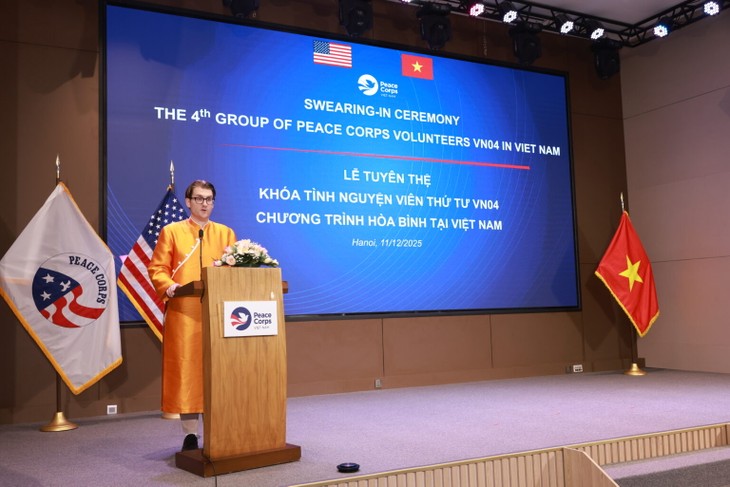 Erik, a Peace Corps volunteer, delivers remarks in Vietnamese. (Photo credit: US Embassy in Vietnam) Erik, a Peace Corps volunteer, delivers remarks in Vietnamese. (Photo credit: US Embassy in Vietnam) |
Such a scene has become familiar in many schools in Hanoi and Ho Chi Minh City over the past few years, as Peace Corps volunteers quietly build bridges through everyday interactions.
Since Vietnam welcomed the first group of Peace Corps volunteers in 2022, more than 50 Americans have come to work alongside Vietnamese colleagues, primarily in English education.
US Deputy Chief of Mission in Vietnam Courtney Beale elaborated, “Education, and English, and people-to-people ties are an important component of our Comprehensive Strategic Partnership. As we celebrate 30 years of US-Vietnam relations, we reflect on how far we’ve come, and on the future-oriented ways we’re now working together.”
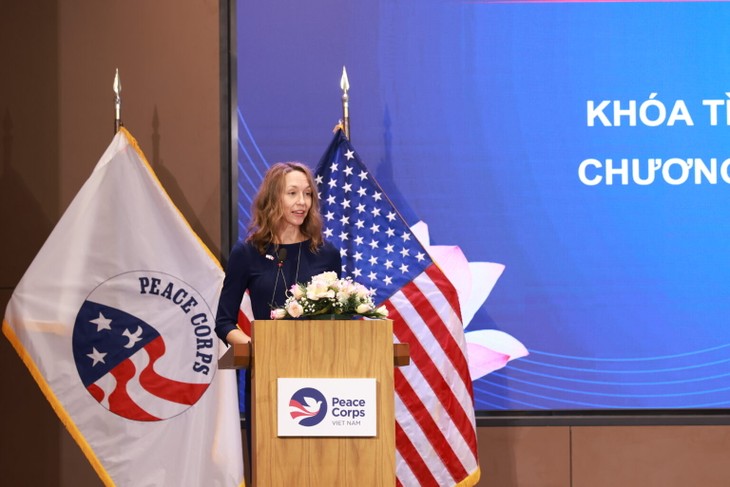 US Deputy Chief of Mission in Vietnam Courtney Beale speaks at the event. (Photo credit: US Embassy in Vietnam) US Deputy Chief of Mission in Vietnam Courtney Beale speaks at the event. (Photo credit: US Embassy in Vietnam) |
The volunteers follow a sustainable, capacity-building approach. Rather than teaching independently, they work as partners with Vietnamese educators in a co-teaching model designed to strengthen local capacity.
“Our volunteers work with teachers in the school. They co-teach. They don't solo teach. They don't lead things on their own. They're partners, and that's the Peace Corps model for teaching. We work with the school director, the school principals,” Kimberly Mansaray, Peace Corps Vietnam Country Director, explained.
This approach allows the American volunteers to learn and adapt their styles to the Vietnamese educational context. Most Peace Corps volunteers, said Mansaray, are assigned to schools around Hanoi and Ho Chi Minh City, usually in facilities that are "a little bit outside" the urban center to ensure that the benefits of the program reach semi-rural communities.
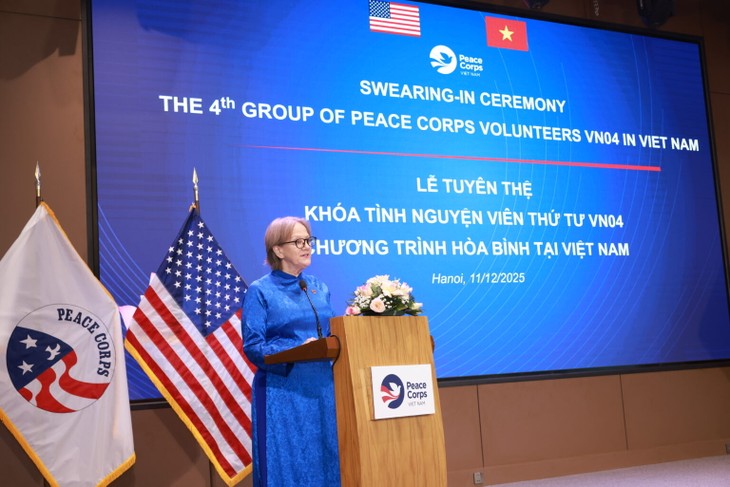 Kimberly Mansaray, Peace Corps Vietnam Country Director Kimberly Mansaray, Peace Corps Vietnam Country Director |
Isabella, a 23-year-old volunteer from San Francisco, describes her experience as a “two-way street” of learning.
“I’ve been overwhelmed by the warmth and curiosity of the community. I want learning English to be fun, something people feel excited about. I want students and teachers to feel comfortable talking to me—knowing I’ll help them speak English, but also that I’m learning Vietnamese from them.”
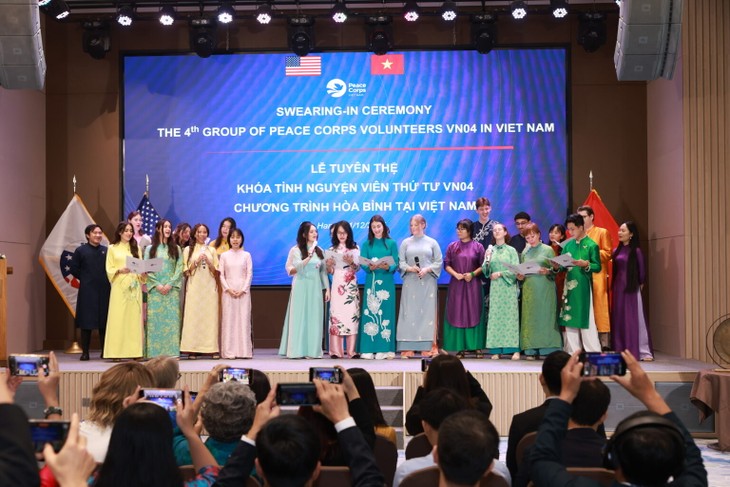 Peace Corps volunteers sing the popular song “Chalk dust” in Vietnamese. (Photo credit: US Embassy in Vietnam) Peace Corps volunteers sing the popular song “Chalk dust” in Vietnamese. (Photo credit: US Embassy in Vietnam) |
Before arriving in Vietnam, all volunteers undergo 10 weeks of intensive pre-service training, covering language, culture, and technical teaching skills. But mindset, said Mansaray, is just as important as methodology.
“The most important thing for Peace Corps volunteers is adaptability, and humility, and a willingness to learn, and a willingness to engage. Also respect; respect for the culture, respect for the community around them,” she said. “And they're all here with that in mind. They're all here to say, ‘I want to learn about Vietnam. I want to learn about life here, and I want to help these students and teachers succeed.’ We always say we can't do it alone. We must have that cooperation.”
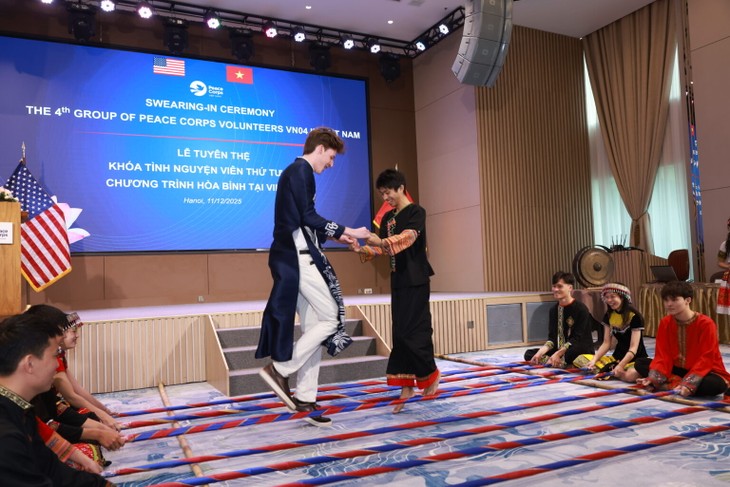 A Peace Corps volunteer and a Vietnamese student join a “sap” dance. (Photo credit: US Embassy in Vietnam) A Peace Corps volunteer and a Vietnamese student join a “sap” dance. (Photo credit: US Embassy in Vietnam) |
Success for Peace Corps volunteers isn't measured by test scores, but by the strength of the community bonds formed like a foreigner learning a traditional dance.
“What I always hear from Peace Corps volunteers is just how much they learn from their communities and how much they enjoy becoming part of a Vietnamese community and seeing the beauty of the villages, and the beauty of the culture, and exploring the food, and making Vietnamese friends. Those are the lasting memories that they come away with after two years in the Peace Corps,” said US Deputy Chief of Mission in Vietnam Courtney Beale.
“I will know that I've had a successful two years if, when I'm walking down the street in my community, almost every face that I pass knows that they can say hi to me and greet me in Vietnamese or English,” said Isabella.
Through thousands of small, everyday interactions like these, Peace Corps volunteers are helping transform diplomatic ties into human connections—building bridges that may well last for decades to come.
The Peace Corps is an independent agency of the executive branch of the US government, established in 1961 by President John F. Kennedy.
To date, more than 240,000 Americans have served as Peace Corps volunteers in 142 countries worldwide.
Vietnam became the 143rd partner country in 2022. Since then, Peace Corps volunteers have been working in Vietnam primarily in the field of English education, supporting the country’s development priorities through people-to-people cooperation.