(VOVWORLD) - Vietnam plans to build integrated boarding schools for both primary and secondary students in 248 land-border communes. This is the first time Vietnam has introduced a model of integrated boarding schools in border areas. The strategic and urgent initiative is designed to bridge the educational gap, develop local human resources, implement ethnic minority policies, and ensure social security.
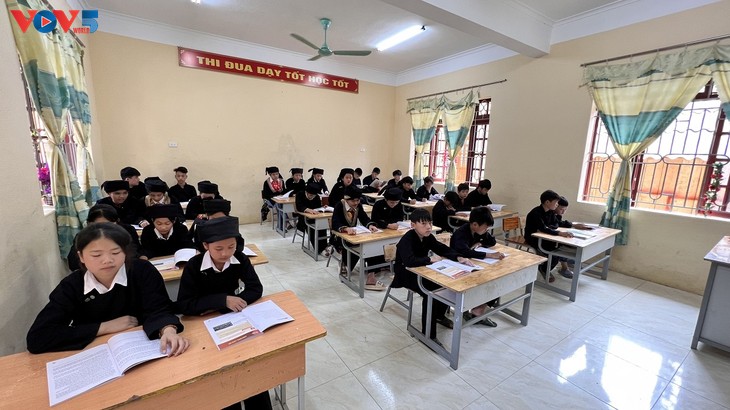 A classroom at a school in a border commune in Lang Son province. (Photo: Duy Thai/VOV) A classroom at a school in a border commune in Lang Son province. (Photo: Duy Thai/VOV) |
Vietnam currently has 22 provinces and cities with land borders, comprising 248 border communes that have 956 general education schools with more than 625,000 students. 330,000 of these students need a boarding or semi-boarding school, but fewer than 20% of them have access to one.
A key task in socio-economic development, ethnic policy
Investing in schools in land-border communes is a crucial task of Vietnam’s socio-economic development and ethnic minority policy implementation. The government’s plan to build boarding schools calls for 6.5 million USD per school. Each school will be built on a 5-hectare site and fully equipped with classrooms, kitchens, laboratories, playgrounds, sports training facilities, and more.
Pham Van Tuan, Principal of the semi-boarding Secondary School for Ethnic Minorities in Muong Lan commune, Son La province, said: "Our teachers and students are looking forward to having a new school. With more investment, we can narrow the education gap between border regions and lowland areas while ensuring safe schooling."
In the initial phase, Vietnam aims to complete the construction or renovation of 100 schools no later than the start of the next academic year. These will serve as models before scaling up to all 248 target communes within the next two to three years.
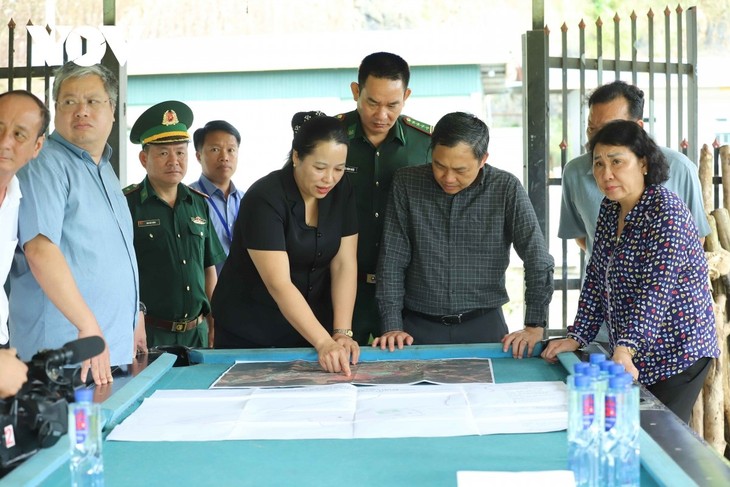 A working group from Son La province surveys the site for the construction of an integrated school in Muong Lan commune. (Photo: Tran Long/VOV) A working group from Son La province surveys the site for the construction of an integrated school in Muong Lan commune. (Photo: Tran Long/VOV) |
At a government meeting in Hanoi on Sunday, Prime Minister Pham Minh Chinh directed swift actions to complete the construction of 100 schools in border communes by August 30, 2026. Many provinces and cities have begun implementing the Prime Minister’s directive. In Son La province, which has 13 border communes and 44 schools, most of the schools are in urgent need of infrastructure upgrades.
Nguyen Dinh Viet, Chairman of the Son La provincial People’s Committee, said: "This is an opportunity to reform education in border communes. Communes need to select a site of 3 to 5 hectares for each school and let provincial specialists conduct field surveys. We need data on land area, student numbers, current infrastructure, investment needs, and information concerning site clearance or road access."
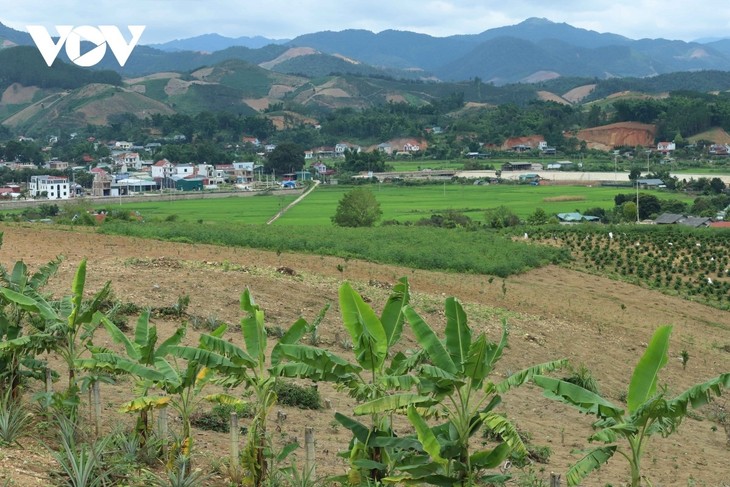 Son La province leaders prioritize choosing the most convenient location for building a school for students. (Photo: Tran Long/VOV) Son La province leaders prioritize choosing the most convenient location for building a school for students. (Photo: Tran Long/VOV) |
Da Nang city has six border communes that are in urgent need of boarding and semi-boarding schools.
Secretary of the Da Nang municipal Party Committee Nguyen Van Quang said: "We’re determined to start construction promptly so that by the next school year, students will have fully equipped boarding schools that meet all their learning and living needs."
A strong commitment to sustainable development
Over the years, the Vietnamese Party and State have adopted numerous policies to improve education in mountain and border regions. Despite some achievements, these areas still have some substandard school facilities and teacher shortages.
The Politburo’s decision to build integrated boarding schools in border communes is a humane and crucial social security policy, reflecting the Party and State’s special attention to people living in remote, disadvantaged border areas.
This initiative will reduce educational disparities and contribute to human resource development and socio-economic growth, narrowing the gap between mountain and lowland regions. It demonstrates the Party and State’s commitment to sustainable development, people’s wellbeing and land protection by promoting education, improving living standards, and expanding development opportunities in the most disadvantaged areas of the country.
Another new policy under a National Assembly resolution to provide lunches to primary and secondary students in border communes will be implemented starting in the 2025–2026 academic year. This coordinated approach combining infrastructure investment with nutrition support will ensure equal and effective learning conditions for children in underprivileged regions.