(VOVWORLD) - The 15th National Assembly concluded its last session on Thursday, putting an end to the five-year term that has left a strong imprint on Vietnam’s development. This term is marked by substantial reform that paves the way for a new era of national development defined by institutional modernization, effective governance, transparency, and a government closer to the people.
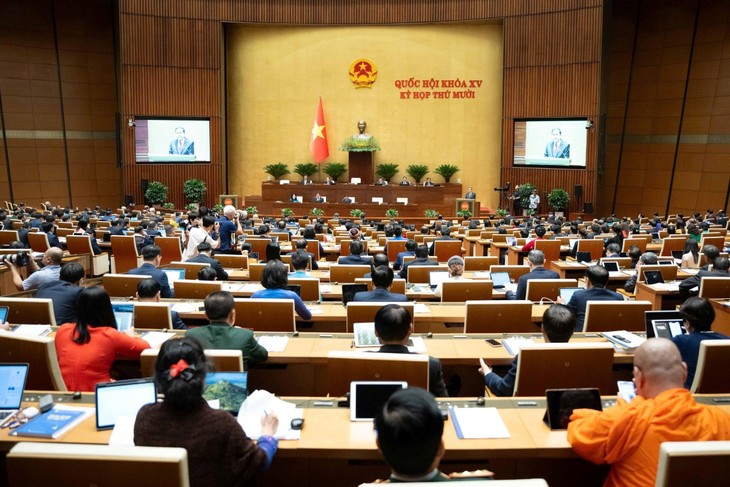 At the 10th session of the 15th National Assembly (Photo: quochoi.vn) At the 10th session of the 15th National Assembly (Photo: quochoi.vn) |
From the outset, the 15th National Assembly demonstrated a strong spirit of action. Over five years, it convened 19 sessions, including nine extraordinary meetings, reflecting its prompt response to urgent national challenges amid post-pandemic recovery, global economic volatility, and the pressing need to renew the growth model.
Bold institutional reform
The legislature made history by revising the 2013 Constitution. Deputy Trinh Xuan An representing Dong Nai said: “The National Assembly boldly amended the Constitution to restructure the local government into a two-tier system, eliminating the district level, which had been existed for 80 years. Alongside constitutional reform, we revised laws governing the state apparatus. These decisions show that the National Assembly dares to act for innovation, development, and the future.”
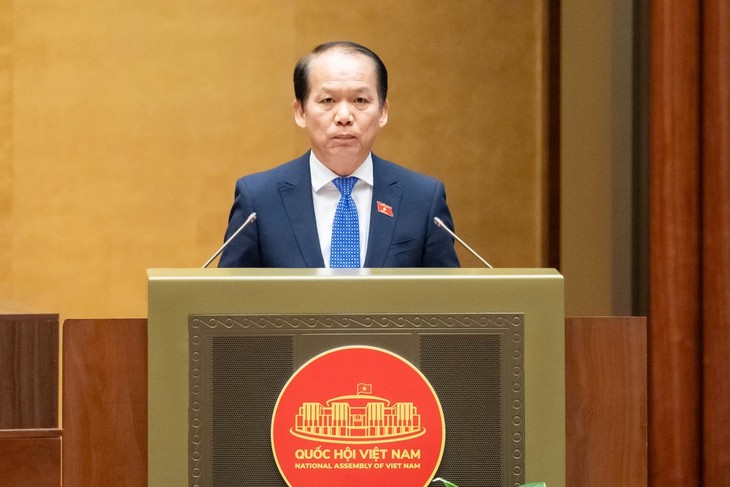 Chairman of the Law and Justice Committee Hoang Thanh Tung (Photo: quochoi.vn) Chairman of the Law and Justice Committee Hoang Thanh Tung (Photo: quochoi.vn) |
149 laws were amended or adopted, creating fresh momentum for administrative reform, decentralization, the restructuring of administrative units, and the completion of a legal framework for sustainable development. These decisions have removed barriers, enabled socio-economic breakthroughs, and shaped a modern, streamlined, efficient system of governance that serves the people.
Hoang Thanh Tung, Chairman of the National Assembly’s Law and Justice Committee, said: "The laws passed clearly define matters under the National Assembly’s authority while giving flexibility to the Government and localities, accelerating decentralization and administrative reform. Policies place people and businesses at the center, remove obstacles, unlock productive potential, and mobilize resources for development.”
During the 2020-2025 tenure, supervisory activities were strengthened, focusing on issues directly affecting daily life, from social welfare and energy security to the real estate market and incentives for businesses and workers. Each debate reflected responsibility, transparency, and a commitment to identifying solutions.
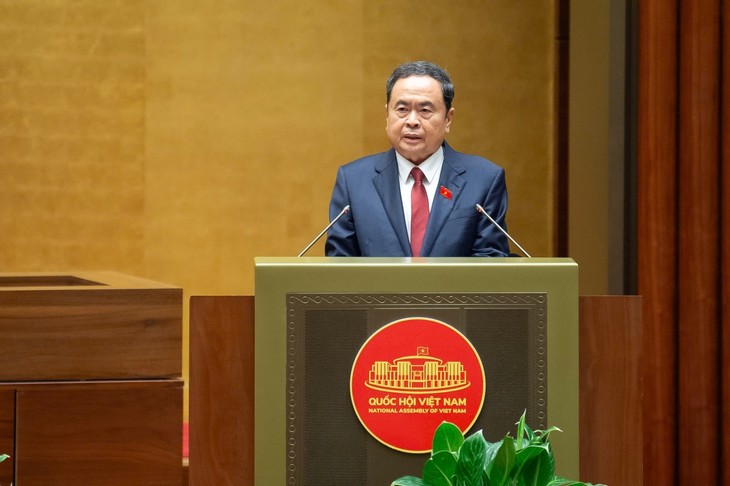 National Assembly Chairman Tran Thanh Man speaks at the 10th Session of the 15th National Assembly. (Photo: quochoi.vn) National Assembly Chairman Tran Thanh Man speaks at the 10th Session of the 15th National Assembly. (Photo: quochoi.vn) |
Shaping the future
These reforms serve not only immediate goals but also long-term national strategy. With a more refined institutional framework, streamlined apparatus, and stronger decentralization, Vietnam is better positioned for the next phase of development.
National Assembly Chairman Tran Thanh Man said: “The country is facing momentous opportunities and challenges. The National Assembly will continue to follow the Party’s orientations, listen to voters, work with the Government, and coordinate closely with relevant agencies to effectively carry out lawmaking, oversight, and decisions on state affairs.”
Yet, numerous challenges lie ahead. Policy implementation at both the ministerial and local level needs greater consistency; coordination in law enforcement must be more seamless; and citizens expect tangible improvements to their lives.
Party General Secretary To Lam said: “Every decision of the National Assembly not only affects today’s socio-economic conditions and the lives of millions, but also leaves a lasting mark on the nation’s future. The National Assembly must demonstrate wisdom, courage, objectivity, and integrity in deciding strategic issues—socio-economic development plans, national budget allocations, major infrastructure projects, social welfare policies, key national strategies, international integration, and matters related to independence, sovereignty, and territorial integrity.”
The 15th National Assembly leaves behind a defining legacy: reform for the people, for development, and for building a modern institutional framework that opens a new era for the nation. This spirit of innovation will continue to guide future terms.