(VOVWORLD) -Cao hamlet in Con Minh commune, Thai Nguyen province, is famous for its handmade canna vermicelli. Women play a central role in preserving the traditional craft while developing it to improve household incomes and the local economy.
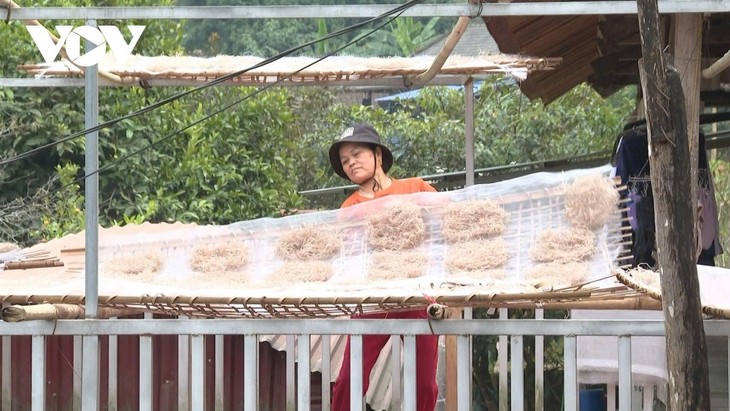 Handmade vermicelli strands are dried in the sun. (Photo: Thuy Kieu) Handmade vermicelli strands are dried in the sun. (Photo: Thuy Kieu) |
The hamlet is home to 70 families, about 95% of whom belong to the Nung ethnic group. 10 of the families specialize in producing a handmade canna vermicelli type which has a distinctive flavor and chewy texture. It’s made entirely by hand using traditional techniques.
Ha Thi Hoa, who has been engaged in the craft for many years, said growing market demand has encouraged her family to invest more in production to supply both the local market and outside markets in Hanoi, Hai Phong, Quang Ninh, and several southern provinces. “My family has been making vermicelli for more than a decade. Handmade vermicelli tastes better and making it by hand ensures cleanliness and food safety. It’s more elastic and chewier, doesn’t become clammy, and is preferred by consumers. Every year we are completely sold out,” Hoa told VOV.
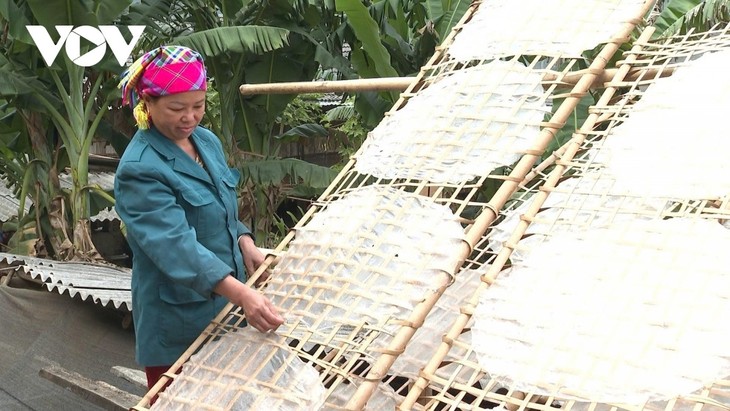 Women in Cao hamlet maintain the traditional handmade method. (Photo: Thuy Kieu) Women in Cao hamlet maintain the traditional handmade method. (Photo: Thuy Kieu) |
Local residents say that since the 1960s, canna plants have been grown in Con Minh and made into vermicelli for daily use. The production process involves cleaning the roots, grinding them, mixing a batter, spreading thin sheets, steaming the sheets, cutting them into strands, sun-drying them, and packaging the vermicelli.
After they’re cleaned, the canna roots are ground to extract the starch, which is mixed with water and filtered several times to remove impurities. Part of the cooked starch is blended with raw starch before being spread in thin sheets, steamed, and cut into vermicelli strands, and dried.
While canna vermicelli production in many places has been largely mechanized, with machines used for grinding, cooking, pressing, and drying, the women in Cao hamlet have steadfastly maintained the traditional handmade method. They believe handmade vermicelli has a unique flavor, and the market continues to favor traditional products.
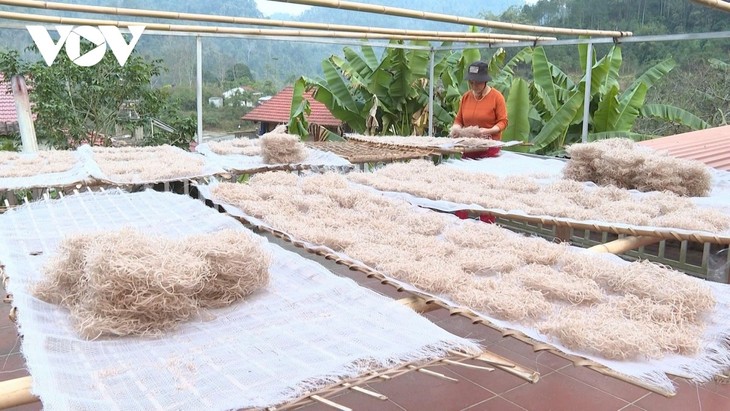 Handmade vermicelli is preferred by consumers. (Photo: Thuy Kieu) Handmade vermicelli is preferred by consumers. (Photo: Thuy Kieu) |
During the peak period before Tet, when demand surges, the women hire additional workers to increase their output to 40 to 50 kilograms per day.
Luc Thi Bang, a resident of Cao hamlet, said that the consumption of handmade vermicelli is quite stable every year. “So far, we’ve sold 600 to 700 kilograms. From now until Tet, a similar amount remains for customers to buy as Tet gifts or for household use. Since we learned the craft, my family’s income has improved significantly. As we have been recognized as a craft village, selling our vermicelli has gotten easier,” said Bang.
As the Lunar New Year approaches, Luc Thi Hoa, Ha Thi Lien, and other women in the hamlet are increasingly busy as orders continue to rise. “Toward the end of the year, we sometimes don’t have enough vermicelli ready for packaging. To serve the Tet market, we try to work at full capacity,” said Hoa.
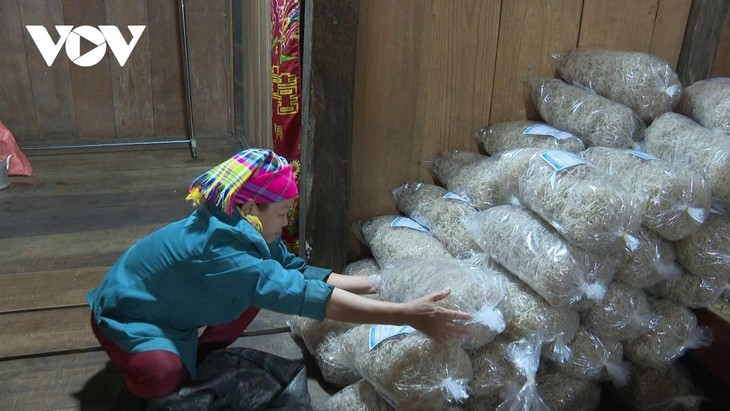 Packs of vermicelli are ready for the market. (Photo: Thuy Kieu) Packs of vermicelli are ready for the market. (Photo: Thuy Kieu) |
Cao hamlet has been officially recognized as a traditional handmade canna vermicelli craft village. Cooperatives have been established, providing stable jobs for dozens of local women. As a result, living standards in the hamlet have improved, the poverty rate has fallen below 10%, and the number of well-off households is increasing.
According to Loc Van Tuan, head of Cao hamlet, “In the past, villagers faced many difficulties and often had no income at the end of the year. Life is much better now. Households engaged in vermicelli production have more stable livelihoods, better homes, and better-invested workshops.”