



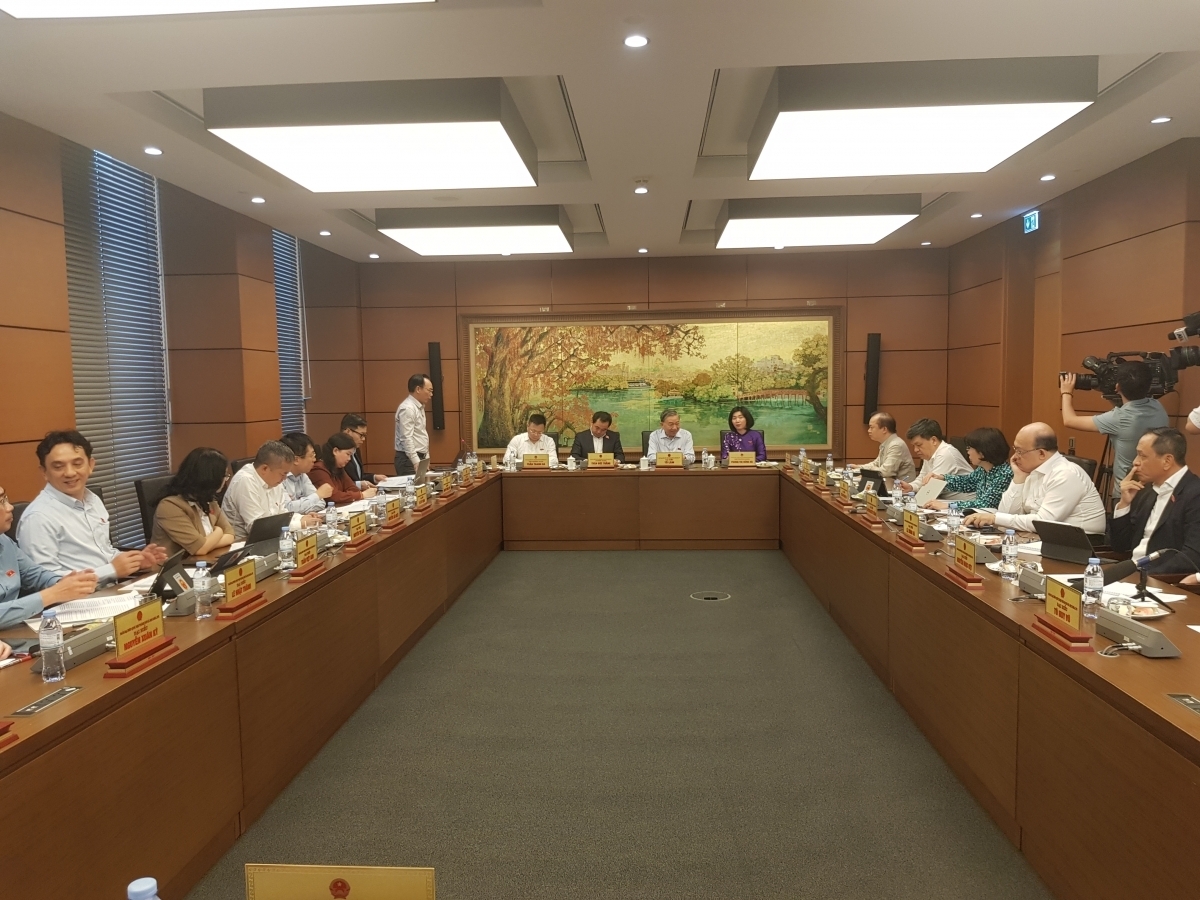
The deputies agree with the Government’s assessment of the global situation as well as the goals, solutions, and tasks to achieve set targets. Those tasks include revising the growth model, streamlining institutions to remove bottlenecks, strengthening regional linkages and value-chain-based production, and improving the efficiency of public investment.
Institutional reform to create breakthroughs
Unlocking institutional resources has been identified as the key to creating breakthroughs in socio-economic development. The deputies agreed on the need to strengthen institutional reform, with stronger decentralization and delegation of authority to localities, particularly in land management and private investment. It’s important to focus on improving legal frameworks on land and public investment, while creating a secure and predictable legal environment for businesses.
Trinh Xuan An, a National Assembly deputy for Dong Nai province, said: “It’s important to shift the State’s role from managing enterprises to accompanying them, with a focus on reducing legal risks. At the same time, more practical mechanisms are needed to help small and medium-sized enterprises access capital and land, and participate deeply in value chains. Administrative procedures also need further reform.”
The private economic sector, considered the most important component of the economy, is still operating within an institutional framework that is not yet commensurate with its role. Strategic sectors such as high tech and infrastructure still lack private enterprises.
Pham Trong Nhan, a deputy for Ho Chi Minh City, said: “I propose that the National Assembly consider a fundamental framework law, the Law on the Right to Private Economic Development. This law should focus on three pillars. First, institutionalizing substantive and consistent equality among economic sectors in areas such as land, credit, and markets. Second, establishing a legal safety zone for production and business activities, protecting long-term property rights, and minimizing risks arising from policy changes. Third, setting up a monitoring mechanism through annual Government reports to the National Assembly on the implementation of private sector rights, to comprehensively assess that sector.”
Renewing the growth model from extensive to intensive development
According to the deputies, annual double-digit growth in the 2026–2030 period will be a big challenge. Deputy Prime Minister Nguyen Van Thang said that to meet the requirements for strong, sustainable growth, there’s no alternative but to revise the growth model and make fundamental changes to the economic structure. The government continues to identify macroeconomic stability as a prerequisite and foundation for achieving strong, sustained economic growth.
Mr. Thang said: “The new growth model must be based on a modern, competitive development institution, a culture of innovation, and an efficient allocation of resources. The Government has submitted to the National Assembly 11 groups of tasks and solutions for the 2026–2030 period, with 92 specific tasks, including those to be implemented immediately in 2026, linked to renewing the growth model and achieving double-digit growth. Science and technology, innovation, and digital transformation are the main drivers of development, and new growth drivers include the data economy, the digital economy, the green economy, and the circular economy. The Government is implementing solutions to maximize national potential and advantages, especially in the initial stage when investments in science, technology, innovation, and digital transformation may not yield immediate results. All economic sectors will be promoted on the basis of fair competition and value chain linkages.”
The deputies agreed that the dual goal is to achieve double-digit growth and ensure long-term stability. Ta Thi Yen, a deputy for Dien Bien province, said: “If we continue with the old growth model, which relies heavily on capital, natural resources, and cheap labor, it will be difficult to achieve our target. Growth must shift toward productivity, innovation, and added value, with particular emphasis on the digital economy, the green economy, the circular economy, and the opportunities brought by the 4th Industrial Revolution.”
The Government has set a goal of achieving rapid and sustainable development, targeting GDP growth of at least 10% in 2026 and an average of 10% or higher for the 2026–2030 period, while maintaining macroeconomic stability. GDP per capita is projected to reach 8,500 USD by 2030, 1.7 times higher than in 2025. Vietnam also aims to preserve a peaceful and stable environment and improve all aspects of people’s lives so that citizens can fully benefit from development gains. These efforts are seen as essential to realizing Vietnam’s 2045 vision of becoming a developed, high-income country with a modern industrial base, ranked among the leading economies in Asia.