




In the past, Vietnam’s defense industry focused on repairing, upgrading, and producing basic equipment. But safeguarding the nation under new conditions now demands a very different approach. High-tech warfare, cybersecurity, electronic warfare, and artificial intelligence are reshaping how countries strengthen national defense. In this context, science and technology have become the key to improving Vietnam’s self-reliance and modernizing its defense industry.
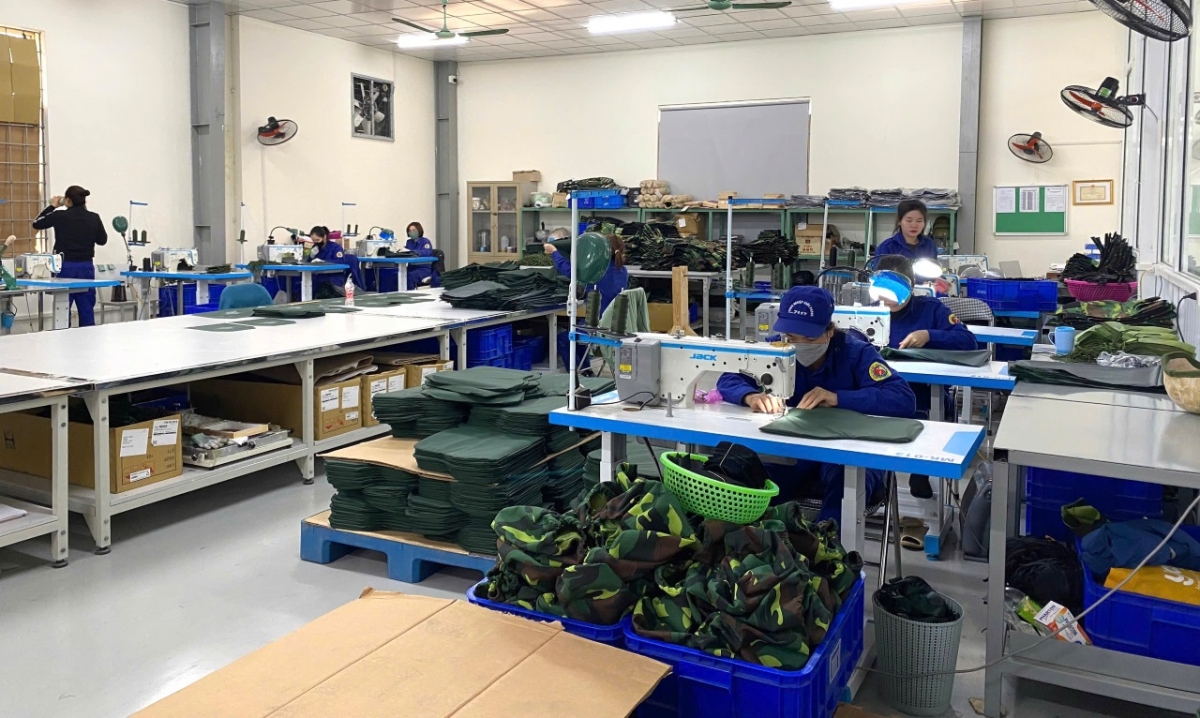
At defense enterprises like Factory Z117 under the General Department of Defense Industry, which manufactures mortars, sound-suppressed mortar rounds, bulletproof vests, and ballistic helmets, smart production lines are replacing manual operations. Senior Lieutenant Colonel Trinh Hoang Thiep, the Director of Factory Z117, said, “The factory is now almost fully automated. In the past, each machine required two operators. Today, workers mainly oversee equipment, monitor quality, and inspect products to ensure the highest standards.”
Many enterprises are also intensifying research and mastering core technologies in military electronics, radar systems, telecommunications, cybersecurity, and unmanned aerial vehicles (UAVs). Many of these technologies have strong dual-use potential, serving both national defense and civilian economic development.
Captain Nguyen Van Sau of the R&D Division at Factory Z113, which develops UAVs integrated with search-and-rescue applications, said, “To master and create high-tech products, besides maintaining strong motivation and continuously improving our expertise, we closely follow global military technology trends. When advanced countries introduce new technologies, we study them carefully in order to develop products with similar features and equivalent quality.”
The dual-use development trend is opening a new path for Vietnam’s defense industry. Today, modernization is no longer simply about investing in machinery and upgrading production lines. It’s about mastering science and technology and fostering innovation among Vietnamese officers, engineers, and military personnel.
Colonel Dr. Pham Tuan Hai, Director of the Institute of Technology under the General Department of Defense Industry, said, “We closely monitor global technological trends and the equipment requirements of the Ministry of National Defense for the Vietnam People’s Army.”
“We have mobilized the collective expertise of our scientific council and scientists to develop long-term strategies covering both basic and applied research. Specialized research groups have also been established via technology incubation projects proposed by individuals and teams, working together with the Institute to design and manufacture weapons, military equipment, and other defense products,” Colonel Hai added.
In recent years, many “Make in Vietnam” defense technologies have been successfully researched, produced, and mastered. These include VR/AR simulation training systems, digital combat command software, AI-powered target identification and surveillance applications, and satellite observation technologies serving national defense purposes.
But technology-driven modernization also presents major challenges. Vietnam still depends on imports for certain foundational technologies and lacks high-quality human resources in advanced technology. Global military technology is evolving at an extremely rapid pace. This reality requires closer cooperation among defense enterprises, research institutes, universities, and civilian technology companies.

In the digital era, defense capability is measured by modern weaponry and a nation’s capacity for innovation and technological mastery. Deputy Prime Minister and Minister of National Defense Phan Van Giang said during a working session with the General Department of Defense Industry, “We have identified the task of building a modern defense industry that can lead the nation’s industrial development as both a responsibility and a mission. To achieve modernization, we must develop a highly educated and thoroughly trained workforce with comprehensive knowledge of the defense industry.”
From automated assembly lines to high-tech “Make in Vietnam” products, Vietnam’s defense industry is undergoing a significant transformation powered by science, technology, and the aspiration for self-reliance. This is essential for strengthening national defense and lays the foundation for improving the nation’s industrial and technological capabilities in the future.