




In today’s Doctor at Home, pediatrician Dr. Nguyen Tri Minh explains how to recognize warning signs, care for a sick child, and help prevent the spread of hand, foot, and mouth disease.
Reporter: Hello, Dr. Tri Minh. It’s great to have you with us today. Let’s start with a question many parents have: What does a mild case of hand, foot, and mouth disease typically look like in children?
Dr. Tri Minh: Most cases of hand, foot and mouth disease are mild. In fact, some cases are so mild that parents may not even realize their child has had the infection. The child may only have a low-grade fever, become a little irritable, eat or drink less than usual, or simply seem less active for a few days. Some children develop the typical painful mouth ulcers and small red spots or blisters, usually on the hands, feet, knees, or buttocks. But these skin lesions are not always very obvious. And this brings us to two common misunderstandings about hand, foot and mouth disease.
The first is: “It’s usually a mild viral illness, so there’s nothing to worry about.” Yes, most children recover well, and some may even have such mild symptoms that the illness goes almost unnoticed. But a small proportion of children can progress to more serious disease, so parents still need to monitor the child closely during the illness. The second misunderstanding is: “The more blisters my child has, the more severe the disease must be.” That’s not true.
Some children may have many obvious blisters and still have a mild illness, while another child may have only a few skin lesions but become more seriously unwell. So rather than counting the blisters, look at the child as a whole—how they’re behaving, eating and drinking, sleeping, and interacting with you. The number of blisters does not tell us how severe hand, foot, and mouth disease is.
Reporter: Most cases are mild, so what changes should alert parents that the illness may be becoming more serious?
Dr. Tri Minh: Parents should become concerned when their child starts behaving differently from usual, especially if there is frequent startling, persistent high fever, repeated vomiting, or unusual irritability or drowsiness. One sign that I particularly want parents to recognize is frequent startling or sudden jerking movements. If this happens more than once, especially while the child is awake, the child should be examined by a pediatrician.
Fever also matters. A temperature above 39 degrees Celsius, fever lasting more than 48 hours, or persistent high fever despite appropriate fever management should not simply be watched at home. These signs don’t necessarily mean that severe complications have already developed, but they do mean that the child should be examined by a pediatrician rather than simply waiting at home.
Reporter: What warning signs should parents watch for at home?
Dr. Tri Minh: The major warning signs of severe disease involve the nervous system, breathing, and circulation. Neurologically, parents may notice tremors, unsteady walking, weakness, seizures, increasing drowsiness, or the child becoming less responsive. If breathing is affected, the child may breathe very quickly, have difficulty breathing, or develop an unusual or irregular breathing pattern. And if circulation becomes affected, the child may become very pale, sweaty, have cold hands and feet, or look extremely weak and unwell. If you see neurological symptoms, abnormal breathing, or signs of poor circulation, the child needs urgent medical care.
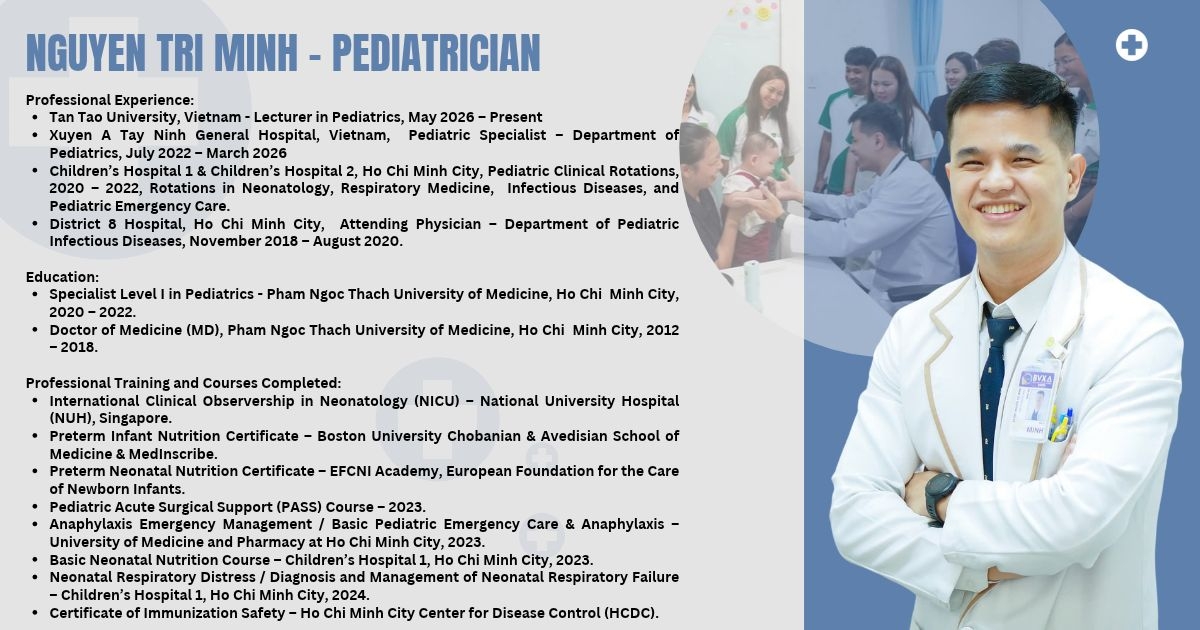
Dr. Nguyen Tri Minh is a pediatrician with more than seven years of clinical experience caring for children.
He has worked in pediatric care at District 8 Hospital and Xuyen A Tay Ninh General Hospital, and completed clinical rotations at Children’s Hospital 1 and Children’s Hospital 2 in Ho Chi Minh City with training in neonatology, respiratory medicine, infectious diseases, and pediatric emergency care.
He currently serves as a Lecturer in Pediatrics at the School of Medicine, Tan Tao University. Dr. Minh holds a Doctor of Medicine degree and a Specialist Level I qualification in Pediatrics from Pham Ngoc Thach University of Medicine.
Reporter: How should parents manage mouth sores and keep their child hydrated at home?
Dr. Tri Minh: For a mild case, home care mainly comes down to two things: keeping the child comfortable and keeping them well hydrated. There is currently no specific antiviral treatment for uncomplicated hand, foot and mouth disease, so treatment is mainly supportive. For fever or painful mouth ulcers, parents can use paracetamol at the appropriate dose for the child’s weight. Because mouth ulcers can make eating and drinking painful, don’t force the child to finish a normal meal. Offer small amounts more frequently. Cool drinks, milk, and soft foods are easier for them to tolerate, while very hot, spicy, salty, or acidic foods may make the pain worse. What matters more in the short term is whether the child is drinking and urinating normally. A dry mouth, much less urine than usual, no tears when crying, or increasing tiredness may suggest dehydration. So don’t worry too much if your child eats less for a few days. Keeping fluids going is the priority.
Reporter: What common mistakes should parents avoid when treating hand, foot and mouth disease at home?
Dr. Tri Minh: The most common mistakes I see are unnecessary medication, over-treating the skin lesions, and forcing a child to eat. Hand, foot and mouth disease is caused by viruses, so antibiotics do not treat the disease unless there is a separate bacterial infection. Parents also don’t need to apply many different creams, powders, or home remedies to the blisters, and they shouldn’t intentionally break them. And one more thing: don’t become so focused on bringing the temperature back to normal that you forget to look at the child. How the child behaves, drinks, sleeps, and interacts with you often tells us much more than one number on the thermometer.
Reporter: At what point does a child need immediate emergency medical care?
Dr. Tri Minh: A child needs emergency medical care if they develop difficulty or abnormal breathing, have a seizure, become very weak or difficult to wake, lose consciousness, or show signs of poor circulation such as becoming very pale, cold, or unusually sweaty. At this stage, don’t wait for another dose of fever medicine to work, and don’t wait until the next morning. Take the child to the emergency room immediately. It’s always better to have a child assessed early than to wait until they become critically ill.
Reporter: During an outbreak, what can families do to avoid infection at home, daycare, or school?
Dr. Tri Minh: The most effective everyday measures are good handwashing, proper cleaning of contaminated objects and surfaces, and reducing contact with the child’s secretions and stool. Hand, foot and mouth disease spreads very easily among young children because they touch everything, share toys, and frequently put their hands in their mouths.
So wash your hands and your child’s hands with soap under clean running water for at least 20 seconds, especially after using the toilet or changing diapers, and before preparing food or feeding a child. Toys, tables, door handles, and other frequently touched surfaces should also be cleaned and appropriately disinfected. Children should avoid sharing cups, spoons, towels, and other personal items while they are sick. And there’s one thing parents may not realize: even when the child looks better, the virus can continue to be shed in the stool for some time. So good hand hygiene, particularly after toileting or changing diapers, remains important even after the obvious symptoms have improved.
Reporter: Many parents are curious about active prevention options, especially the hand, foot and mouth disease vaccine. Could you share your insights on its availability, effectiveness, and role in protecting children?
Dr. Tri Minh: Yes. An EV-A71 vaccine is now available in Vietnam, and the clinical-trial data are very encouraging. The vaccine showed about 97 percent efficacy against hand, foot and mouth disease caused by EV-A71. But the words “caused by EV-A71” are very important. Because hand, foot, and mouth disease can be caused by several different enteroviruses, this vaccine does not prevent every case of the disease. A vaccinated child can still develop disease caused by other viruses. EV-A71 is an important target because it has been associated with some of the more serious neurological and cardiopulmonary complications. The vaccine is intended for young children, and protection is not immediate after the first injection, so parents should follow the recommended vaccination schedule. In clinical studies, most reported reactions were mild and temporary, such as pain or redness at the injection site, fever, irritability, or decreased appetite.
So I see vaccination as an important additional layer of protection, especially against EV-A71, but it doesn’t replace handwashing and the other preventive measures.
Reporter: Do you have any additional advice for parents caring for a child with hand, foot and mouth disease?
Dr. Tri Minh: I would give parents three simple things to remember: First, don’t panic, but don’t underestimate the disease either. Most children recover well, but parents still need to watch them closely for any change in their general condition. Second, don’t judge the severity by the number of blisters. Pay more attention to how your child is behaving, drinking, sleeping, and breathing, and watch for warning signs such as frequent startling, persistent high fever, repeated vomiting, or unusual irritability or drowsiness. I think the message is quite simple: Watch the child, know the warning signs, and keep those little hands clean.
Reporter: And that brings us to the end of today’s Doctor at Home. Many thanks to Dr. Nguyen Tri Minh for joining us and sharing his advice with parents. We hope today’s conversation has given you a clearer idea of what to watch for when your child has hand, foot and mouth disease. Thanks for listening, and see you next time on Doctor at Home.