(VOVWORLD) - The To Huu Museum, dedicated to revolutionary poet To Huu, was inaugurated in 2020 to mark the 100th anniversary of his birth and the 1,010th anniversary of Thang Long–Hanoi. The museum, developed from the former To Huu Memorial House in Nghia Do ward, Hanoi, displays a vast collection of documents and artifacts related to To Huu’s life and career.
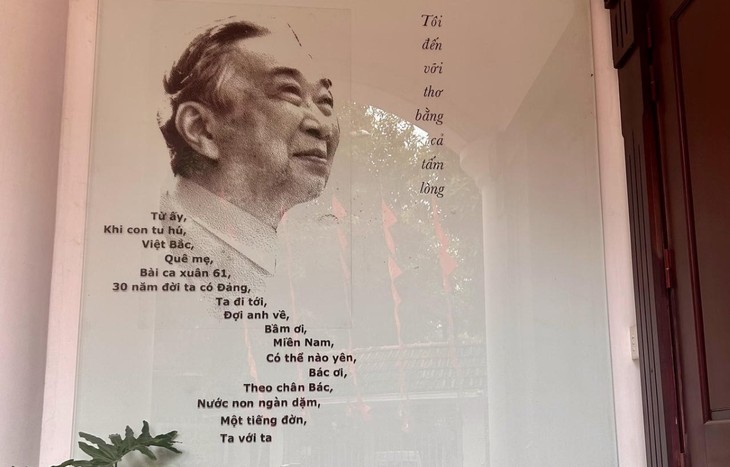 Portray of poet To Huu and names of his famous poems (Photo: baovanhoa.vn) Portray of poet To Huu and names of his famous poems (Photo: baovanhoa.vn) |
Poet To Huu, whose real name was Nguyen Kim Thanh, was born on October 4, 1920, in Quang Dien commune, Hue city. A renowned poet and politician, he once served as First Deputy Chairman of the Council of Ministers – a position now called Deputy Prime Minister.
The To Huu Museum presents two parallel narratives – one on his life and political career and the other on his poetry. Poet Tran Dang Khoa said, “The museum reflects two aspects of To Huu – revolutionary leader and poet. Visitors are introduced to both To Huu the poet and To Huu the revolutionary leader and soldier.”
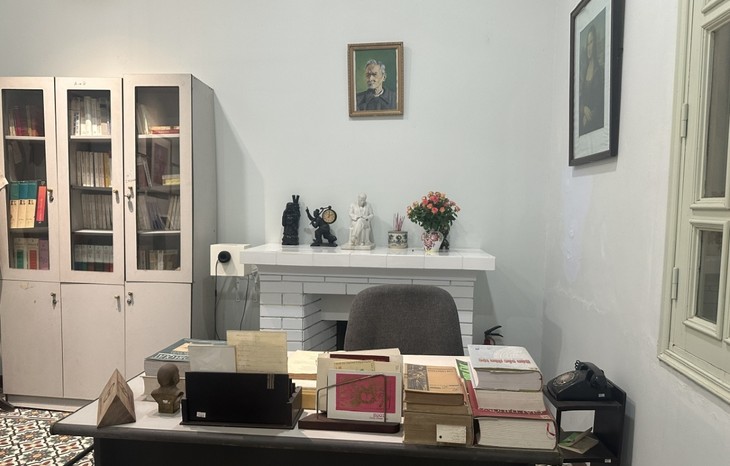 The workspace of To Huu at 76 Phan Dinh Phung street, Hanoi (Photo: baovanhoa.vn) The workspace of To Huu at 76 Phan Dinh Phung street, Hanoi (Photo: baovanhoa.vn) |
At the entrance of the museum stands a prominent stone slab engraved with a verse from
Spring Song 1961: “What could be more beautiful in life than this. People loving one another, living to love each other.” The stone expresses To Huu’s noble ideals, compassion, and optimism for the future.
The section on To Huu’s life and career displays his seven poetry collections, including hundreds of original manuscripts and rare artifacts, using a modern audiovisual system to show how his poetry paralleled the revolutionary history of Vietnam.
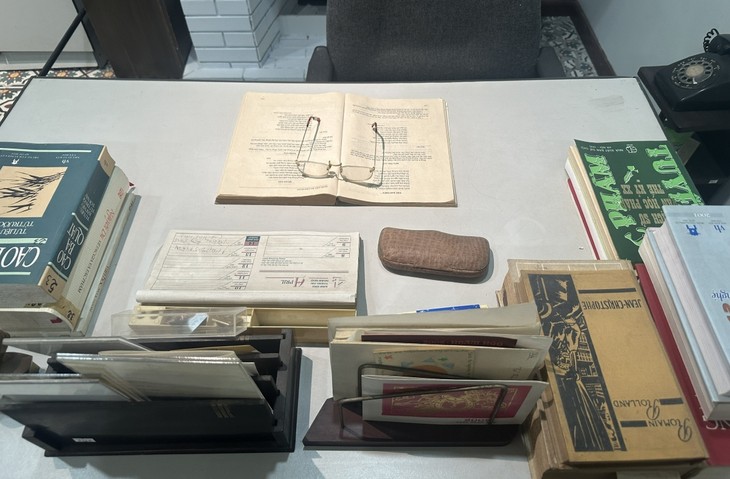 The documents and keepsake of To Huu (Photo: baovanhoa.vn) The documents and keepsake of To Huu (Photo: baovanhoa.vn) |
His daughter Nguyen Minh Hong said, “Our family wants to spread the cultural and spiritual values of To Huu as both a poet and a revolutionary. We hope the To Huu Museum will become a cultural destination where many more people will learn about To Huu.”
Another part of the museum presents the living room and workspace at 76 Phan Dinh Phung street, Hanoi, where To Huu lived with his family from 1960 until his death in 2002. The space has a warm, intimate atmosphere – both the living room where he received friends and colleagues and the smaller space with a round table where he used to drink tea and write poetry. Each photograph, document, and keepsake tells the story of a great soul, a poet of ideals and aspirations.
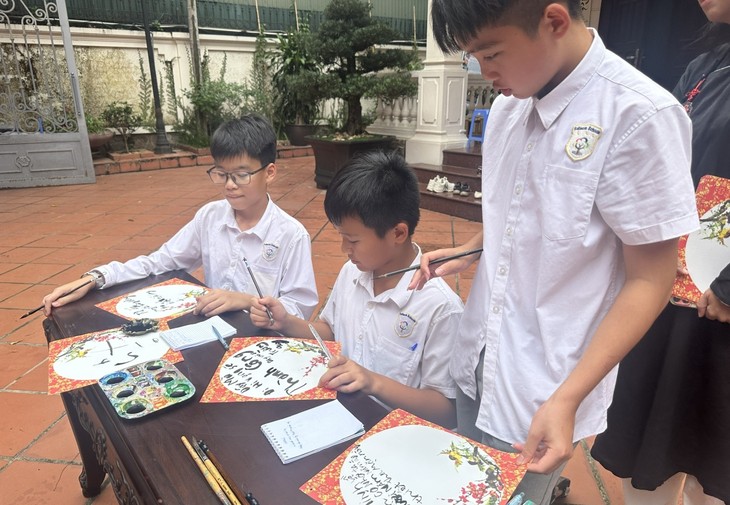 Children write To Huu's poems in calligraphy. (Photo: baovanhoa.vn) Children write To Huu's poems in calligraphy. (Photo: baovanhoa.vn) |
According to Pham Kim Ngan, Deputy Director of the To Huu Museum, “The museum displays items that belonged to the two sons of Tơm, a woman who sheltered To Huu in Cu Lao Hanh in 1942 after he escaped from Dak Glei prison and became acting Secretary of the Thanh Hoa provincial Party Committee. The two sons gave haircuts to earn money to help support To Huu and his comrades, and also gathered information for them. At the time, To Huu and his comrades were publishing a newspaper called ‘Duoi giac nuoc (Chase away the enemy)’, whose paper and ink were paid for by the haircut earnings.”
The museum integrates multimedia elements for reading, viewing, listening, and interactive experiences that make visitors feel as if the poet himself is guiding them through 70 years of his poetry and revolutionary life.
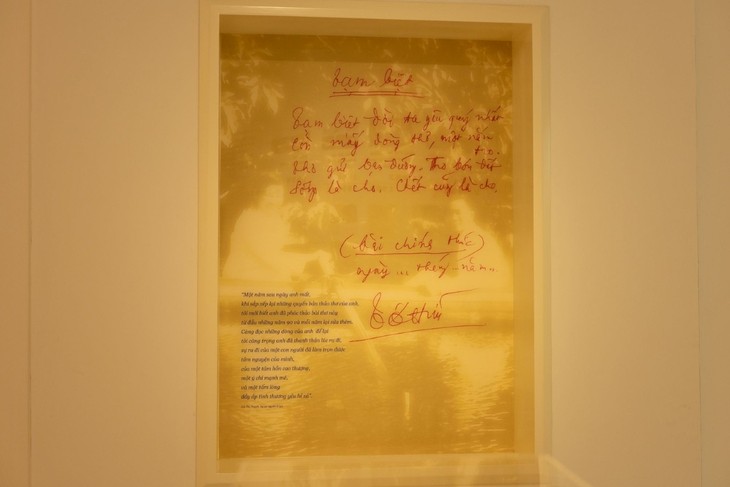 The handwritten manuscript of poet To Huu (Photo: baovanhoa.vn) The handwritten manuscript of poet To Huu (Photo: baovanhoa.vn) |
To Huu Museum is quickly becoming a popular venue for poetry lovers, teachers, and students. “I was most impressed by the poet’s glasses placed on a book. I think they accompanied him in creating many beautiful poems,” said a visitor.
“This study trip is very meaningful for students. Poet To Huu is the pride of Vietnamese poetry, especially revolutionary poetry. Students have the opportunity to learn touching stories about his life and important historical milestones of Vietnam,” according to a museum goer.