“Before electronic medical records, we had to write doctors’ orders for every patient into our own notebooks. It took a lot of time, and mistakes could easily happen. Since electronic medical records were introduced, everything has become much more convenient. We can even check patient information directly on our phones.”
For medical staff like nurse Phan Thi Cam Tien from Binh Dan Hospital, Ho Chi Minh city, the impact of digitalization is felt most clearly in everyday routines, fewer handwritten notes, faster access to patient information, and smoother coordination between departments. Her experience reflects a broader shift underway across Vietnam’s healthcare system, where digital data is increasingly replacing paper as the backbone of clinical work and medical management.
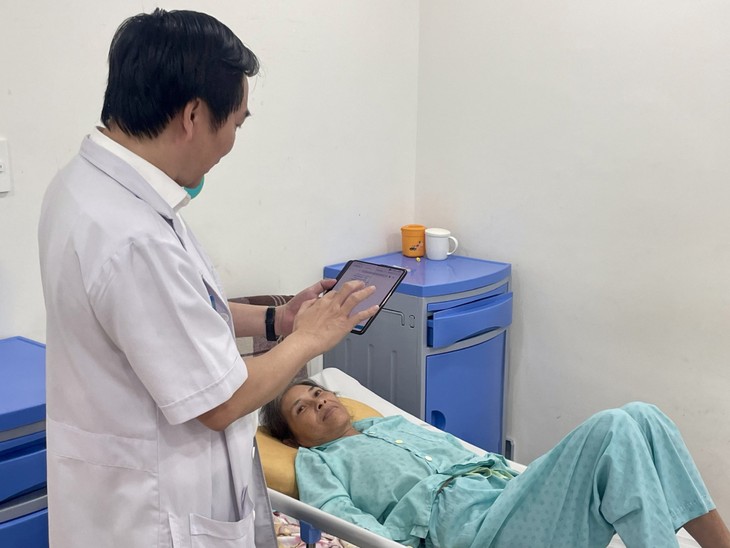 A doctor checks patient information directly on his phone (Photo: VOV) A doctor checks patient information directly on his phone (Photo: VOV) |
In Ho Chi Minh City, 2025 marks a pivotal stage in the rollout of electronic medical records. After years of gradual preparation, many hospitals have accumulated enough digital data to move beyond basic digitization toward more advanced models of smart hospital management. Paper files that once filled storage rooms are being replaced by standardized digital records that support clinical practice, hospital administration, and long-term planning.
Binh Dan Hospital was among the first in Ho Chi Minh City to adopt electronic medical records, starting in 2013. The hospital initially used software from private firms before its in-house IT team took over, ensuring long-term system stability. Early on, just over 20 forms were digitized, later expanding to around 70 as regulations evolved. By late September 2020, the hospital completed its transition under the national roadmap. While challenges remain with complex records and patient consent, technical solutions such as electronic signatures and data standardization continue to be refined.
According to Associate Professor Luong Thanh Tung, Deputy Director of Binh Dan Hospital, the hospital’s progress is rooted in its internal capacity. Tung said, “Our IT workforce is entirely in-house, which allows us to operate and maintain the system ourselves. The key challenge now is strengthening the technical infrastructure needed to run the data systems reliably, and the hospital is planning further investment to ensure long-term digital healthcare.”
 The IT workforce is entirely in-house, which allows Binh Dan Hospital to operate and maintain the system. (Photo: VOV) The IT workforce is entirely in-house, which allows Binh Dan Hospital to operate and maintain the system. (Photo: VOV) |
Building a shared medical data foundation is not limited to major tertiary hospitals. Across Ho Chi Minh City, many healthcare facilities are accelerating the digitalization of medical records. At Le Van Thinh Hospital, data from thousands of patient visits is updated and stored daily on the hospital’s information system, while self-service kiosks help patients register for examinations and pay fees, cutting waiting times. However, the process remains challenging. Nguyen Thi Thai Hoa, Head of the IT Department at Le Van Thinh Hospital, said limitations in both technical infrastructure and human resources persist.
“Technology providers’ personnel doesn’t have in-depth understanding of the healthcare sector. At the same time, hospitals do not have sufficient internal resources to develop systems entirely on their own. Many of our existing systems no longer meet current operational needs and upgrading them will require significant investment,” said Thai Hoa.
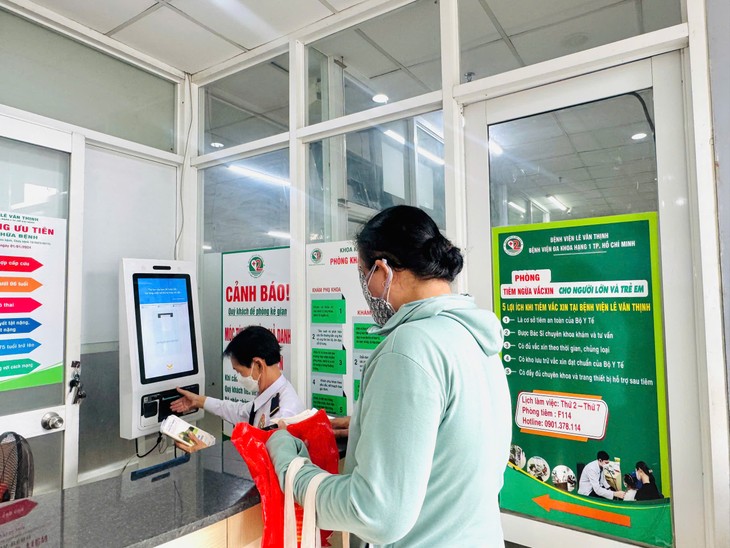 Patients register for examinations and pay fees via self-service kiosks. (Photo: VOV) Patients register for examinations and pay fees via self-service kiosks. (Photo: VOV) |
Shared electronic medical record platform
According to the Ho Chi Minh City Department of Health, as of April 2025, 35 hospitals in the city had not yet met the conditions to transition from paper-based records to electronic medical records. After five months of intensive training, technical support, and capacity building, progress accelerated. Up to now, 95 percent of hospitals in Ho Chi Minh city have implemented electronic medical records.
A key development in this process is the pilot implementation of a shared electronic medical record platform connected to the city’s centralized healthcare data repository. This platform supports hospitals with limited resources by synchronizing data across facilities and providing tools for management, monitoring, and analysis.
Tang Chi Thuong, Director of the Ho Chi Minh City Department of Health, explains the broader significance of this effort: “Disparities in IT resources are a structural challenge in the healthcare sector. They exist not only between regions, but also among hospitals within Ho Chi Minh City itself. Therefore we have proposed long-term policy mechanisms, so that hospitals can have stable resources to maintain and steadily develop their information technology systems.”
These electronic medical records are not an end in themselves. They form the foundation for a broader transformation: telemedicine. In Vietnam, telemedicine is no longer seen as a temporary solution introduced during the COVID-19 pandemic. It has become a strategic component of the modern healthcare system, serving tens of thousands of patients each year, particularly in remote areas and among vulnerable populations.
Telemedicine marks broader transformation of Vietnam’s healthcare
Vietnam is gradually completing the legal framework for remote medical examination and treatment. Associate Professor Tran Van Thuan, Deputy Minister of Health and Chairman of the National Medical Council, stresses that sustainable development of telemedicine requires more than technical connectivity.
“The biggest challenges lie in data standardization, information security, building digital trust, and designing long-term operational mechanisms. In the coming period, the Ministry of Health will prioritize institutional reform, professional standardization, data interoperability, and capacity building for healthcare workers in the digital environment,” Thuan said.
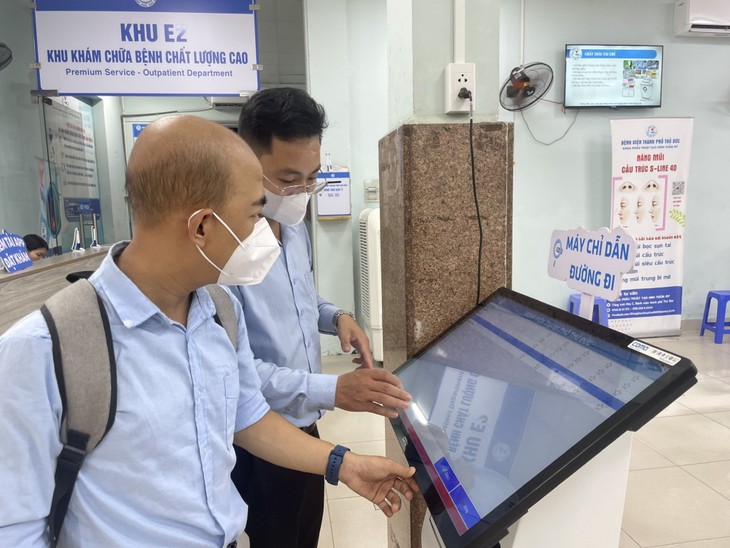 Self-service kiosks help patients register for examinations and pay fees, cutting waiting times (Photo: VOV) Self-service kiosks help patients register for examinations and pay fees, cutting waiting times (Photo: VOV) |
Nguyen Trong Khoa, Deputy Director of the Department of Medical Services Administration, said, “To implement telemedicine in practice, we still need to do a great deal of work. We must standardize data systems and information transmission. Another critical issue is financial mechanisms, including health insurance payment for telemedicine, and clearly defining the responsibilities of each healthcare facility.”
As digital healthcare expands, information security and personal data protection become increasingly central. Nguyen Truong Nam, Deputy Director of the National Health Information Center, emphasizes the need for strict safeguards.
“Telemedicine involves third parties providing software, devices, integration and data storage. Clear contracts and responsibilities are required. Personal data must not be exploited or misused without citizens’ consent. All parties involved must understand the risks and comply strictly with safety requirements,” Truong Nam said.
The scale of healthcare data in Vietnam presents a significant challenge. The system includes nearly 400,000 clinical terms, technical procedures, disease classifications, and various coding systems, covering everything from hospital beds and medical devices to pharmaceuticals, insurance codes, and patient identification through the national VNeID system. Experts agree that building clean, high-quality data is an urgent requirement if digital healthcare applications are to function effectively.
From everyday clinical practice in cities across Vietnam to online consultations reaching remote and underserved communities, digital data is quietly reshaping how healthcare is delivered. The shift from electronic medical records to telemedicine is not merely a technological step forward. It reflects a deeper reorganization of healthcare services—one that places data, connectivity, and patient-centered care at its core. While challenges remain, a more connected and digitally enabled healthcare system in Vietnam is steadily taking shape.