(VOVWORLD) -Khmer brocade weaving has been existing for centuries in Sray Skoth hamlet in An Cu commune, An Giang province. Locals produce sophisticated brocade using natural dyes that give it a distinctive Khmer identity.
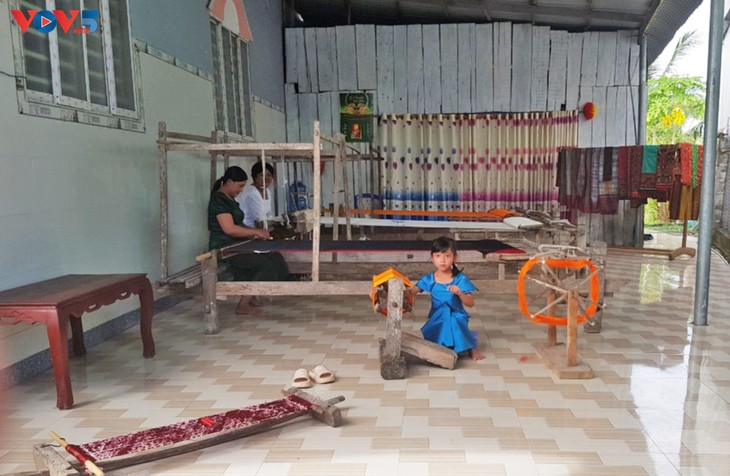 Khmer’s brocade weaving in An Cu commune has been existing for centuries. (Photo: Ngoc Anh) Khmer’s brocade weaving in An Cu commune has been existing for centuries. (Photo: Ngoc Anh) |
An Cu commune, which covers 90 square kilometers, was formed by merging three former communes—Van Giao, Vinh Trung, and An Cu. The commune is home to Kinh, Khmer, and Chinese ethnic groups, with the Khmer community accounting for 70% of the population. In the past, every household owned a loom, and women wove fabric for scarves and sarongs. But over the years the craft began to wane, and at times it seemed on the brink of disappearing.
A turning point came in 1998, when CARE International Australia—a global NGO focused on poverty reduction and humanitarian assistance—partnered with the An Giang provincial Women’s Union to launch a project to revive Khmer brocade weaving in what was then Van Giao commune.
In 2002, the Khmer Brocade Weaving Cooperative of Van Giao commune (now part of An Cu commune) was officially established. Since then, the craft has been revitalized, and its products have gained popularity domestically and internationally thanks to diverse designs, delicate colors, and intricate patterns.
Neang Chanh Da Ty, Head of the Van Giao Khmer Brocade Weaving Cooperative, told VOV that her family has practiced this craft for three generations—her grandmother, her mother, and now herself. “Khmer brocade weaving comes from the skilled hands of local women. Our signature products include shirts, shawls, sarongs, and bags. There are 17 stages in the weaving process. What makes Khmer brocade unique is that everything is done by hand. We receive many orders from Cambodia,” said Ty.
In 2006, “Van Giao Brocade Silk” was granted collective trademark protection by the National Office of Intellectual Property at the Ministry of Science and Technology. A year later, in 2007, weaving was officially recognized as a traditional handicraft by the An Giang provincial People’s Committee. In 2023, sarongs produced by the Khmer weaving village in Van Giao were certified as a 3-star OCOP product. The village’s brocade items have also been recognized as outstanding rural industrial products of Vietnam’s southern region.
The patterns woven into Khmer fabrics are deeply rooted in culture, religion, and everyday life. Motifs range from pagodas, flowers, and leaves to Buddhist symbols. Various techniques—such as plain weaving, cross-weaving, and flower-knot weaving—are employed, each creating distinct textures and visual effects.
Artisans in An Cu often use a three-layer technique with three different colors of silk thread to produce shawls, sarongs, tapestries, and tablecloths that depict ancient legends. The secret behind the lustrous, long-lasting colors of Khmer brocade lies in the use of natural dyes, which give the silk a smooth texture that resists fraying.
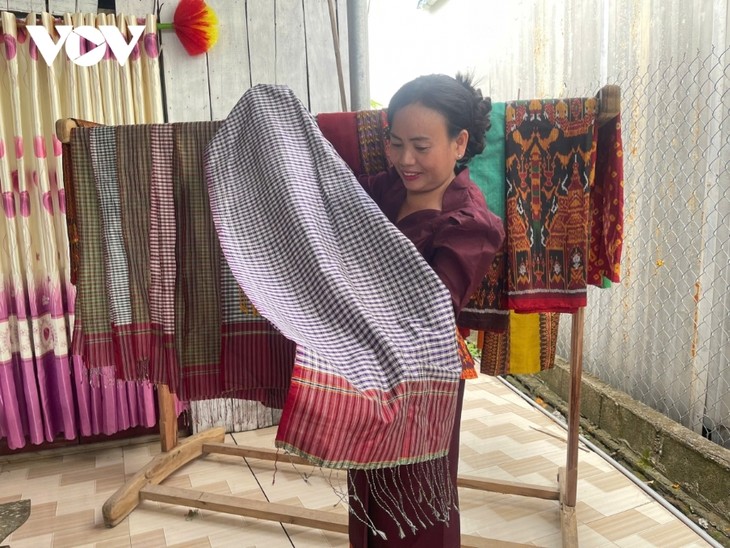 Artisan Neang Chanh Ty introducing Khmer brocade products Artisan Neang Chanh Ty introducing Khmer brocade products |
Artisan Neang Chanh Ty explained, “There are 63 households practicing the craft in the commune, but only a few true artisans—just two of us. Handmade products are very beautiful. The fabric is made from silk, so it’s soft. The most difficult stages are designing the patterns, dyeing the silk, and fluffing the cotton. Our products are sold in Cambodia and to tourists from the UK and the US.”
Local artisans and master weavers play a key role in preserving the craft and passing it on to younger generations. Neang Soc Kun, a member of the cooperative, said, “I’m not yet proficient because I’ve only been learning for a few months. I come to practice whenever I have free time. Learning the craft is free. I already know how to dye silk, cut patterns, and spin threads. I can weave, but I’m not yet skillful. There are many stages to master, and it takes about two years to become proficient.”
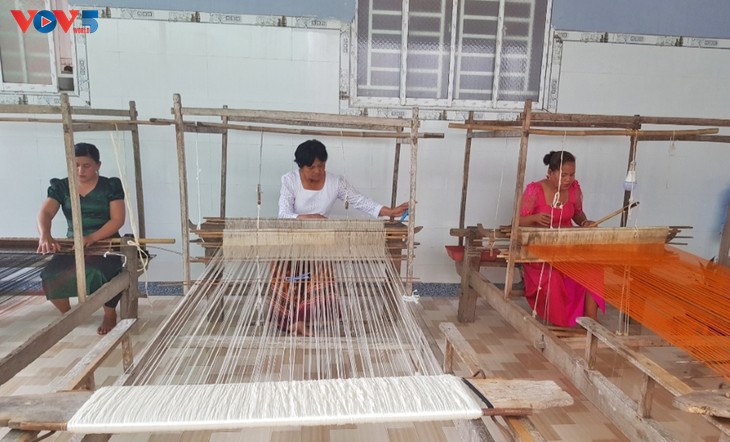 The traditional brocade weaving craft has helped the locals have a better life and preserve distinctive Khmer identities. (Photo: Ngoc Anh) The traditional brocade weaving craft has helped the locals have a better life and preserve distinctive Khmer identities. (Photo: Ngoc Anh) |
The An Cu commune authorities have identified Khmer brocade weaving as both a key livelihood and a distinctive cultural value of the local Khmer community. Nguyen Duy Phong, Chairman of the An Cu commune People’s Committee, said, “Our key solution is to expand our market. The village’s products are promoted at political and cultural events, festivals, and trade fairs to reach consumers from other localities.”
“We’re also developing an agro-ecology map to establish raw material zones. The commune has allocated 1 hectare for mulberry cultivation to support silk production and provides preferential loans ranging from 190 USD per household to 3,800 USD for larger projects,” said Phong, adding, “We’re developing the craft in combination with community-based tourism, forming an experiential tourism model in which visitors can experience Khmer life and culture.”
Khmer brocade products from An Cu are now sold widely within and beyond An Giang province under the brand name “Khmer Silk” and have been exported to Thailand, Cambodia, and Myanmar.