(VOVWORLD) - There is a village in Lai Vung commune, Dong Thap province, that makes wooden chopping boards. For more than 70 years, Dinh An craft village has been building its reputation in the region.
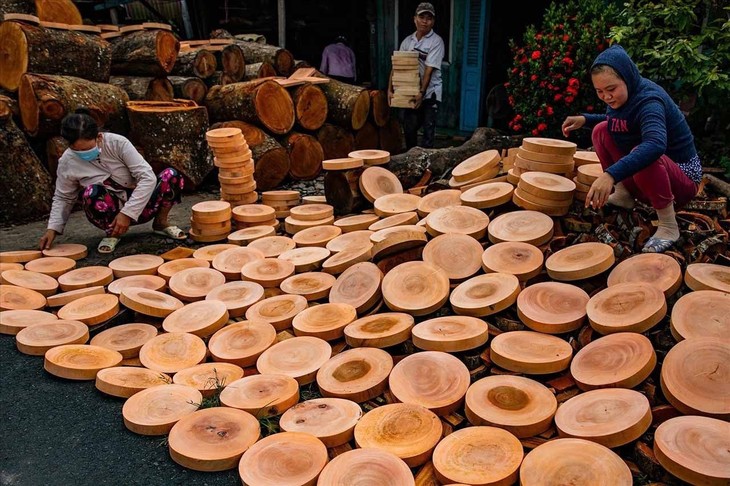 The chopping board making in Dinh An village has existed for more than 70 years and is well known in the region. (Photo: vovgiaothong.vn) The chopping board making in Dinh An village has existed for more than 70 years and is well known in the region. (Photo: vovgiaothong.vn) |
Visitors know they’ve arrived at Dinh An village located along National Highway 54, when they see neat rows of wooden boards drying in the sun and hear the steady hum of saws and grinders coming from workshops. Barges loaded with timber are lined up along the riverbank, waiting to unload at the local sawmills.
The village elders can’t pinpoint exactly when the craft began. They only recall that it had its heyday in the 1950s. The legend is that the locals once used river junks to carry local agricultural products to distant provinces. On their return, they brought back palm leaves for roofing and oil-nut wood for house pillars. Leftover timber was made into chopping boards for household use, and surplus boards could be traded or sold. As their quality gained recognition, orders for the boards began to pour in, and Dinh An started gaining a reputation as a craft village.
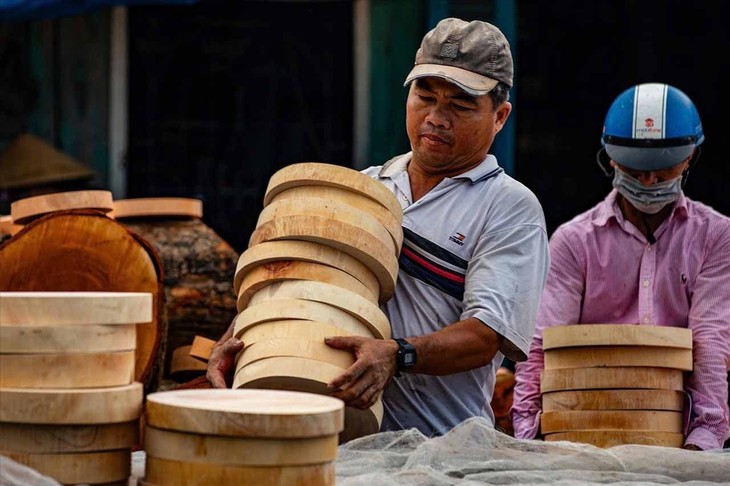 The craft is generating many jobs for local people. (Photo: vovgiaothong.vn) The craft is generating many jobs for local people. (Photo: vovgiaothong.vn) |
Nguyen Van Thi, a second-generation craftsman, told VOV, "Years ago, my father bought oil-nut wood to make plows and axles for sale. He used leftover wood to make chopping boards for the market. Demand gradually increased, and we expanded production. Back then, everything was manual and we made just enough to get by. Now production has scaled up significantly."
People favor Dinh An chopping boards for three reasons: they’re durable thanks to dense wood that doesn’t splinter into the food being chopped; they’re affordable because they’re made from locally sourced materials; and they’re aesthetically pleasing, with a perfectly round shape and a smooth, glossy finish.
The boards range from 20 to 50 centimeters in diameter and are made from various types of wood, including oil-nut, mahogany, mango, and jackfruit. Dinh An boards are entirely handmade without the use of chemicals and are sun-dried to prevent warping and ensure resistance to mold.
Nguyen Quoc Viet, a workshop owner, explains, "The craft has been passed down through generations. These boards are completely natural—no chemicals or dyes are used. The designs are simple but beautiful. The whole village can produce up to 1,000 pieces a day, supplying the Mekong Delta and increasing local income."
The secret of the Dinh An cutting board lies in selecting large, aged logs and carefully drying them to remove all resin. The process involves multiple stages: segmenting, cutting, marking, shaping, hewing, and surface planing.
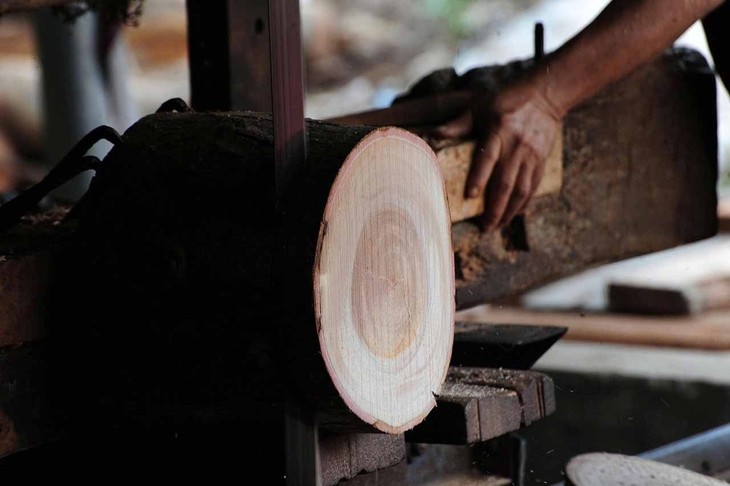 According to experienced workers in Dinh An, large and aged logs are selected to make chopping boards. (Photo: vovgiaothong.vn) According to experienced workers in Dinh An, large and aged logs are selected to make chopping boards. (Photo: vovgiaothong.vn) |
While modern machines now assist with production, the craft still demands skilled hands. Achieving the right balance of thickness and diameter—so the board doesn’t crack—requires years of experience. The final smoothing, in particular, must be done by hand to achieve a silky finish that machines can’t replicate.
The work is labor-intensive and highly collaborative. Each worker specializes in a specific stage, passing the product along the production chain. Many households operate a small, family-run workshop. Men typically handle heavy tasks such as transporting logs, sawing, and chiseling, while women focus on sanding and drying. Drying is perhaps the most challenging stage.
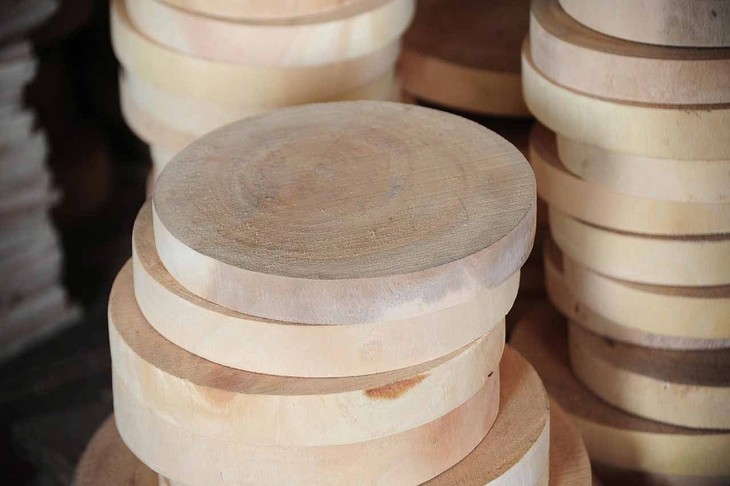 The signature Dinh An products are chopping boards made from oil-nut wood because of their beauty and durability. (Photo: vovgiaothong.vn) The signature Dinh An products are chopping boards made from oil-nut wood because of their beauty and durability. (Photo: vovgiaothong.vn) |
With unpredictable weather, boards must be constantly monitored. During the rainy season, it can take up to a full week of sunshine before a board is ready for final finishing. The village’s hallmark is its chopping boards made from aged oil-nut wood.
Le My Trang, a local worker, said, "A high-quality board must have a smooth, glossy surface. The best ones are made from oil-nut or conch wood. We no longer use mango or rain tree wood. Oil-nut is the most valued—it can last up to 10 years without growing moldy or cracking."
On average, a single household in Dinh An produces around 200 boards per day, with output rising to as many as 1,000 during peak periods such as the lead-up to the Lunar New Year. The steady rhythm of saws, chisels, and lively conversations provide a distinctive soundtrack that embodies the vitality of this riverside craft village.