(VOVWORLD) -A sugarcane molasses-making village in Vu Quang commune in Ha Tinh province has kept its fires burning for more than half a century. Vu Quang molasses has become a signature product that provides a stable income for locals.
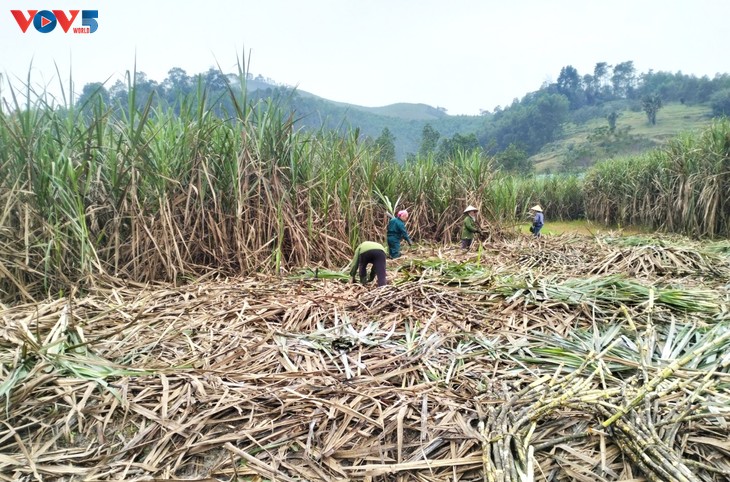 Residents in Vu Quang are busy harvesting sugarcane for molasses production. (Photo: Kim Lieu) Residents in Vu Quang are busy harvesting sugarcane for molasses production. (Photo: Kim Lieu) |
At dawn, the villagers head to the fields to harvest sugarcane and carry it back to be pressed. Wood-fired furnaces burn continuously, with plumes of smoke rising and a sweet aroma spreading throughout the village. The arduous work, requiring experience and patience, has become a familiar rhythm for many families. Cooking molasses has been a tradition for more than 50 years in Vu Quang commune (formerly Son Tho commune of Huong Son district, Ha Tinh province).
Phan Hong Yen, Chairwoman of the communal People's Committee, told VOV that the locals have grown sugarcane and made molasses from the stalks for a long time. “The Tho Dien area of Vu Quang is the traditional craft village. One hectare of sugarcane can generate between 4,600 and 5,000 USD for the producers. Vu Quang sugarcane products have achieved a 3-star OCOP rating. We’ve found that sugarcane is more profitable than other crops," Yen said.
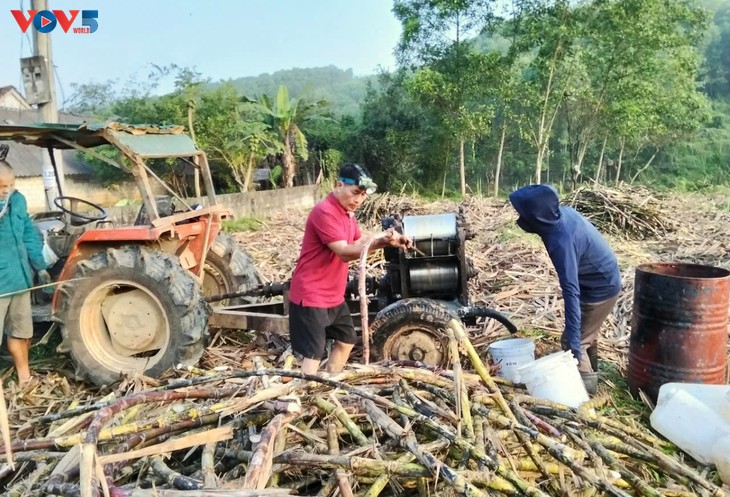 Pressing sugarcane to extract juice for molasses making (Photo: Kim Lieu) Pressing sugarcane to extract juice for molasses making (Photo: Kim Lieu) |
Vu Quang commune used to just grow raw sugarcane. But due to uncertain output and unstable prices, the locals started pressing the sugarcane and cooking molasses to increase their product value. Starting with a few small-production households, molasses-making has become a major part of local economy.
The commune now has cultivated 30 hectares of sugarcane and supplies about 190 tons of molasses to the market each year. The peak production season runs from the 10th to the 12th lunar month when sugarcane reaches full maturity and high sugar content produces the most aromatic molasses.
After it’s harvested, the sugarcane is cut into short sections and pressed to extract the juice, which is transferred to large pans and cooked for 5 to 7 hours to create a thick molasses with a beautiful color and intensely sweet flavor.
35-year-old Luong Van Dat told us that cooking molasses is a complex process that requires skill and experience to produce good batches. “After pressing the juice, we prepare the furnace and wood for cooking. To produce one pan of molasses, you need up to 100 liters of sugarcane juice. When it boils, impurities rise to the surface. At that point, you must quickly skim off the foam and residue with a strainer; otherwise, the liquid will overflow onto the stove."
The most critical part of the process is maintaining a steady fire. If the fire is too hot and the stirring uneven, the molasses can easily burn. If the fire is too low, the thickening takes much longer. Although the recipe is not very complicated, it demands persistence, experience, and dedication.
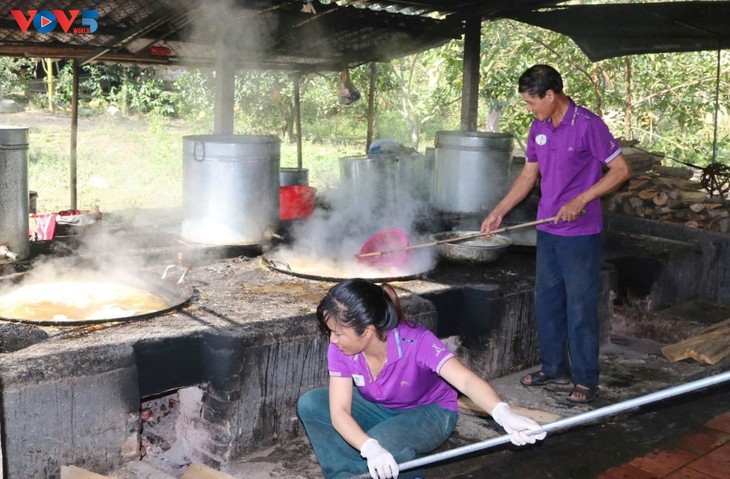 Large pots are used to cook sugarcane juice (Photo: Kim Lieu) Large pots are used to cook sugarcane juice (Photo: Kim Lieu) |
Vu Quang resident Dang Van Thanh, who has 30-year experience, said, "The thickening stage is the final and most elaborate step, requiring the most time and labor. During this stage, the cook must stir continuously.” “When it starts boiling, if the foam is not skimmed in time to prevent overflowing, the molasses will turn dark and lose its fragrance. When the juice becomes syrupy and takes on a reddish color, the cooking process is complete. After it cools, if a layer of sugar bubbles appears on the surface, the molasses has reached the required quality."
Production households in the village have teamed up and established the Sơn Thọ Molasses Service Cooperative to build a Vu Quang molasses brand and distribute it to markets nationwide. Doan Thi Nhan, the Cooperative’s Director, said, "Each year, the Cooperative supplies between 15,000 and 20,000 liters of molasses to the market. This year, because of the high number of orders, we have to operate at full capacity, with the kitchen fires burning almost all day. We press about 3 to 4 tons of fresh sugarcane daily, enough to produce around 300 liters of finished molasses."
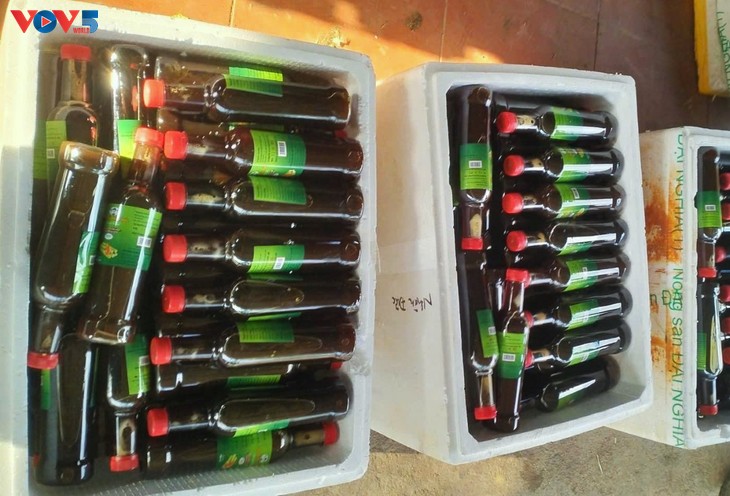 Molasses from Vu Quang commune has been recognized as an OCOP product. (Photo: Kim Lieu) Molasses from Vu Quang commune has been recognized as an OCOP product. (Photo: Kim Lieu) |
Recognition as a province-level OCOP product in 2020 opened up opportunities for Vu Quang molasses to expand its market.