(VOVWORLD) - Vietnam stands at a historic crossroads in pursuing its global climate goals. High-level blueprints like Just Energy Transition Partnership and the Power Development Plan for 2021-2030 known as PDP8 are in place, but the true challenge is implementing them. Juhern Kim, Vietnam Country Representative of the Global Green Growth Institute (GGGI), which is tasked with facilitating the mobilization of 1 billion USD in green financing for Vietnam by 2028, talked with VOV24/7 about opportunities and challenges facing Vietnam in achieving Net Zero by 2050.
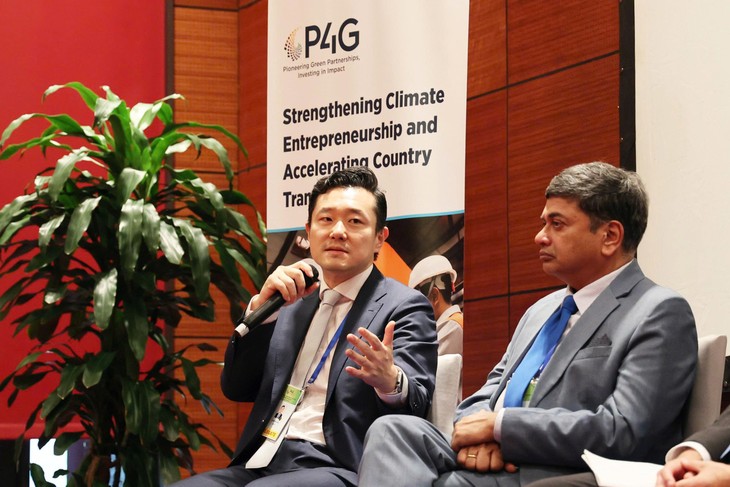 GGGI Country Representative Juhern Kim speaks at the National Platform Gathering of the 2025 P4G Vietnam Summit, April 2025 (Photo: GGGI) GGGI Country Representative Juhern Kim speaks at the National Platform Gathering of the 2025 P4G Vietnam Summit, April 2025 (Photo: GGGI) |
Reporter: Welcome to VOV24/7. Mr. Juhern Kim, Vietnam Country Representative of the Global Green Growth Institute (GGGI). Could you briefly introduce the Global Green Growth Institute and its activities in Vietnam?
Juhern Kim: GGGI is a treaty-based inter-governmental organization. We do three things: we facilitate investment mobilization for green projects, we provide policy advice, and we provide capacity-building services. For more than ten years in Vietnam, we've tried to do those three things. We were behind the development of Vietnam’s national green growth strategy and action plan. Recently, we helped the Vietnamese government develop a carbon market. Now we’re very excited to expand and strengthen our services here in Vietnam with a new 5-year development period.
The Global Green Growth Institute (GGGI) in Vietnam
As a founding member since 2012, Vietnam partners with GGGI to achieve its Net Zero 2050 goal. Since 2014, GGGI has provided technical assistance to 13 government agencies, shaping the National Green Growth Strategy and domestic carbon markets.
GGGI’s key Achievements in Vietnam as of 2025:
GGGI has facilitated the mobilization of 400 million USD in green capital.
In term of policy, it has delivered 25+ advisory outputs for central and provincial authorities.
For Innovation, it accelerated 13 climate-tech startups, with 3 raising 2.5 million USD.
GGGI has served as fiduciary manager for programs funded by 10 funding sources.
Reporter: What makes the next five years pivotal year for Vietnam’s green transition, and how do you see the alignment between policy direction, market demand, and investment shaping the country’s competitiveness and role in regional and global supply chains?
Juhern Kim: I think it's a very important period because, for the first time, the policy direction, market demands, and investment ambition are working together towards green transition. If you look at the cities, they wanted to electrify the motorbikes, especially Hanoi and Ho Chi Minh City. If you look at industrial parks, they wanted to modernize the factories to be more energy-efficient and more resource-efficient. 2026 may be the first year of pushing that implementation. This is about Vietnam's competitiveness and its new role in regional and global supply chains.
Reporter: What is GGGI doing to help Vietnam in this period to achieve its goal?
Juhern Kim: If you look at the global scenario analysis done by the International Energy Agency (IEA), by 2050 or 2070, if the global society wants to achieve Net Zero, they’ll need certain climate technologies that aren’t commercially viable. More than 50% of emissions reduction depends on those technologies. That's why we need startups and entrepreneurs to bring that technology to the market. We’re looking for companies that can generate clear climate impacts. We want to find potential winners because the technology can only be expanded and create an impact if it’s commercially viable.
We established a program called “Accelerating Innovative Startups for Energy Efficiency”, a program in collaboration with the Ministry of Industry and Trade and sponsored by the European Union. We selected 15 startup businesses to accelerate. One of the winners uses AIOT software to detect energy consumption problems in building and recommends ways to reduce them. After applying their services, one of the famous fast-food chains was able to reduce the energy consumption of their businesses an average of 20%.
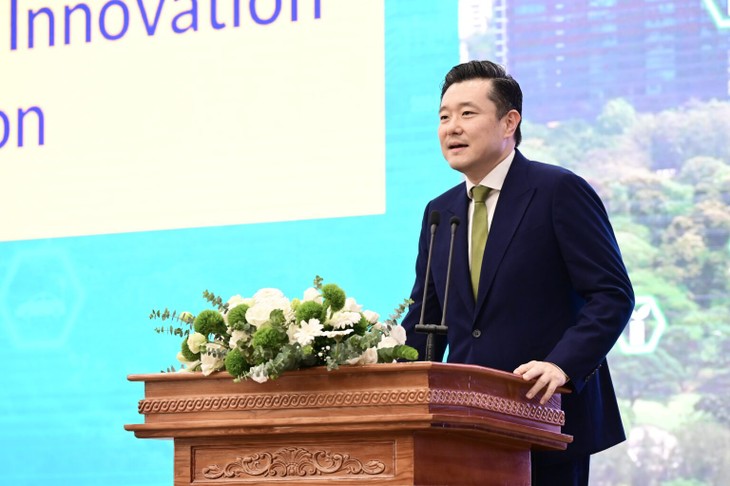 Juhern Kim speaking at the “Innovate Vietnam 2025” - Vietnam’s flagship event on science, technology, and innovation (Photo: GGGI) Juhern Kim speaking at the “Innovate Vietnam 2025” - Vietnam’s flagship event on science, technology, and innovation (Photo: GGGI) |
Reporter: GGGI is now working with the National Innovation Center in supporting entrepreneurs. How is your organization working with the center to promote climate technologies and cooperation between Vietnamese and Korean startups?
Juhern Kim: The role of the National Innovation Center is crucial because entrepreneurs need a platform to talk to and get some support from. The reason we’re collaborating with the National Innovation Center is to link the climate agenda to their innovation agenda. We’re trying to promote new technologies like clean hydrogen, maybe green steel in the future, and also the general climate technology acceleration program.
Climate issues and climate threats are a universal thing. We’re trying to solve the problem through new techniques like AI or any kind of new climate technologies that can be applicable to the energy industry, waste industry, and other industries. Korea has relevant experience in each sector – making it more climate-proof or climate-resilient and renovating their supply chain to be more climate-friendly. That’s why GGGI is trying to develop a new climate tech accelerator program together with the Korean government and Vietnamese government to put Vietnamese and Korean startups in the same cohort so that they can generate new opportunities for Vietnam.
Reporter: Thank you, Mr. Kim, for sharing your insights with us.
Juhern Kim: Thank you for having me. It was a pleasure.