(VOVWORLD) - The 14th National Party Congress has drawn attention from the public at home and overseas by introducing important new strategic orientations. For the first time, Vietnam has explicitly integrated self-reliance into its core diplomatic identity while elevating external relations to a status equal to national defense and security. In this week’s Q&A, Mr. Nguyen Hong Hai, Assistant Professor of Politics and International Relations, College of Arts and Science, VinUniversity and Adjunct Associate Professor, University of Sunshine Coast, Australia, will break down the new pillars of Vietnamese diplomacy.
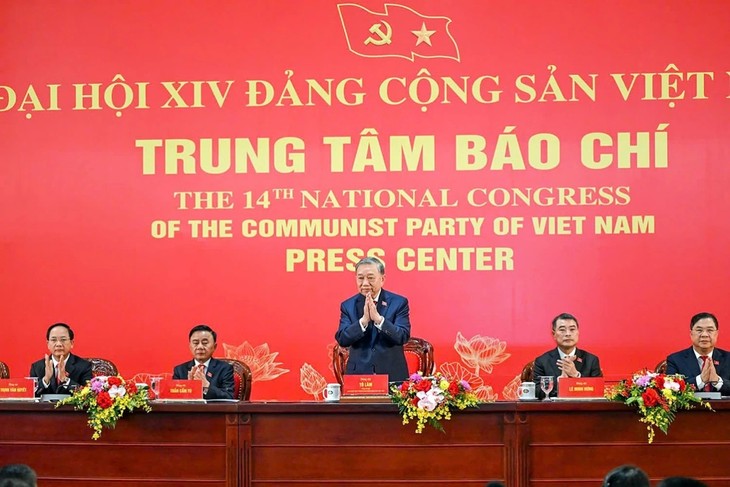 Party General Secretary To Lam chairs an international press conference on the outcomes of the 14th National Congress of the Communist Party of Vietnam. Party General Secretary To Lam chairs an international press conference on the outcomes of the 14th National Congress of the Communist Party of Vietnam. |
Bao Tram: Thank you, Dr. Hai, for joining us today. In your opinion, what are the most notable new aspects of the foreign policy Vietnam adopted at its 14th National Party Congress?
Dr. Hai: In the political report adopted at the 14th Party Congress, there are quite a few new points of foreign policy that will be very important for Vietnam's foreign relations in the coming years and decades.
For the first time, the aspect of self-reliance was emphasized. It tells us that Vietnam will expand collaboration and relations with partners, but it also emphasized Vietnam’s synergy. After 40 years of Doi Moi, Vietnam has made a lot of progress toward the level of a middle power. Emphasizing self-reliance shows that Vietnam has achieved a level of development that will enable us to make our own decisions. Vietnam has resources and the capacity to expand and develop relationships with other partners without relying on external factors.
A second new point is that diplomacy, or external relations, has been elevated to the same level as defense and security. That said, external relations are now considered a core and constant task.
Bao Tram: You mentioned diplomacy is now a “core and constant task”. How will this shift shape Vietnam’s diplomatic activities, particularly in terms of strategic proactive engagement?
Dr. Hai: It means that diplomacy and foreign relations now will be more proactive. More proactive means we will reach out to different partners, diversify more partnerships. We are not going to focus only on one partner or another partner. One of the other keywords that our leaders have recently emphasized is strategic proactiveness. Strategic proactiveness—that means we will not wait for other countries to come to us, but we also proactively reach out to other partners. Because at the end of the day, national interest is most important. We need to take the flexible approach in order to protect the core or the interest of the country. That means we link diplomacy with economic development to get out of the middle-income trap.
Bao Tram: Science and technology are now priorities. How can Vietnam use its foreign policy of multilateralization and diversification of relations to access core technologies from major powers without "taking sides" in global competitions?
Dr. Hai: There's no doubt that we have to expand our collaboration with major powers, for instance with European Union, with United States, and China. China is very well advanced in innovation and technology. Because Vietnam's foreign policy is very clear. We are not taking sides with anyone. We be friendly to all countries around the world and of course we also willing to be a reliable partner of the international community. We will take advantages of our partnerships to gain, to have, and even to possess core technology. And of course in that process we will promote our innovations in order to bring into full play the contributions of all sectors in the economy including the private economy and foreign invested sector as well. That's why if Vietnam really want to be more resilient, more reliant, then of course we need to build that kind of relationship.
Bao Tram: Looking toward Vietnam’s centenary goals, how will the digital economy and AI drive Vietnam’s new diplomatic and economic strategy?
Dr. Hai: The 21st century is the century of AI, of big data, of digital economy, and of robotics economy. Whoever possesses the core technologies will win the competition in the world today. Our leaders and the Party identified correctly that innovation and technology play the key, or the core even, part in our development in the next decades. How we can achieve that? I think by empowering the private economy, by inviting giant IT companies to our country to help build the technological foundation for our country to develop.
Bao Tram: Finally, what do you think about the role that media organizations like Voice of Vietnam, particularly VOV5, play in this new period?
Dr. Hai: VOV has an important role in promoting Vietnam’s image and disseminating the Party and government’s foreign policy. In the coming years, VOV should focus more on soft power promotion. Soft power promotion means telling international audiences about Vietnamese culture and people. Competition in the media sector is very severe now, and media agencies are competing with each other for the audience, so VOV needs to be more creative. For instance, it might invite some international reporters, or it might have some on-radio forums that focus on specific Vietnamese issues. If international voices disseminate the image of Vietnam in a new era, I think Vietnam would be more influential and more convincing.
Bao Tram: Thank you, Dr. Hai, for your insights.
Mr. Nguyen Hong Hai is a political scientist and an experienced lecturer/researcher in politics and international relations.
Before joining VinUniversity, Mr. Hai held different positions in Vietnam and Australia.
He has published on politics and international relations in Southeast Asia, Asia, and the Indo-Pacific. He often appears in peer-reviewed academic and international forums and outlets such as East Asia Forum, the Diplomat, the Strategist, and VOVWORLD, offering his insights on Vietnam's politics and foreign relations, regional politics and international relations.
Mr. Hai is currently holding the following positions: Adjunct Associate Professor of the University of Sunshine Coast; Adjunct Senior Lecturer, School of Social Justice, Faculty of Creative Industries, Education and Social Justice, Queensland University of Technology; Visiting Research Fellow, Australia-Vietnam Policy Institute.