







 |
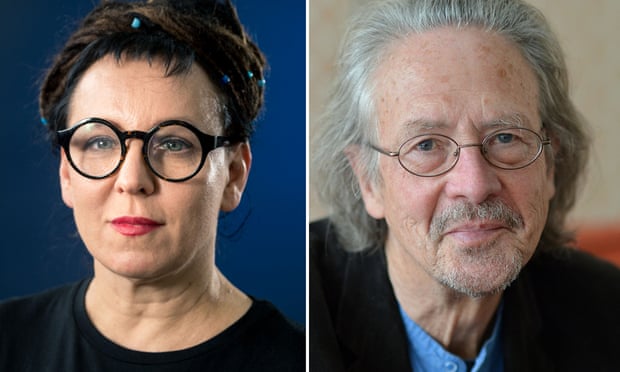
At the Swedish Academy in Stockholm on Thursday, the permanent secretary of the Swedish Academy Mats Malm announced Tokarczuk as 2018’s Nobel literature laureate, and Handke as 2019’s winner. Tokarczuk was cited by the committee for “a narrative imagination that with encyclopedic passion represents the crossing of boundaries as a form of life”, and Handke for “an influential work that with linguistic ingenuity has explored the periphery and the specificity of human experience”.Malm said both laureates had been informed of their win. Handke was at home, and Tokarczuk was on a reading tour in Germany and had to pull her car to the side of the road when she received the call.
Tokarczuk, an activist, public intellectual, and critic of Poland’s politics, is a bestseller in her native Poland, and has become much better known in the UK after winning the International Booker prize for novel Flights. The Nobel committee’s Anders Olsson said her work, which “centres on migration and cultural transitions”, was “full of wit and cunning”.
Handke is a more controversial choice. Olsson described the Austrian author as “one of the most influential writers of contemporary fiction, and part of the literary debate since 1966”, who “with great artistry explores the periphery and unseen places”.


