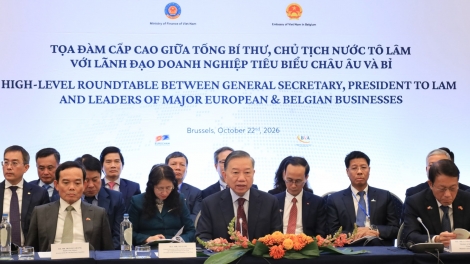



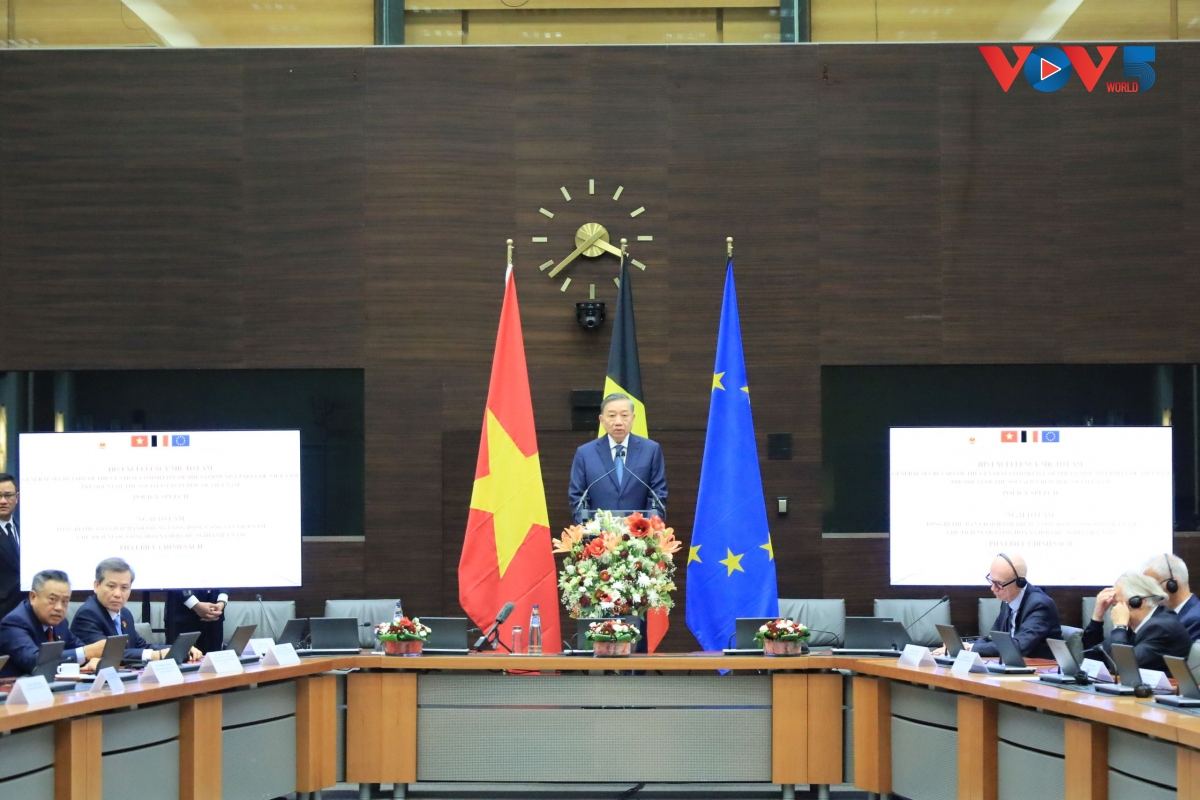
General Secretary and President Lam’s address is titled “Turning Vision into Action: From Political Resolve to a Model of Cooperation.” His first major message is recognizing the strategic shifts of the current era—a period of profound transformation that carries the risk of fragmentation while simultaneously opening new opportunities, with the European Union (EU) continuing to play a central, pioneering role. Second, the growing alignment in vision, values, and the concept of “strategic autonomy” between Vietnam and the EU—a solid foundation for both sides to advance further. Third, the identification of breakthrough strategic directions for Vietnam-EU relations, with the Vietnam-Belgium partnership serving as a key driver and a vivid testament to this cooperation.
According to the top Vietnamese leader, nations are currently living through a period in which the international order is undergoing a profound reshaping. Strategic competition among major powers has permeated every core structure—from the economy, trade, and supply chains to strategic technologies, artificial intelligence (AI), and data standards.
The emergence of policies centered on “economic security” or “de-risking” is creating new boundaries within technological ecosystems and production chains, pushing the world toward the serious risk of geo-economic fragmentation, top leader To Lam said. "Experience has shown that no single nation can address these global risks on its own. The strategic challenge lies in how to safeguard national autonomy while simultaneously contributing to building an international order that is fair, open, and based on the rule of law."
"This question requires a joint solution from both Vietnam and the EU. I believe that the more we engage in dialogue, the more we will realize that we share far more strategic common ground and core values than we have differences," he added.
According to the General Secretary and President Lam, in response to this challenge, Vietnam has adopted a guiding motto: "Self-confidence, autonomy, self-reliance, self-strengthening, and national pride." The underlying philosophy is that self-reliance and self-strengthening foster resilience and autonomy. Extensive international cooperation, meanwhile, expands the space for national development. On this journey, Vietnam seeks strategic, fair, balanced, and effective partnerships with international allies—among whom the European Union stands out as a premier partner.
General Secretary and President Lam affirmed that the emergence of the European Union serves as an inspiring lesson in the capacity to transcend history and embrace differences to forge a shared future—a philosophy that resonates deeply with the Vietnamese people.
He noted that, despite geographical distance and disparities in levels of development, Vietnam and the EU share a profound alignment across four strategic pillars: the convergence of both sides’ "strategic autonomy" and Vietnam’s ethos of self-reliance; a constructive perspective on new green standards (CBAM and EUDR); a commitment to fair, transparent, equitable, and mutually beneficial free trade and economic security; and the upholding of international law and maritime security (UNCLOS 1982).
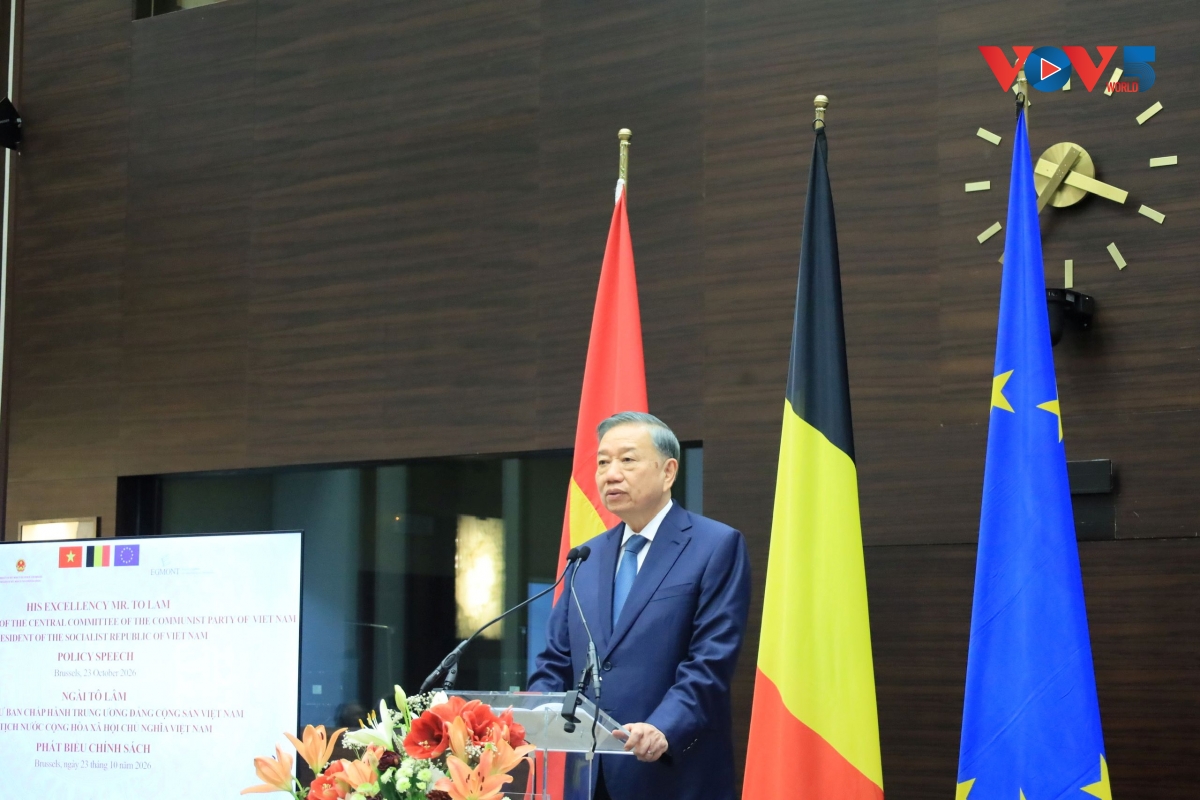
On this basis, General Secretary and President Lam proposed five areas for breakthrough strategic cooperation between Vietnam and the EU. First, elevating political trust and economic security. Second, institutionalizing economic, trade, and investment cooperation at a new, higher level. Third, achieving breakthroughs in science and technology, semiconductors, and innovation. Fourth, accelerating the green transition and a just energy transition. Fifth, strengthening the foundations for education, training, and people-to-people exchanges.
Concluding his address, the General Secretary and President highlighted a remarkable convergence between two sources of inspiration: the motto on the Belgian national coat of arms "Unity makes strength," and the teaching of President Ho Chi Minh "Unity, unity, great unity; success, success, great success."
This serves as a common denominator for the new era—unity in diversity, moving forward together while respecting differences—to jointly write a new chapter for peace and prosperity across both continents, he said.