






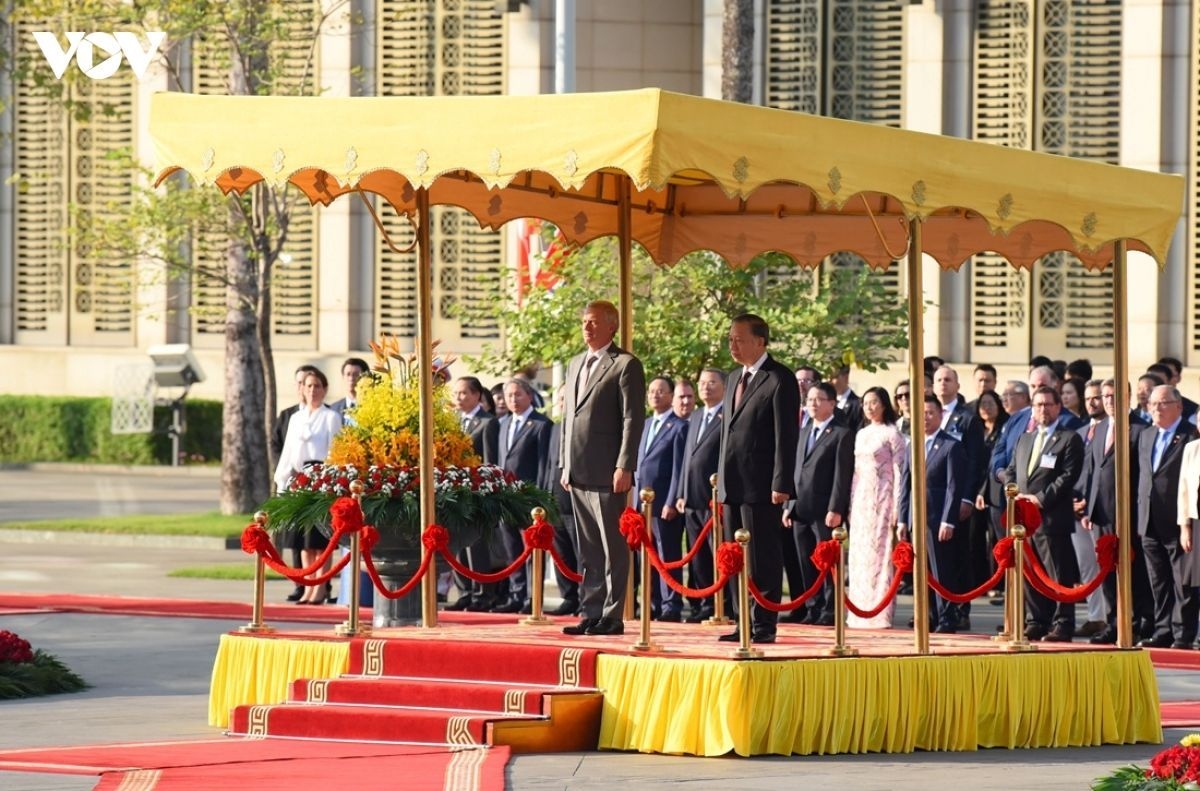
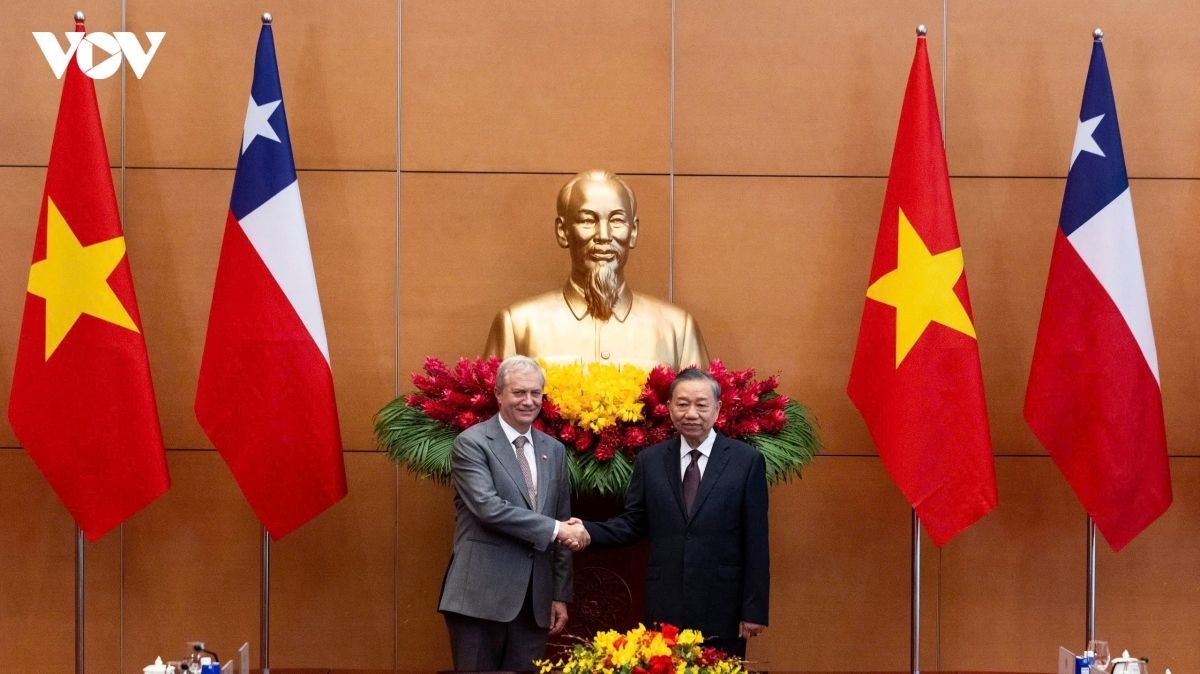
During the talks held following the welcome ceremony, General Secretary and President Lam and President Kast concurred that the relationship between Vietnam and Chile has reached a stage ripe for a new level of development, characterized by a higher degree of political trust and deeper, more substantive cooperation.
Both leaders decided to officially elevate the Vietnam-Chile relationship to a Strategic Partnership, and agreed to promptly develop an action plan to concretize and effectively implement six key pillars within this new framework.
They agreed to expand cooperation across high-potential sectors, including agriculture, national defense, security, critical minerals, finance and banking, the maritime economy, transportation, culture, tourism, education, and people-to-people exchanges. They also committed to advancing negotiations toward the signing of cooperation agreements in security, defense, finance, customs, and science and technology.
General Secretary and President Lam proposed that both sides enhance research, technology transfer, and the sharing of management expertise in areas such as smart mining, environmentally friendly deep mineral processing, green hydrogen production and storage technologies, and the development of solar and wind energy.
Regarding regional and global issues, both sides reaffirmed the importance of upholding the universality and integrity of the 1982 United Nations Convention on the Law of the Sea (UNCLOS).
They emphasized the resolution of maritime disputes through peaceful means, in accordance with international law, most notably the United Nations Charter. The two leaders further agreed to strengthen coordination within the United Nations and other multilateral organizations and forums.
Immediately following their talks, General Secretary and President To Lam and Chilean President José Antonio Kast met with the press to announce the outcomes of their discussions.
Also Monday afternoon, Chilean President José Antonio Kast met with National Assembly President Tran Thanh Man at the National Assembly House. The two leaders agreed on the importance of further strengthening mutual understanding and political trust through the exchange of delegations and contacts at various levels and channels.
They also emphasized the need to leverage existing bilateral cooperation mechanisms and continue refining a stable, favorable legal framework to facilitate cooperation between the two nations.



