







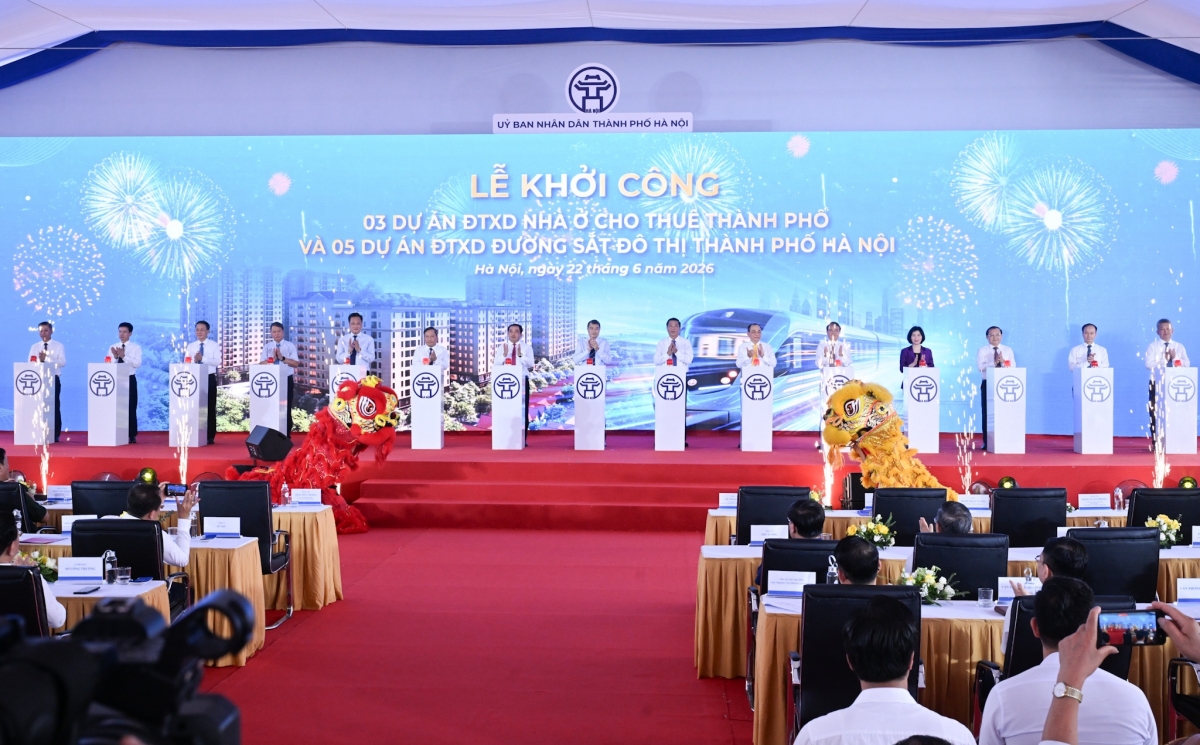
Prime Minister Le Minh Hung attended the ceremony, which was held at the main location of the rental housing project in Viet Hung ward, plus online connections in Long Bien ward and the Phap Van-Tu Hiep urban area.
The three rental housing projects are pioneers in Hanoi's rental housing development program. It marks the first step towards forming a large-scale rental housing market and a sustainable urban development model following the trend of major cities around the world.
Chairman of the Hanoi People's Committee, Vu Dai Thang, said, “The goal of Hanoi is to step by step establish a professional, high-quality, and affordable rental housing market, ease the pressure of home ownership at all costs, build a healthy, sustainable real estate market that aligns with international development trends. In the future, rental housing areas will be planned in conjunction with urban railway lines, employment centers, education, healthcare, and public services, creating modern, civilized, and convenient urban communities for residents.”

The urban railway projects include Metro Lines 1, 2, 8, 10 and 14.
Metro Line 1, spanning approximately 81 kilometers, will connect the Hung Vuong Stadium area with Ngoc Hoi, Hanoi Railway Station, Gia Lam and Noi Bai International Airport.
Metro Line 2, about 56.5 kilometers long, will run from Noi Bai International Airport through South Thang Long, Hoan Kiem Lake, Tran Hung Dao and Thuong Dinh to southern urban areas.
Metro Line 8, stretching roughly 91 kilometers, will serve as an east-west corridor connecting Hoa Lac Hi-Tech Park with logistics centers, industrial zones and key growth areas in eastern Hanoi.
Metro Line 10, approximately 43 kilometers in length, will link Co Loa, Vo Chi Cong, Ring Roads 3 and 2.5, and Times City, helping ease traffic congestion in densely populated areas.
Metro Line 14, extending about 32 kilometers, will connect northern Hanoi from Thang Long Bridge and Ciputra Hanoi through the city center to Ocean Park and eastern districts.
The lines are planned according to the TOD (Transit-Oriented Development) model, that centers around public transportation systems.


