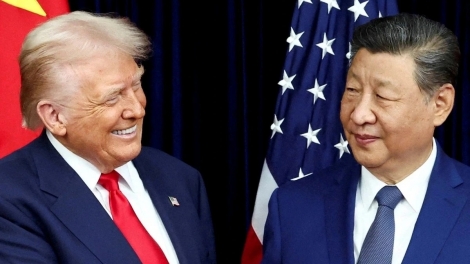




This will be President Trump’s first visit to China during his second term and just the second US-China summit in nearly a year, following the meeting last October in Busan, South Korea, on the sidelines of the APEC Summit.
Middle East hotspot
Planned and announced in the media since late last year, President Trump’s visit was initially expected to take place at the end of March. However, the expanding conflict in the Middle East following US and Israeli strikes on Iran on February 28 forced the US administration to delay the trip in order to focus on the conflict. Although the trip was postponed by a month and a half, Trump has not yet found a way out of the conflict, and the Middle East is expected to be one of the thorny issues discussed in Beijing.
Before the trip, President Trump repeatedly said China should get more involved in resolving the Middle East conflict. Observers predict that Trump will ask Chinese President Xi to use his influence with Iran to help reopen the Strait of Hormuz.
Ryan Hass, Director of the China Center at the Brookings Institution, said: “Both President Trump and Beijing have a shared interest in not seeing the conflict in Iran escalate or expand. I think both countries would like the war to end as soon as possible. It is not serving either country's interests.”
Hass said the US and China have different levels of concern about the Middle East conflict. While the US clearly wants to reach an agreement with Iran quickly, China appears less worried about a prolonged conflict because of its stronger position in security, energy, and supply chains. Whether Trump can persuade Xi to take more action in the Middle East is a big question.
Professor Alejandro Reyes of the Department of Politics and Public Administration at the University of Hong Kong says the US is not likely to resolve its tensions with Iran during Trump’s China visit. Although China and Iran have close economic and energy ties, their foreign policies are relatively independent. The biggest deadlocks between the US and Iran – the Strait of Hormuz and Iran’s nuclear development – are unlikely to be resolved through outside influence.
“I think the United States, and even Donald Trump, often overestimate the influence that China may have on its many partners around the world, including Iran. So the idea that Tehran would take notes from Beijing and do whatever Beijing wants it to do is not really an accurate way to understand that relationship,” said Reyes.
Establishing a cooperation and competition framework
Although the Middle East conflict could influence the US-China summit, most experts agree that the Russia-Ukraine conflict has shown that China won’t allow such a conflict to dominate its relations with the US.
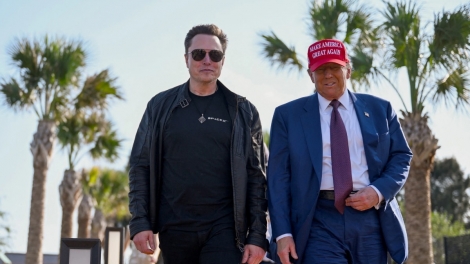
Henrietta Levin of the Center for Strategic and International Studies said the US business delegation accompanying President Trump to China, which will include Elon Musk, the CEO of Tesla and Space X, and Tim Cook, the CEO of Apple, shows that trade, investment, and technology will be top concerns of the meeting.
The meeting in Beijing may help to establish a more stable long-term framework for bilateral relations, and clarify the rules of cooperation and competition in key areas like semiconductors, artificial intelligence chips, and rare earths.
Levin said: “The US is focused on securing quick commercial wins at this upcoming summit. There is a lot of focus on getting China to promise to buy additional US agricultural products, especially soybeans. The US is looking for these quick economic wins that will be felt by certain communities in the US, ideally ahead of the November elections.”
The meeting between Trump and Xi is expected to strongly impact other global issues, from trade and tariff disputes to the management of strategic global supply chains and geopolitical competition in many regions.
Kenneth Quinn, former US Ambassador to Cambodia, said: “The relationship between China and the US is crucial not only for America and China, but also for the world. I believe the relationship is at a critical point in determining which direction we are going to go. There are forces pulling us apart, but there are also compelling needs that should be pulling us together.”
Overall, observers don’t have high expectations this summit will create any major breakthroughs. But, as Ryan Hass points out, the fact that the top leaders of China and the US continue to engage in direct talks is already meaningful for the world.