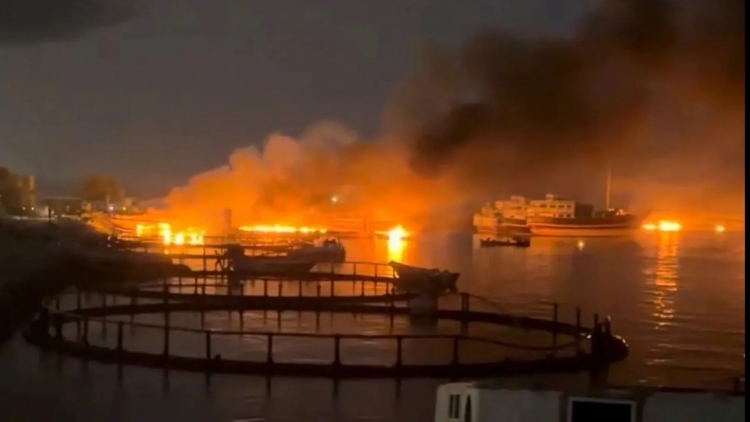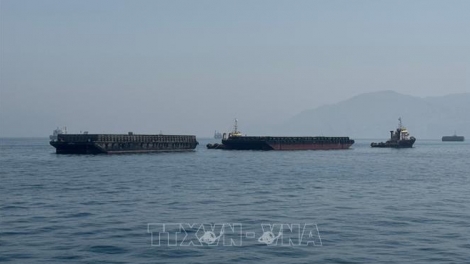




The US military launched a series of airstrikes against Iran on Wednesday under President Trump's orders, marking the second consecutive night of renewed large-scale attacks on Iran. Before that Iran attacked three commercial vessels in the Strait of Hormuz.
Conflicts resumes
The US launched new airstrikes almost immediately after Trump said at the NATO Summit in Ankara, Turkey, that the US-Iran ceasefire was over. The US Central Command (CENTCOM) said 170 Iranian military targets were hit in 2 days and warned that further military actions will follow if ordered by Washington.
The US said the airstrikes were retaliation for Iran’s attacks on commercial shipping in the Strait of Hormuz. Iran rejected the accusation, saying the US has violated the ceasefire agreement, and quickly retaliated with ballistic missile and drone attacks on US military bases in the region, including the headquarters of the US Fifth Fleet in Bahrain.
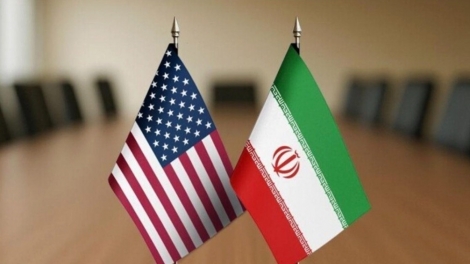
Although sporadic hostilities have continued since the US and Iran signed an MoU on June 17, the current violence is a return to full-scale conflict between the two countries. UN spokesman Stephane Dujarric said on Thursday: "The incidents that we have seen over the last 24 hours risk derailing the diplomatic progress achieved between the Islamic Republic of Iran and the United States. A return to full-scale hostilities would have a catastrophic consequences for the people of the region and for international peace and security and for the global economy as a whole."
Observers say the dispute continues to center on control of the Strait of Hormuz, one of the world's most important oil and gas shipping routes. Iran demands that commercial vessels follow designated routes and, in the long term, intends to impose transit fees. The US says freedom of navigation through the Strait of Hormuz is non-negotiable.
Renewed fighting between the US and Iran adds fresh uncertainty to the global financial and energy markets and weakens hopes of bringing inflation under control.
"Experts are telling us a fact that it's going to take several months, probably closer to a year to really get everything lined up again with regard to distribution, refinery operation, and transportation, even through an open Strait of Hormuz. Ultimately, I don't think the inflation picture is over. I expect it to be stickier, longer for higher as a narrative, and I expect that to be our foreseeable future," said Chris Brigati, Chief Investment Officer at the US financial services company SWBC.
Negotiating strategy
A key question is whether President Trump's declaration that the ceasefire is over is simply part of his now familiar negotiating strategy.
Many analysts believe the current situation is another example of the US strategy of "maximum pressure". Supporters of this view point out that Trump is sending "mixed messages". On one hand, he uses extremely harsh language against Iran's leadership, announces the end of the ceasefire, and orders airstrikes. On the other hand, at the NATO Summit in Ankara, he says negotiators "can continue talking if they want" and the airstrikes will be brief rather than another prolonged war.
The US seems intent on pressuring Tehran to make greater concessions and accept stricter conditions on its nuclear program within the 60-day timeframe set out in the MoU.
Most analysts believe this strategy is unlikely to succeed because the core disagreement is over control of the Strait of Hormuz, and the MoU leaves significant ambiguities on this issue.
"If you look at the text, the way it's written, that draft text suggests that there is room for the Iranians to claim sovereignty and even potentially impose service fees for free passage, which is something that Gulf states and the US find unacceptable. Iran still has a lot to meddle with when it comes to how, when, and to what extent they will open up the Strait of Hormuz, under what conditions," said Dr. Andreas Krieg, Associate Professor at the School of Security Studies at King's College London.
With both sides maintaining a firm position, the role of mediating countries like Pakistan, Qatar, and Egypt will be crucial to any hope of reviving the agreement.