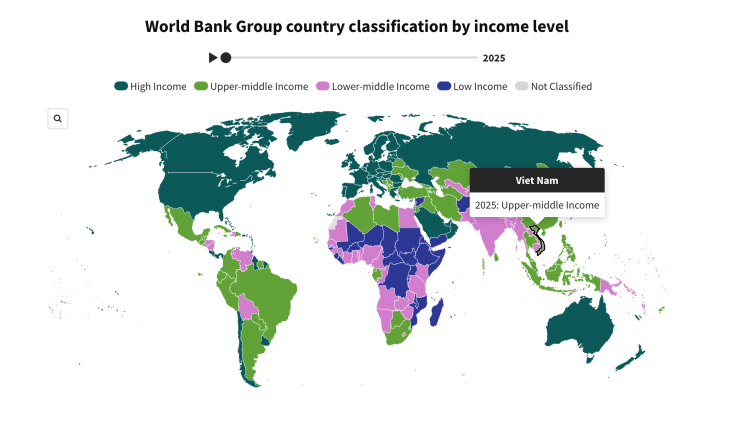




From a poor, war-ravaged country with a per capita income of only a few hundred US dollars in the early 1990s, Vietnam has surpassed the threshold of 4,636 USD to enter the upper-middle-income group.
The achievement has been attributed to Vietnam’s doi moi (renewal) process, deep international integration, and stable political and social environment, and the economic development efforts of the Vietnamese business community and people.
A stable economy
Although the global economy remains unstable, Vietnam has maintained strong economic growth, kept inflation under control, and steadily improved people's incomes. These achievements show the effectiveness of a development strategy that makes stability the foundation and reform the driving force. Institutional reforms have been pursued with strong determination, a factor that has been rewarded by international investors.
Max-F. Scheichenost of the Private Capital Investment Development Organisation, an investor who has studied the Vietnamese market for many years, said: “I think the biggest change that I see is also the mindset shift. The mindset shift is like now when we work, like with the policymakers and with the people who are working on the implementation of the decrees, there's a lot of listening. There's a lot of inviting international experts. Especially in the last one to two years, we've seen a dramatic change. But now it's our role to communicate this message regionally and globally because we have to inform and bring the awareness to international investors that Vietnam is getting more and more modern, Vietnam is having like a pro-business stance.”
Scheichenost's assessment reflects investors’ interest in market size, quality of governance, and capacity for reform. Transparent policies, open governance, and greater attention to businesses’ views strengthen investor confidence. That confidence will help Vietnam attract more high-quality investment, advanced technologies, and bigger added-value projects.
However, becoming an upper-middle-income country is just the beginning of a new stage of development with higher expectations for the quality of economic growth. As the advantage of low-cost labour wanes, future growth must come from innovation, technology, digital transformation, labour productivity, and the quality of human resources. And economic growth must go hand in hand with sustainable development, social welfare, and improvements in people's quality of life. This development vision has been consistently mentioned by Vietnamese leaders at international forums.
Warrick Cleine, Chairman and CEO of KPMG Vietnam, said: “I was very fortunate to spend a week in London with the General Secretary last year, one of his first big overseas. He made a policy speech at Oxford, you can read it online. And it really sets out what he thinks developed status by 2045 means. And it's a lot more than GDP. It is about the quality of life of the people. It's about governance. It's about having a digital economy, an industrialized economy, improvement in material, but hopefully also, if it's done right, an improvement in quality of life and an improvement in lifespan, another great measure of developed countries.”
From milestone to development aspiration
With one of the world's largest populations but an economy that has yet to match its demographic strength, Vietnam has a chance of breakthrough growth if it continues to accelerate reforms, improve labour productivity, and harness new growth drivers.
Businessman Mai Huu Tin said: "Vietnam’s population ranks 16th in the world, placing it among the largest countries globally. However, its economic size ranks only 32nd. This means Vietnam has considerable room to expand its economy to match its population. If we can move quickly during this period and overcome the middle-income trap, Vietnam could become one of the world's top 20 economies."
Vietnam's demographic advantage will become a real strength only if it is translated into higher productivity, better-quality human resources, and stronger innovation. These are the key conditions for Vietnam to escape the middle-income trap, moving up the global value chain, and realising the goal of becoming a high-income developed country by 2045.