



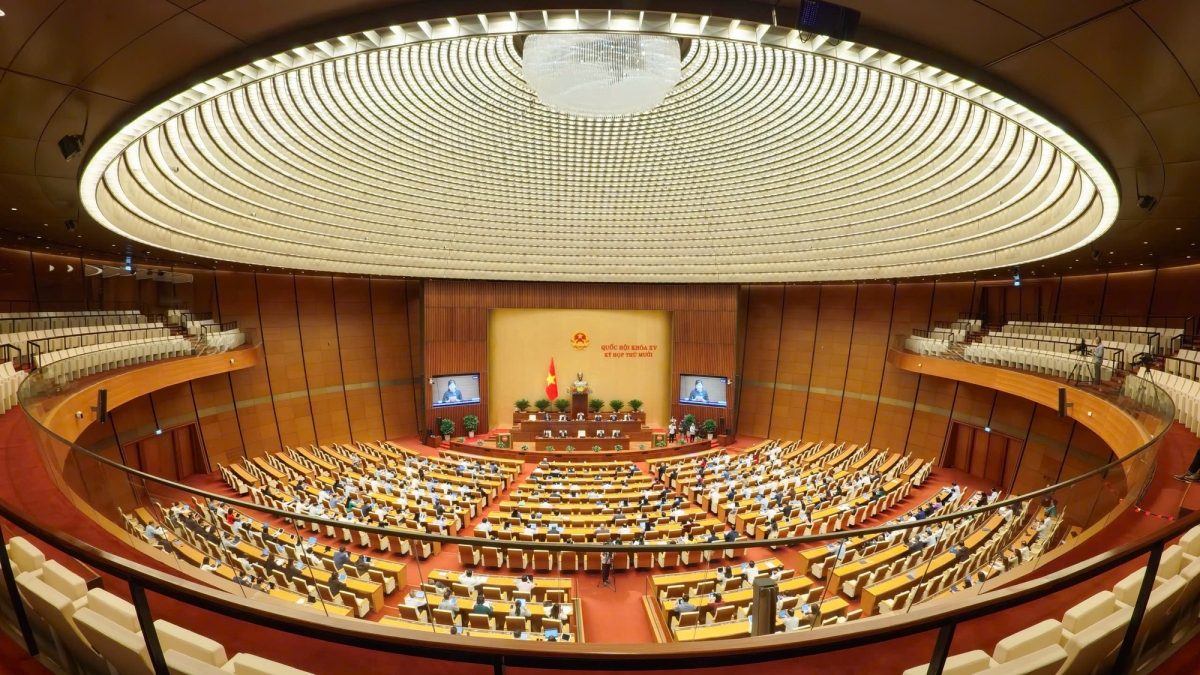
The National Assembly is scheduled to debate and pass 43 laws and two resolutions and a range of important issues concerning socio-economic development, the state budget, and oversight.
Reforming legislative thinking, addressing practical issues
At meetings with National Assembly deputies, voters acknowledged the National Assembly’s efforts to improve the legislative process.
“Following the adoption of numerous laws and resolutions at an earlier extraordinary session, the National Assembly will consider and pass another 43 laws and resolutions at this session. This is a very rapid pace of work by the legislature to establish a legal framework for the Government and state agencies to operate effectively,” Pham Thi Loi, a Ho Chi Minh City resident, said.
Party General Secretary and President To Lam, a member of the Hanoi National Assembly delegation, said the legislative process needs to be reformed toward development goals. “The overarching principle is to make significant shifts in our thinking. Laws must not serve merely as tools of management. They must foster development and create favorable conditions for people, businesses, and the system.”
Land policy remains one of the key issues of voter concern. Land regulations directly affect people’s lives, and the implementation of investment projects and infrastructure development.
“There will be coordinated amendments to laws covering land, housing, real estate business, investment, public investment and the state budget. We will address these issues comprehensively,” Prime Minister Le Minh Hung, a member of the Hai Phong National Assembly delegation, said.
Ensuring decisions meet voters’ expectations
Voters are also looking to the National Assembly to address issues related to the private sector, administrative reform, digital transformation, and the two-tier local government model.
“Voters expect continued investment in technical infrastructure and technology to ensure that data systems, including population and land databases, are consistently interconnected and integrated. They also expect administrative reform and digital transformation to be effectively implemented, making procedures easier for citizens and businesses and reducing the workload for officials and civil servants,” Ha Thi Nga, Vice President and Secretary-General of the Vietnam Fatherland Front, said.
Policy effectiveness should be measured by results and the tangible benefits delivered to the public.
“Voters are concerned about issues directly affecting their families and communities, and also give opinions on broader provincial and national matters. Their expectations are clear – policies and guidelines must be clear and grounded in reality. Most importantly, policy implementation must bring about genuine, verifiable benefits for the people,” Doan Minh Huan, President of the Ho Chi Minh National Academy of Politics and a member of the Nghe An National Assembly delegation, said.
Voters expect the upcoming National Assembly session to address their concerns, resolve difficulties, create fresh momentum for development, and ensure that people genuinely benefit from policies.