(VOVWORLD) - The world enters 2026 amid growing uncertainties and concerns deriving from geopolitical tensions, trade disputes, and the climate crisis. At the end of 2025, many economic and financial institutions forecast slower global growth in 2026, while noting there is still room for breakthroughs driven by AI technology.
 Ukrainian President Volodymyr Zelensky (Photo: REUTERS/Stephanie Lecocq) Ukrainian President Volodymyr Zelensky (Photo: REUTERS/Stephanie Lecocq) |
Geopolitical tensions
On December 23, 2025 Ukrainian President Volodymyr Zelensky announced a 20-point peace plan that Ukraine, the United States, and several European countries had negotiated for weeks to end the Russia-Ukraine conflict. The future of this plan, the implementation of phase two of the Gaza peace plan, and developments in US-Venezuela tensions will be key factors in determining whether geopolitical tensions will continue to dominate the global political and economic landscape in 2026.
In its 2026 outlook released in last month, experts from the UK Royal Institute of International Affairs (Chatham House) said global security would remain under significant pressure due to prolonged conflicts in several regions. Neil Melvin, Director of International Security at the Royal United Services Institute (RUSI), a prominent UK think tank, said global geopolitical instability, an ongoing trend since the Arab Spring in 2010, will continue to 2026.
“I think what you can see is the very worrying trend, which is starting to bring the major powers into more direct confrontation. So this is the really sort of worrying movement now, that we see playing out in different regional theatres, but also at the global level,” said Melvin.
Geopolitical instability was mentioned prominently in global growth forecasts by international organizations. In its World Economic Outlook released last December, the Organisation for Economic Co-operation and Development (OECD) projected global growth of around 2.9% in 2026, down from about 3.2% in 2025, though it could rebound to around 3.1% in 2027. In mid-October, the International Monetary Fund (IMF) also issued a cautious forecast of 3.1% global growth in 2026.
These reports mentioned common risks, including the continued impact of tariffs on global trade and growth in major export-dependent economies and uncertainty rising from geopolitical instability.
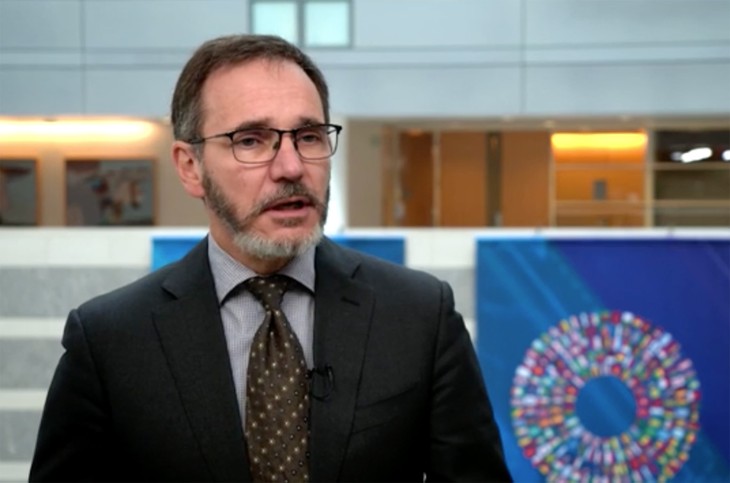 Pierre-Olivier Gourinchas, Director of the IMF’s Research (Photo: IMF/REUTERS) Pierre-Olivier Gourinchas, Director of the IMF’s Research (Photo: IMF/REUTERS) |
However, not all outlooks are pessimistic. The technology boom, especially AI, could be a game changer. Pierre-Olivier Gourinchas, Director of the IMF’s Research, said that a few important developments could quickly brighten the outlook.
“First and foremost, resolving policy uncertainty with clearer bilateral and multilateral trade agreements and lower tariffs can help boost output in the near term. Second, AI has the potential to increase productivity. Many of us are already using it and we can attest to its benefits,” he explained.
Questions surrounding AI
AI is widely seen as a major driver of national economic growth and global trade flows. However, people have also raised a number of questions over AI development, governance, and its real economic benefits.
 OpenAI logo (Photo: REUTERS/Dado Ruvic) OpenAI logo (Photo: REUTERS/Dado Ruvic) |
The term “AI bubble” may become a lingering concern for companies and countries in 2026. According to Carl-Benedikt Frey, Associate Professor on AI and Work at the UK’s Oxford Internet Institute, with signs of a slowdown or decline in AI adoption among certain firms, the key question in 2026 is whether this trend will continue or AI use will rebound.
It's absolutely possible for AI to be a wonderful technology, just like airlines, but also be an unprofitable industry because of vigorous competition, Frey said. “And we're now seeing very vigorous competition, especially from open source models developed in China, which are likely to push down returns. And so the question is, will 2026 be the year of the AI bust in financial terms? And what then happens to the technology if then the bubble bursts?”
The climate crisis is another major factor that could shape the world in 2026. Last year, global economic losses from extreme weather events reached about 135 billion USD, not including loss of life. Experts warn that failing to take weather-related risks into policymaking could make countries increasingly vulnerable.
Ana Yang, Director of the Environment and Society Programme at Chatham House, said global climate policy is gradually shifting from emissions reduction toward adaptation. This trend was also widely discussed at the 30th UN Conference on Climate Change (COP30), held in Brazil last November.
 Emily Theokritoff, a researcher at the UK’s Grantham Research Institute on Climate Change and the Environment (Photo: REUTERS) Emily Theokritoff, a researcher at the UK’s Grantham Research Institute on Climate Change and the Environment (Photo: REUTERS) |
Emily Theokritoff, a researcher at the UK’s Grantham Research Institute on Climate Change and the Environment, said, “But it's also necessary to reduce emissions to make sure that these events don't become worse, because there are also limits to adaptation. So I think also we experienced events where there were signs that no matter how prepared you are, it's really hard to avoid some of these negative impacts.”
Overall, observers believe that the main trends of 2025 will continue to shape 2026. The outcomes will depend largely on each country’s policy adjustments and the reform of multilateral systems.