(VOVWORLD) -Global trade in 2025 has faced the most severe challenges in decades from tariffs and geopolitical tensions. It has shown considerable resilience, however, and recorded stronger growth than expected.
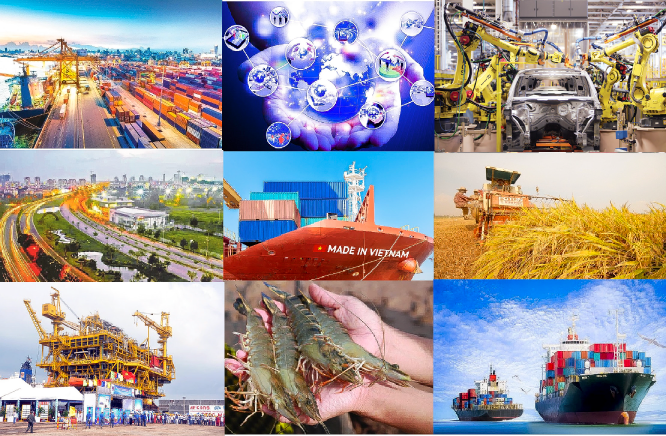 (illustrative photo by kinhte.vn) (illustrative photo by kinhte.vn) |
The WTO’s annual Trade Monitoring Report released on December 3 said global trade in 2025 has confronted the most serious challenges in 80 years, driven by unilateral tariff policies and escalating global geopolitical tensions.
Major challenges
The WTO report said that from mid-October 2024 to mid-October 2025, the value of trade affected by new tariffs and other import measures expanded more than fourfold to about 2.6 trillion USD. Bilateral trade measures, principally tariff increases, have affected 19.7% of world imports, compared to just 12.6% a year earlier. Including similar measures on exports, the total trade affected was worth about 3 trillion USD, more than three times the 888 billion USD of the previous report.
WTO Director-General Ngozi Okonjo-Iweala said developments in the first half of 2025, particularly following US President Donald Trump’s imposition of reciprocal tariffs, represented the greatest challenges to global trade in 8 decades. In June, the WTO warned that a full-blown trade war could divide the global economy into rival blocs and slash worldwide growth by 7% in the long term.
This worst-case scenario was avoided when the US negotiated new trade agreements with many countries. The US and China, the world’s two largest economies, agreed to suspend their trade war for a year. WTO economists estimate that world merchandise trade grew 2.4% in 2025. On December 9, the UN Conference on Trade and Development (UNCTAD) forecast that global trade in goods and services would surpass 35 trillion USD for the first time this year.
Sharp fluctuations continue to raise questions about the need to reform multilateral trade systems, with the WTO as a central pillar. Ms. Okonjo-Iweala said, “The US has some understandable and legitimate concerns about the WTO and the multilateral trading system. Other members, developed and developing, also have concerns of their own. Maybe we could use today's concerns to change the system for the better.”
The WTO noted that 72% of global trade is still conducted under the Most-Favoured-Nation (MFN) mechanism. Alongside rising trade protectionism, WTO members and observers have stepped up new trade facilitation measures. During the latest review period in December, WTO members and observers introduced 331 trade facilitating measures covering an estimated trade value of 2.1 trillion USD, 1.5 times the 1.4 trillion USD of the previous report.
2026 outlook
The WTO, UNCTAD, and other economic organizations have offered cautious assessments of global trade prospects next year. WTO senior economist Marc Bachetta said policy uncertainty remains a significant destabilizing force in global trade. This uncertainty, particularly among major trading powers, is a key concern for the outlook for 2026. . The WTO forecasts that world merchandise trade growth will be 0.5% in 2026. UNCTAD also predicts weaker growth next year due to a slowing global economy, rising debt, and persistently high trade costs.
However, some positive factors could reshape the global trade landscape, particularly a strong rise in demand for AI products. According to the WTO, demand for AI related products increased 20% in the first half of 2025, accounting for nearly half of global trade growth despite accounting for only 10% of total merchandise trade.
Johanna Hill, Deputy Director-General of the WTO, said, “AI offers a bright spot for trade in an increasingly complex global environment. It opens new opportunities to lower trade costs, boost productivity and expand participation in global markets. Secondly, and most importantly, the potential of AI to drive inclusive growth will only be realized if we act deliberately by closing the digital divide."
UNCTAD’s December 9 report said global trade growth this year has been driven mainly by higher transaction volumes, reflecting stable demand, rather than inflationary price increases.
The shift of trade toward politically and geographically closer partners is reshaping global trade chains, most notably in East Asia, which recorded export growth of 9% and intra-regional trade growth of 10% this year. Africa and South–South trade saw strong recoveries, underscoring the growing role of emerging economies in global trade.