(VOVWORLD) -Vietnam and China held the first ministerial-level Strategic Dialogue among their foreign affairs, defense and public security ministries, known as the “3+3 Dialogue,” in Hanoi on Monday.
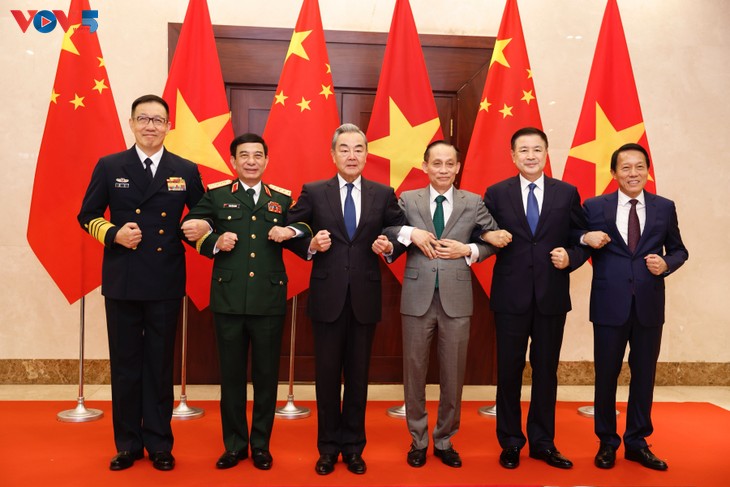 From left to right: Chinese Defense Minister Dong Jun, Vietnamese Defense Minister Phan Van Giang, Chinese Foreign Minister Wang Yi, Vietnamese Foreign Minister Le Hoai Trung, Chinese Public Security Minister Wang Xiaohong, and Vietnamese Public Security Minister Luong Tam Quang, pose for a group photo in Hanoi on March 16, 2026. Photo: VOV From left to right: Chinese Defense Minister Dong Jun, Vietnamese Defense Minister Phan Van Giang, Chinese Foreign Minister Wang Yi, Vietnamese Foreign Minister Le Hoai Trung, Chinese Public Security Minister Wang Xiaohong, and Vietnamese Public Security Minister Luong Tam Quang, pose for a group photo in Hanoi on March 16, 2026. Photo: VOV |
The meeting was co-chaired by Vietnam’s Minister of Foreign Affairs Le Hoai Trung, Minister of National Defense Phan Van Giang, and Minister of Public Security Luong Tam Quang, and Chinese Foreign Minister Wang Yi, Minister of National Defense Dong Jun, and Minister of Public Security Wang Xiaohong.
In his opening remarks, Foreign Minister Trung said, “This is the first 3+3 mechanism of both Vietnam and China with other countries, reflecting the extremely special and unique relationship and high level of trust, the close strategic bond between the two Parties and two countries. It is in line with the new level of the Vietnam-China comprehensive strategic partnership and shared future, and has strategic significance."
"As the Vietnam-China relations maintain positive and favorable momentum, bilateral cooperation mechanisms have been more comprehensive and diverse, demonstrating high trust and substantive cooperation. The "3+3" Strategic Dialogue will create momentum for the two Parties and two countries to strengthen cooperation, enhance solidarity, and jointly respond to global challenges in the new context,” Mr. Trung added.
The Vietnamese ministers proposed that the Ministries of Foreign Affairs, National Defense, and Public Security of both countries contribute to strengthening political trust and take the lead in implementing the high-level common perceptions. They stressed the need to effectively carry out high-level contacts and exchanges between the two Parties and countries, capitalize on cooperation mechanisms and strengthen specialized cooperation.
The ministers called for jointly promoting substantive cooperation in economics, trade, investment, strategic infrastructure, and science and technology. They agreed to coordinate and support each other in United Nations peacekeeping operations, international search and rescue, and humanitarian activities, as well as regional cooperation forums and activities.
The Chinese ministers agreed to closely coordinate to effectively implement the high-level common perceptions, maintain regular exchanges between their respective agencies on the situation of each Party and country, as well as the global and regional situation, and ensure the maintenance of political security. They urged for in-depth cooperation in defense, security, law enforcement, cross-border crime prevention, and high technology, multilateral coordination and effective response to traditional and non-traditional security challenges.
At the event, both sides agreed to strengthen solidarity and cooperation, consolidate political trust, and work together with the international community to address common security and development challenges in accordance with international law and the United Nations Charter. The ministers of both countries emphasized the importance of appropriately handling, controlling, and better resolving maritime issues, in line with the friendly relations between the two countries and international law, creating a peaceful and stable environment for the development of each country and the region.