(VOVWORLD) - If you’ve ever stood on a street corner in Hanoi during rush hour, surrounded by a sea of motorbikes, you’ve felt the pulse of Vietnam’s economy. But beneath that pulse is a sobering reality. Every year, 2,000 young lives are lost in traffic accidents in Vietnam, according to the WHO. Today, we’re looking at a new Hanoi initiative - a collaboration between the Swedish Embassy, helmet maker Protec, and Trung Yen Primary School - to make sure that every child who leaves for school in the morning returns safely in the afternoon.
 Representatives of the Swedish Embassy, helmet maker Protec, and teachers and students of Trung Yen Primary School at the launch ceremony for the “Traffic Safety 2025 – Safer Helmets, Safer Kids” campaign (Photo: Swedish Embassy in Vietnam) Representatives of the Swedish Embassy, helmet maker Protec, and teachers and students of Trung Yen Primary School at the launch ceremony for the “Traffic Safety 2025 – Safer Helmets, Safer Kids” campaign (Photo: Swedish Embassy in Vietnam) |
For some, a motorbike helmet is a hassle, worn mostly to avoid fines. But the educators at Trung Yen Primary School see a motorbike helmet as something much more important - the safeguard of a child’s future.
Ms. Mai Trang, a teacher at the school, told me that safety has become second nature for her. “I always wear a helmet, and so does my 4-year-old, even for a short distance. A helmet helps protect lives and reduce injuries while abiding by the law.”
That phrase “even for a short distance” is crucial. “Approximately 52% to 69% of all accidents occur within 1.6 to 8 km of a person’s home…Because we feel safe in our own neighborhoods, we often leave our helmets on the hook for ‘quick trips,’” reports by the Vietnamese-German Transport Research Centre and AIP Foundation have found.
 Representatives of the Swedish Embassy present helmets to students of Trung Yen Primary School. (Photo: Swedish Embassy in Vietnam) Representatives of the Swedish Embassy present helmets to students of Trung Yen Primary School. (Photo: Swedish Embassy in Vietnam) |
The inspiration for the new program comes from half a world away, Sweden. Since 1997, they’ve followed a principle they call "Vision Zero,” which envisions zero traffic deaths or serious injuries.
Since its official adoption by the Swedish Parliament in 1997, the "Vision Zero” policy has transformed Sweden into one of the safest in the world. Between 1997 and 2021, road deaths in the country fell 60%, despite a significant increase in the number of vehicles and miles driven. In many years, Sweden recorded zero traffic deaths for children under the age of seven, according to Sweden’s Folksam Insurance Group.
Those numbers speak for themselves. But as Swedish Ambassador to Vietnam Johan Ndisi reminds us, technology is only one piece of the puzzle.
"I think it's a combination. There's not one thing that can fix the problem. You have to have the laws, you have to have the technology, but also you have to have the environment where you discuss and ensure that we take care of each other. Like we're doing today to teach the children they need to wear a helmet, and make sure the parents also understand their children need helmets. Everyone has a role. There's no one thing that will fix it, it's a combination, like in many things."
"Work together. The most valuable thing we have in society is our children and their safety and health, so we should all do all we can to ensure they stay safe and healthy," said the Swedish Ambassador.
But how do we bridge the gap between theory and practice? That’s where parents like Tran Thien Toan come in. Toan represents Trung Yen Primary School’s parents, and he’s a big advocate for safety standards over style when it comes to motorbike helmets.
“A standard helmet protects the head and minimizes the rate of traumatic brain injury. Standard helmets are usually made of ABS plastic with a foam layer inside to absorb impact. Parents should be role models for their children and always wear a helmet that meets safety standards,” said Toan.
He cited some surprising data from the WHO to drive his point home: wearing a standard helmet reduces head injury rates by 70% and lowers the risk of death by 40%.
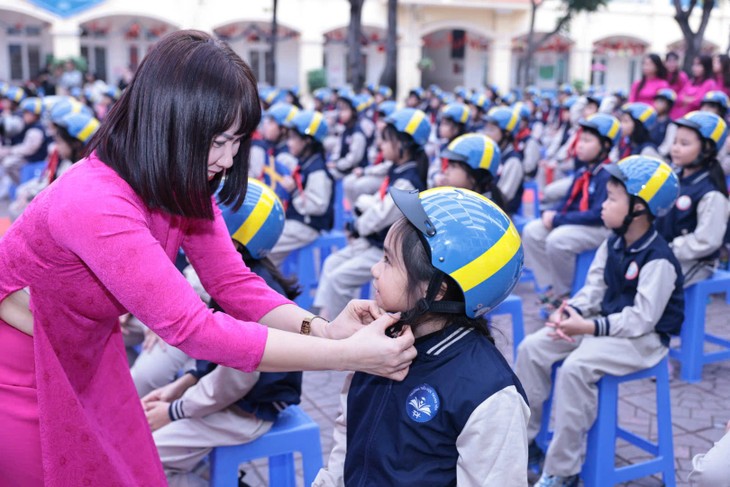 A teacher at Trung Yen Primary School shows a student how to wear a helmet properly. (Photo: Swedish Embassy in Vietnam) A teacher at Trung Yen Primary School shows a student how to wear a helmet properly. (Photo: Swedish Embassy in Vietnam) |
The message is starting to get through. Ten-year-old Nguyen Minh Hieu, one of the kids who received new Protec helmets, understands the stakes. "I think wearing a standard helmet is necessary because it keeps children safer in traffic. It can reduce the risk of a fatal traumatic brain injury by half."
Eight-year-old Nguyen Thuy Chi has turned safety into a personal routine. “The program taught me how to wear a helmet correctly to avoid injury. Before I go to school, I put on my helmet and look in the mirror to adjust it properly. My message to my classmates is simple: ‘Everyone, please wear your helmet the right way and don’t forget to wear it!’”
400 helmets have been handed out to the students at Trung Yen Primary School. That’s 400 commitments to a healthy future. As Vietnam’s streets become busier, this program reminds families that no journey is too short for proper safety precautions.
By combining strict safety laws, smart tech, and a commitment from parents to set a good example, Sweden’s "Vision Zero" can become a Vietnamese reality.