(VOVWORLD) - Located in My Long ward, An Giang province, Hai Ba Trung-Nguyen Hue Pedestrian Street is a dynamic recreational venue and an important communal space for local residents. It has become one of the most attractive destinations in the area.
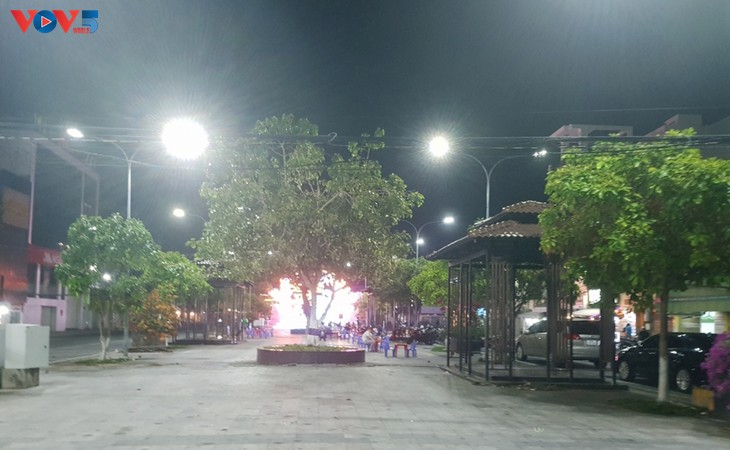 A corner of Hai Ba Trung-Nguyen Hue Pedestrian Street (Photo: Ngoc Anh) A corner of Hai Ba Trung-Nguyen Hue Pedestrian Street (Photo: Ngoc Anh) |
On weekends and during holidays, especially the Lunar New Year Festival (Tet), the pedestrian street comes alive with high-energy street art, music and dance performances, and shopping.
The street, which stretches one kilometer and is 20 meters wide, is paved with natural stone and equipped with a LED lighting system. Along the route are relief sculptures evoking historical moments, a lake with decorative fountains, and rest pavilions in the style of traditional southern Vietnamese houses.
One notable feature is a bodhi tree planted in 2011 by Venerable Huyen Dieu, Secretary General of the World Fellowship of Buddhists. The tree was brought from Bodh Gaya in India’s Bihar state, where the Lord Buddha attained enlightenment more than 2,500 years ago.
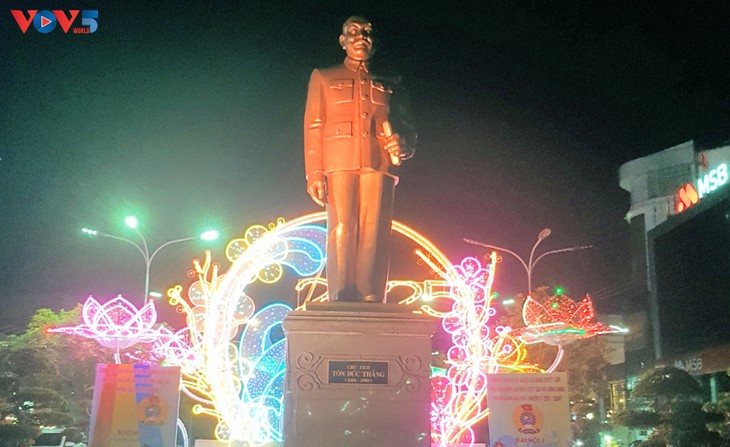 The statue of President Ton Duc Thang (Photo: Ngoc Anh) The statue of President Ton Duc Thang (Photo: Ngoc Anh) |
Another landmark of the pedestrian street is a statue of Ton Duc Thang (1888–1980), the first President of the Socialist Republic of Vietnam and an outstanding son of An Giang province.
“The Ton Duc Thang statue is a popular photo spot. Young people visit the pedestrian frequently because there are music programs, festivals, and photo exhibitions,” said Nguyen Thanh Trung, a local resident.
Tran Dinh Thien, another local resident, said, “The street has plenty of greenery. In the evening, the lights sparkle beautifully. Along both sides of the street are cafés and restaurants, making the area very lively. Fireworks are set off near the Ton Duc Thang statue on New Year’s Eve.”
Hai Ba Trung-Nguyen Hue Pedestrian Street attracts lots of visitors with its street food area, which has the rustic charm of a countryside market. Local specialties include pancake, palmyra palm rice cakes, beef shank, squid, spring rolls, and sugarcane juice. Visitors can take part in traditional folk games such as clay pot smashing, sack jumping, ring tossing, and human chess.
“The pedestrian street is spacious, with are many restaurants and cafés. On Saturday and Sunday evening, there are music and dance performances,” said a female tourist from Hanoi.
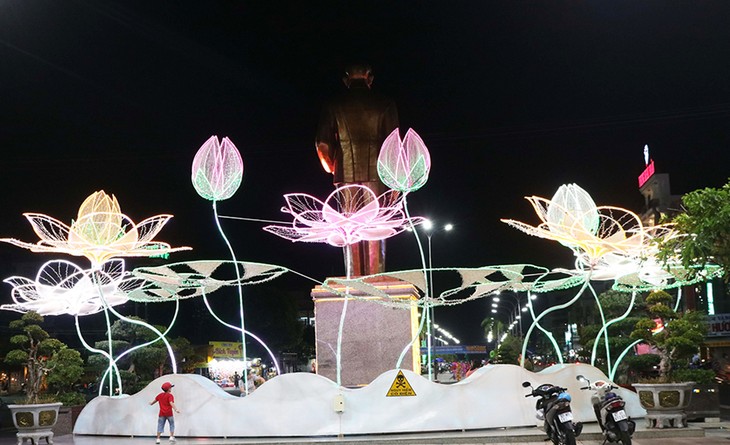 The LED lights are stylized into lotus bunches of various colors. (Photo: baoangiang.com.vn) The LED lights are stylized into lotus bunches of various colors. (Photo: baoangiang.com.vn) |
Tourists can combine their visit to the pedestrian street with sightseeing at nearby attractions like Nguyen Du lake, Long Xuyen cathedral, Long Xuyen floating market, An Giang museum, and Quang Te pagoda.
“This street is open round the clock. During Tet, flower markets and fireworks displays are organized. On major holidays, there are painting exhibitions, fairs, and music and dance performances that attract large numbers of visitors,” said Cafe owner Hinh Van Hung.
Chuong Tran Bao Huy, a local resident, said, “It’s clean and beautiful here, a great place to exercise. In the morning, people come here to jog and work out. In the afternoon, they kick the shuttlecock, roller skate, and play volleyball and badminton.”
Hai Ba Trung–Nguyen Hue Pedestrian Street showcases a lively, modern urban lifestyle while preserving the culture of Vietnam’s southwestern region.