(VOVWORLD) - The National Election Council is expected to announce on Saturday the official results of the elections for the 16th National Assembly and People’s Councils at all levels for the 2026-2031 term. The election saw a turnout of 99.68%, demonstrating that citizens fully exercised their right to nominate, select, and elect qualified representatives. Among the voters were 27 million religious followers, about 27% of the population, showing the engagement of religious communities in national affairs.
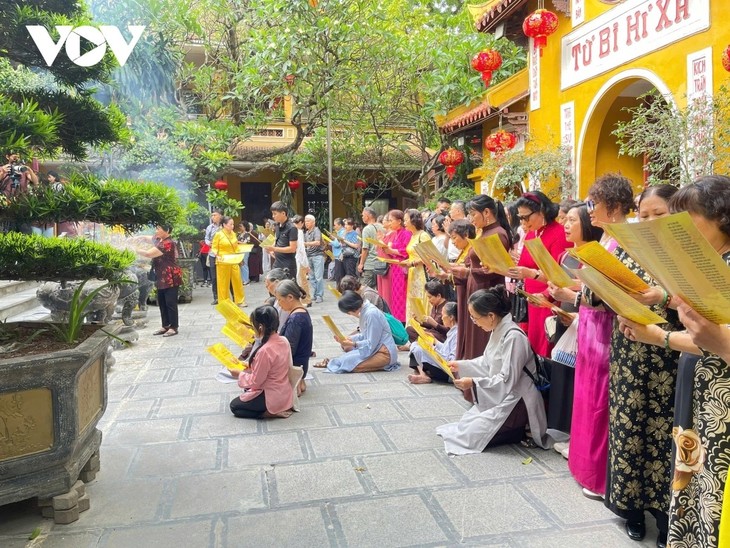 Numerous Buddhists attend the Buddha's Birthday celebration in the year 2569 of the Buddhist calendar - 2025 of the Gregorian calendar. (Photo: VOV) Numerous Buddhists attend the Buddha's Birthday celebration in the year 2569 of the Buddhist calendar - 2025 of the Gregorian calendar. (Photo: VOV) |
According to the 2023 White Paper “Religions and Religious Policies in Vietnam”, Vietnam has 43 State-recognized religious organizations from 16 religions with more than 27.7 million followers.
Vietnam’s 5 major religions – Buddhism, Catholicism, Protestantism, Caodaism, and Hoa Hao Buddhism – each has more than 1 million adherents.
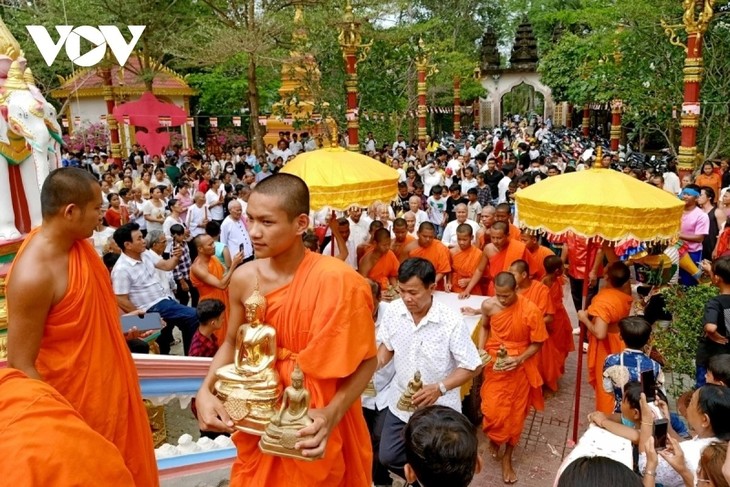 New Year's welcoming ceremony of Khmer Buddhists in Tra Vinh. (Photo: VOV) New Year's welcoming ceremony of Khmer Buddhists in Tra Vinh. (Photo: VOV) |
People’s right to mastery protected
In early March, the Ministry of Ethnic and Religious Affairs issued an official dispatch to provincial and municipal People’s Committees urging for strengthened election communications among religious and ethnic minorities to ensure a fair, democratic, and law-abiding electoral process. The dispatch asked for favorable conditions for people to fully exercise their right to elect capable and virtuous representatives.
K’Len, a Catholic resident of K’Long village in Lam Dong province, said: "Most parishioners went to vote after attending church services. They were well-informed of the Party and State guidelines and excited to exercise their civic rights."
Under the revised Law on Election of Deputies to the National Assembly and People’s Councils, all Vietnamese citizens aged 18 and above, regardless of religious belief, have the right to vote, and those aged 21 and above are eligible to stand for election.
The candidate list for the 16th National Assembly and People’s Councils for the 2026-2031 term reflects diversity, including dignitaries and clergy from Buddhism, Catholicism, Protestantism, Caodaism, and Hoa Hao Buddhism. Their candidacy demonstrates equality of political rights. If elected, they will represent their religious communities and contribute to lawmaking and national decision-making.
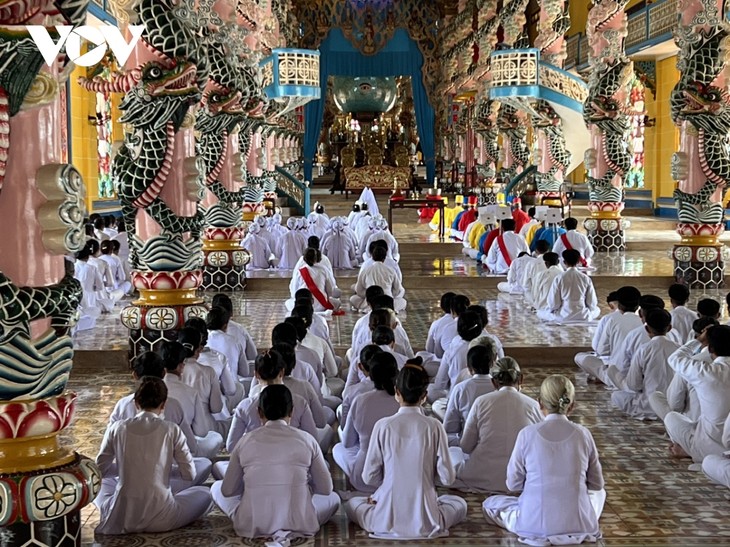 A religious gathering of Cao Dai followers at the Tay Ninh Holy See. This is also a spiritual tourism destination for many visitors. (Photo: VOV) A religious gathering of Cao Dai followers at the Tay Ninh Holy See. This is also a spiritual tourism destination for many visitors. (Photo: VOV) |
Religious freedom reflected in multiple dimensions
The Party and State of Vietnam have consistently ensured representation of ethnic and religious groups in elected bodies. In the 15th National Assembly of the 2021-2026 term, of 499 deputies, 89 were from ethnic minorities and 5 were religious dignitaries. Father Nguyen Van Rien, Vice President and Secretary General of the Vietnam Committee for Solidarity of Catholics, was elected to the 14th and 15th National Assembly and has been nominated again for the 16th Assembly.
At the local level, religious representation is also significant. 88 dignitaries and officials and 35 followers were elected to provincial People’s Councils, 225 dignitaries and officials and 246 followers to district-level councils, and 646 dignitaries and over 5,000 followers to commune-level councils.
The presence of religious figures among candidates and elected representatives reflects the elimination of discrimination and underscores equality among religions in elected bodies. Religious communities continue to be an important resource for national development.
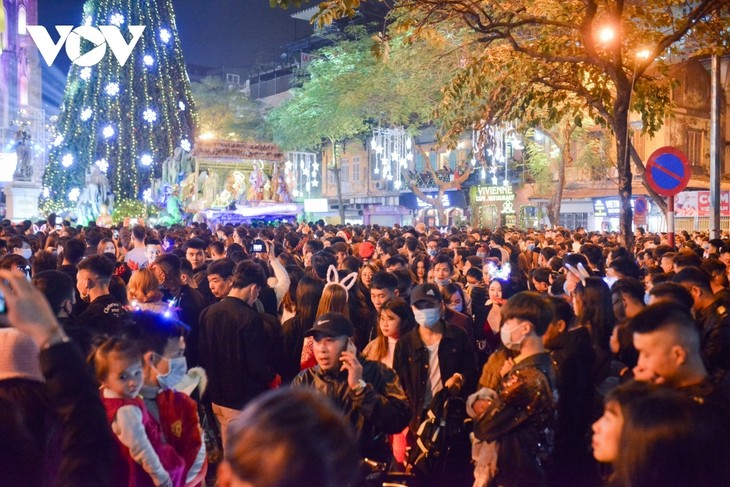 Christmas celebration of Catholics at the Hanoi Cathedral. (Photo: VOV) Christmas celebration of Catholics at the Hanoi Cathedral. (Photo: VOV) |
According to the Ministry of Ethnic and Religious Affairs, religious organizations are operating 300 kindergartens, 2,000 early childhood education facilities, 12 vocational training centers, and many charity classes. They also operate 500 healthcare establishments, including charity clinics, and 125 social assistance facilities.
The White Paper says that between 2003 and 2023 the number of religious followers increased from 17.4 million to 27.7 million, recognized religious organizations rose from 16 to 43, and places of worship from 20,900 to 29,890.
According to the Department of Grassroots Culture at the Ministry of Culture, Sports and Tourism, Vietnam hosts 544 religious festivals annually. While these festivals are organized internally by each religion, many draw wide community participation.
Religious communities are an integral part of Vietnam’s great national unity bloc. Ensuring religious freedom is about respecting diversity within unity and creating a space in which every citizen, regardless of belief, feels they are an indispensable part of the nation’s achievements.