







A: Let's begin with a beautiful letter from Chiu Wai Yin in Guangdong, China. Chiu Wai Yin says the Voice of Vietnam has become a bridge between the Chinese and Vietnamese people. "China and Vietnam share a border and are geographically connected. I really enjoy listening to shortwave radio programs from neighboring countries and have always appreciated the programs of Voice of Vietnam. China and Vietnam have many similar customs and traditions, and have maintained close and harmonious neighborly relations over many generations."
B: Thank you, Chiu Wai Yin, for those warm and thoughtful words. We couldn't agree more. As neighboring countries with many cultural similarities, China and Vietnam have a long history of people-to-people exchanges. And we're delighted that radio can play a small but meaningful role in bringing our two peoples closer.
A: We also heard from Ivan Lebedev in Russia, who writes: " Like a lot of listeners of VOV, I love Vietnam and your broadcasting station. I sincerely hope, that people to people diplomacy, friendship and international relationships will be great with your country.”
B: Thank you, Ivan. People-to-people exchanges are indeed an important part of international friendship. That's why VOVWORLD continues to tell stories not only about Vietnam's policies and economic development, but also about its people, traditions and daily life.
A: From the Republic of Korea, Kim Do-yoon writes about Vietnam's efforts to search for and honor fallen soldiers: "The efforts to search to the very end and honor the martyrs who sacrificed their lives for the country are truly meaningful. I hope the search for remains and identification efforts will proceed smoothly, bringing some comfort to the families of the fallen."
![Rows of graves stand as a lasting tribute to the immense sacrifices made by generations of fallen soldiers for the peace Vietnam enjoys today. [Photo: Kim Thanh/VOV]](/sites/default/files/styles/large/public/2026-08/500-2.jpg)
B: Thank you, Kim Do-yoon. Your words touch on a deeply emotional issue in Vietnamese society.
A: For many Vietnamese families, the war did not truly end when the fighting stopped. Thousands of families still do not know exactly where their loved ones are buried.
B: That's why Vietnam continues efforts to search for, recover and identify the remains of fallen soldiers. Modern technologies, including DNA testing, are increasingly being used to help identify remains that could not be identified through traditional methods.
A: The national DNA database of martyrs' relatives is being developed simultaneously nationwide. In the first half of the year, the Ministry of Public Security has analyzed and uploaded 53,000 DNA data profiles of unidentified martyrs' relatives to the national database. Around 300,000 DNA samples from martyrs' relatives are expected to be collected this year.
B: In addition to building a national database, next-generation DNA testing technology is being used to find new ways to identify martyrs' remains. The NGS-SNP DNA testing technology, trialed by the Vietnam Academy of Science and Technology since 2025, has yielded highly accurate results.
Dr Tran Trung Thanh of the DNA Identification Centre, Institute of Biotechnology, Vietnam Academy of Science and Technology (VAST), said: “NGS-SNP sequencing technology involves a series of processes applied to the nuclear genome. Its main advantage is that it expands the pool of relatives eligible for testing in both the maternal and paternal lines, reaching as far as the fourth or fifth generation of descendants. Crucially, this technology also allows for definitive conclusions to be drawn without requiring complete empirical data.”
A: This technology offers new hope to families who have spent decades searching for their missing loved ones, even when close relatives are no longer available for testing.
B: In his correspondence to VOVWORLD this week Amir Jameel in Pakistan says he wants to learn about famous traditional craft villages in northern Vietnam.
A: Around Hanoi and the Red River Delta, generations of craftspeople have preserved specialized skills. Bat Trang is famous for ceramics; Van Phuc is known for silk; Dong Ho for traditional woodblock prints; Phu Lang for pottery; and villages around Hanoi are also renowned for lacquerware, embroidery, bamboo and rattan products, wood carving and metalwork.
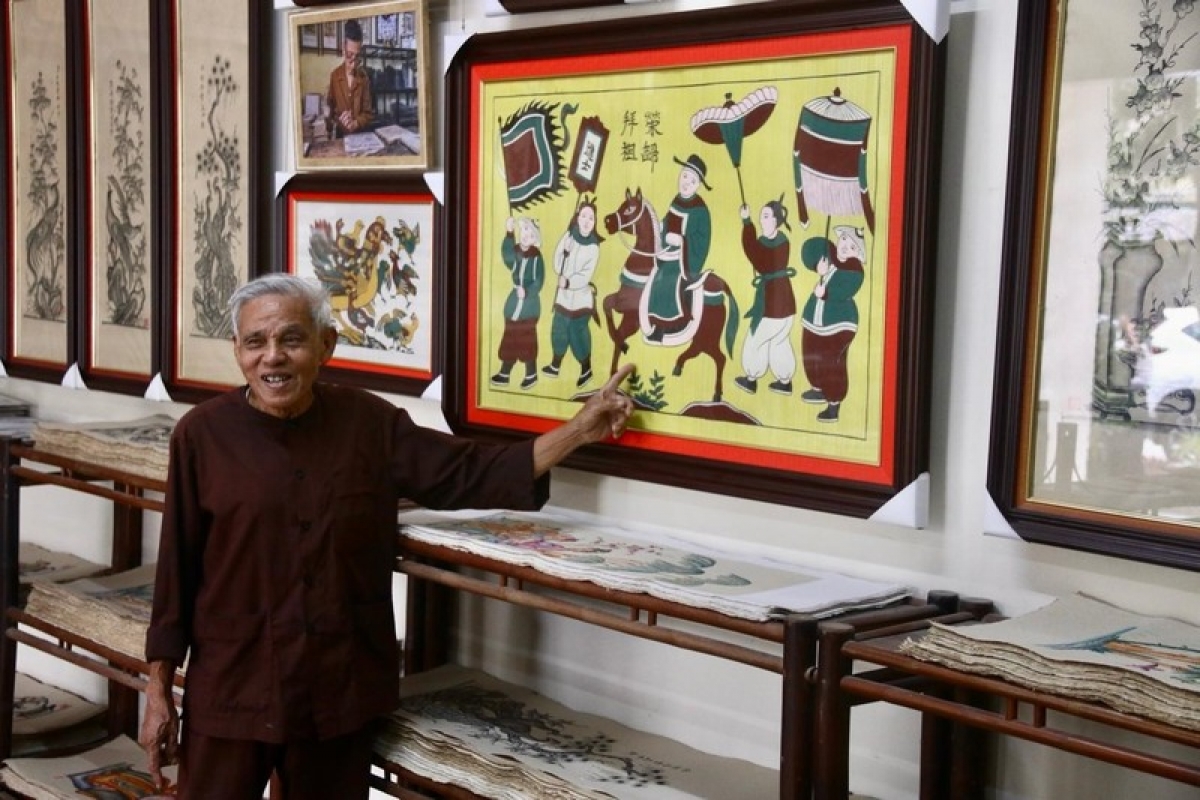
B: In today’s Letter Box, let’s take a short trip to Dong Ho village in Bac Ninh province which is famous for its traditional folk paintings. The craft, originating about 500 years ago, is known for its unique woodblock printing techniques, natural colors, and distinctive themes, featuring worship paintings, New Year blessings, and historical, daily-life, and landscape scenes. The works are traditionally associated with the Lunar New Year, or Tet, and Mid-Autumn celebrations.
A: Dong Ho village, once home to 17 clans involved in folk painting, now sees only two, the Nguyen Dang and Nguyen Huu clans. They are working diligently to preserve this traditional craft. Artisan Nguyen Dang Che, a 20th-generation heir, says the use of entirely natural materials including poonah paper, sophora flowers, indigo leaves, kitchen ash, bamboo charcoal, and scallop shells, contributes to the unique charm of the art.
B: To preserve the time-honored values of Dong Ho paintings, artisan Che sticks to the original processes, using traditional materials, methods, colors, carving, and printing. But to keep them relevant, he updates the themes to give the art a fresh appeal. Mr. Che said: "Now, they’ve all been restored. So far, I’ve got 250 designs for individual paintings and 17 designs for sets of paintings."
A: Bac Ninh province has established the Dong Ho Folk Painting Conservation Center, showcasing over 1,000 documents and artifacts gathered from local residents.
B: In 2013, Dong Ho folk painting was recognized as a National Intangible Cultural Heritage. On December 9, 2025, the Dong Ho folk painting craft of Bac Ninh province has been inscribed on UNESCO’s List of Intangible Cultural Heritage in Need of Urgent Safeguarding.
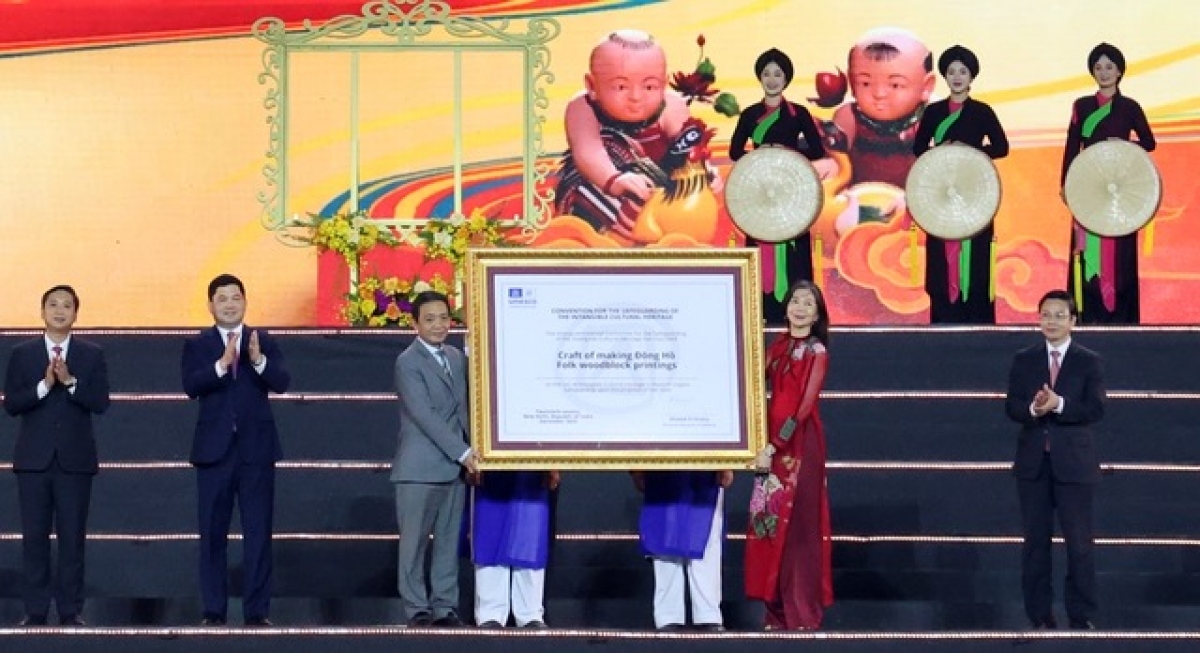
A: Mai Son, Standing Vice Chairman of the Bac Ninh People’s Committee, said:"The recognition of Dong Ho folk painting by UNESCO acknowledges its unique craftsmanship, with the Vietnamese spirit and life philosophy embodied in each artwork. The recognition elevates Bac Ninh's cultural standing on the world heritage map. We deeply appreciate the contributions of the Dong Ho craftsmen and generations of artisans who have preserved and passed down this tradition for centuries."
A: So if you're interested in Vietnamese culture, don't just visit a museum. Put a craft village on your itinerary and you may discover that the workshop itself is a living museum.
B: Next, in his correspondence to VOVWORLD this week, Keopich of Cambodia shared his interest in Tra Su Cajuput Forest.
A: Tra Su is in An Giang province in southern Vietnam, in the Mekong Delta. It's famous for its waterways covered with brilliant green duckweed and its extensive cajuput forest.
B: One of the most enjoyable ways to explore it is by boat. Visitors travel quietly through narrow waterways surrounded by trees, while birds and other wildlife can often be seen in the forest.
B: Keopich, if you ever travel from Siem Reap to southern Vietnam, we hope you'll have the opportunity to experience the peaceful atmosphere of the Mekong Delta for yourself.
A: Next, we are delighted to hear from Pedro Mataix Juan in Spain, who successfully received our English-language shortwave broadcast on 11,885 kHz. Pedro, thank you for keeping shortwave alive, and for recording your reception and sharing your DX-listening experience with us.
B: We also congratulate the Pariwar Bandhu Shortwave Listeners' Club in India on its 36th anniversary on August 15. With hundreds of members and more than three decades of promoting radio listening, the club is a wonderful example of how radio can create friendships that cross borders.
A: To all our listeners, from veteran shortwave enthusiasts to those discovering VOVWORLD online, thank you for staying connected. Your letters, reception reports and ideas remind us that radio is not simply about broadcasting to the world, it is about building a conversation with the world.
A: Keep listening, keep writing, and keep discovering Vietnam with VOVWORLD.
B: Goodbye and best wishes from Hanoi!


