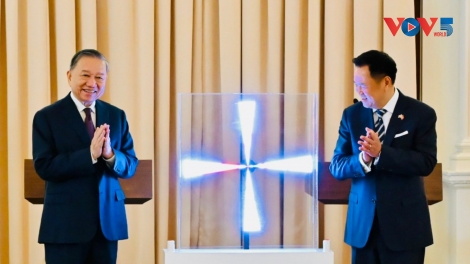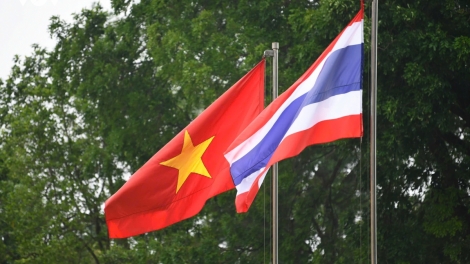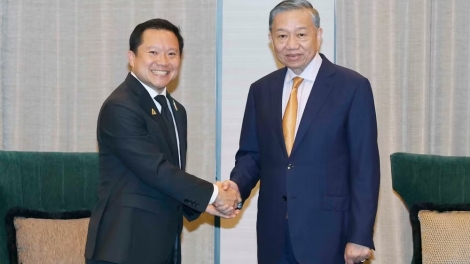




In addition to strengthening bilateral ties, both nations are seeking to play a more active role in shaping a resilient, prosperous and forward-looking ASEAN. To better understand this shared vision, VOV correspondent in Thailand spoke with Dr. Morragotwong Phumplab, Assistant Director for Research at the Institute of East Asian Studies, Thammasat University.

VOV correspondent: Thank you, Dr. Morragotwong, for joining us today. Prime Minister Anutin’s visit to Vietnam follows soon after General Secretary and President To Lam’s trip to Thailand. In your view, what does this tell us about the evolving nature of the Vietnam–Thailand Comprehensive Strategic Partnership?
Dr. Morragotwong Phumplab: Thank you very much for your question. I think the significance of this reciprocal visit lies with the fact that they represent more than diplomatic protocol. They signal a deliberate effort by both governments to transform the newly established Comprehensive Strategic Partnership into a substantive and forward-looking framework for cooperation, and the more important thing is that I think the timing is particularly important. We are witnessing these exchanges during the 50th anniversary of diplomatic relations between Thailand and Vietnam, but we are also witnessing them at the moment when Southeast Asia is facing profound geopolitical and economic uncertainty, with the great power competition in intensifying supply chains are being reorganized, and ASEAN is under the pressure to maintain both its unity and relevance. Ultimately, what we are seeing is simply an exchange of the visit between the two leaders. We are witnessing the emergence of more mature relationship, in which Thailand and Vietnam increasingly see themselves as what I call “co-architect” of regional stability, economic resilience, and also the ASEAN future.
VOV correspondent: Looking at the broader regional platform, the upcoming ASEAN Future Forum in Hanoi will gather regional leaders to discuss ways to strengthen ASEAN amid global uncertainties. In what ways do you think might strategic coordination between Vietnam and Thailand contribute to the ASEAN Community Vision 2045?
Dr. Morragotwong Phumplab: As we know that the ASEAN community vision 2045 is not simply about the economic growth like in the past. It is about ensuring that ASEAN remains relevant in a rapidly changing world. In this context, I think the strategic coordination between Thailand and Vietnam is particularly important. Why? That's because Thailand and Vietnam are now among the most influential middle powers in ASEAN. And together I think they represent nearly 1/3 of the mainland Southeast Asia's GDP and population. More importantly, I think both countries share a common interest in mending regional stability, strengthening economic integration, also preserving ASEAN central role in the regional architecture, or regional foundation as well. I think the partnership between both governments can contribute to ASEAN Community Vision 2045 in at least three ways. The first one, I think, promoting deeper economic integration to the enhanced connectivity, like supply chain cooperation, also digital transformation in the global disruption era right now. Secondly, I think we can strengthen the Mekong-sub regional cooperation, which also is still very important, especially in the mainland Southeast Asia. The Mekong sub region is very crucial for us in terms of the food security, terms of the water governance, as well as the energy connectivity and sustainable development as well. Thirdly, we can act as a bridge builder in ASEAN, as well, like helping to maintain consensus among the member states amid the growing geopolitical competition. Moreover, Thailand and Vietnam are no longer simply bilateral partners. They are increasingly becoming a co-stakeholder in shaping ASEAN future trajectory, so the two countries have very high potential in cooperating with each other.
VOV correspondent: Turning to specific areas of action, energy security and green growth are among central themes at this year’s ASEAN Future Forum. What concrete initiatives we can expect to drive cooperation between Thailand and Vietnam?
Dr. Morragotwong Phumplab: Thailand is likely to approach energy security and green growth from a pragmatic rather than ideological perspective, because the country recognizes that economic growth, energy security, and environmental sustainability are no longer a separate agenda; they are increasingly interconnected.
One area where Thailand is expected to play a significant role is regional energy connectivity, because ASEAN's future energy security will depend not only on national energy systems, but also on cross-border electricity trade and regional power integration. Thailand has long supported initiatives such as the ASEAN Power Grid. Another important area is renewable energy investment. Thailand possesses significant expertise in solar power, bioenergy, and energy infrastructure development, so Thai companies are already investing across the region. The third area is concerned with sustainable supply chains and the green economy, as the global market is increasingly demanding low-carbon production. Thailand is therefore likely to support initiatives related to carbon reduction, green manufacturing, and the electric vehicle ecosystem, where Vietnam also has a very strong point.
This creates a strong rationale for closer cooperation between Thailand and Vietnam, particularly in the Mekong region, where environmental challenges transcend national borders. What makes Thailand and Vietnam cooperation especially important is that the two countries possess complementary strengths. Thailand brings expertise in industrial development, energy infrastructure, and logistics, which is our strong point, while Vietnam has emerged as one of the region's fastest-growing renewable energy markets and a major manufacturing hub. Together, they could become a key driver for ASEAN's green transition. Thailand and Vietnam are well-positioned to demonstrate that green growth can be not only environmentally necessary but also economically competitive.
VOV correspondent: Thank you very much, Dr. Morragotwong, for sharing your valuable insights with the Voice of Vietnam today.