







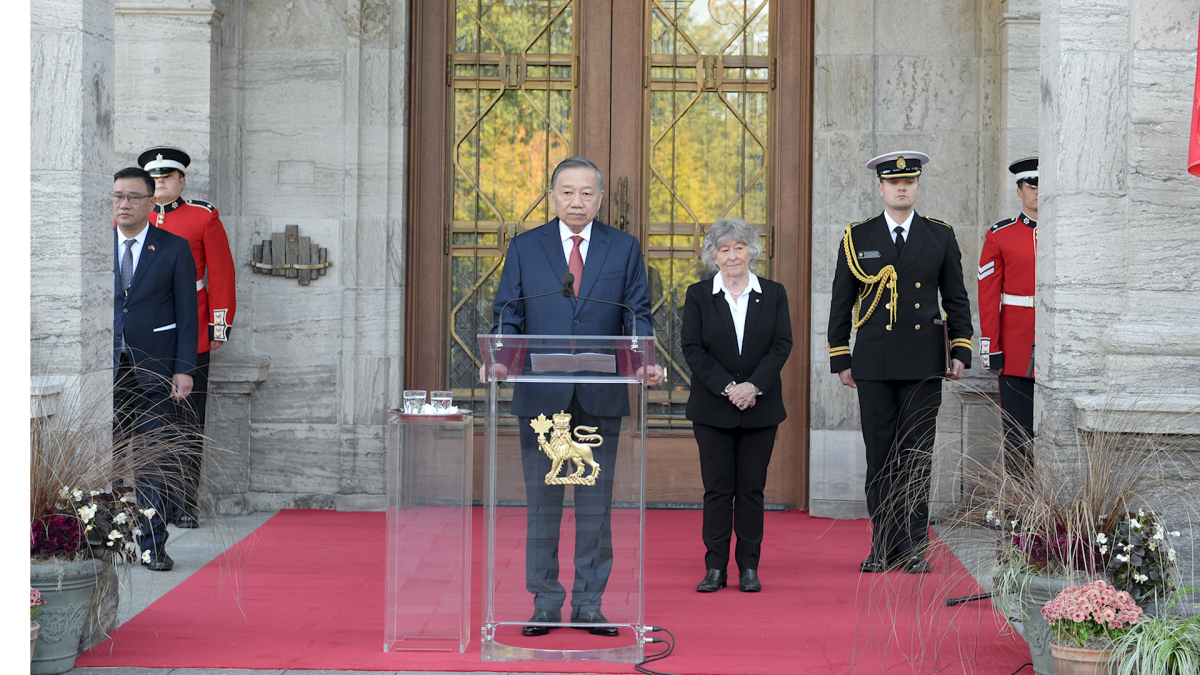
She said the visit provided an opportunity for both sides to acknowledge their achievements and look toward the future. In a world undergoing profound changes, cooperation remains the best way for the two countries to address shared challenges, promote prosperity, and contribute to long-term stability, she said.
Mr. Lam said Vietnam-Canada relations are entering a more strategic, comprehensive, substantive, and effective phase of development.
“We expect this visit to open a new chapter in Vietnam-Canada relations, reflecting a higher level of political trust, a deeper convergence of interests and vision, and a shared determination to build a long-term, stable, substantive relationship that can serve as a model of cooperation between two nations on opposite sides of the Pacific,” Mr. Lam said.
At a meeting following the welcome ceremony, Governor General Arbour said Canada regards Vietnam as an important partner and stands ready to leverage its strengths in resources, technology, education, energy, agriculture, and finance to enhance cooperation with Vietnam.
Mr. Lam encouraged the two sides to increase contacts and exchanges of delegations at all levels, consolidate political trust, promote existing cooperation mechanisms, and strengthen coordination and mutual support at multilateral forums.
He urged the two countries to make effective use of existing cooperation and economic integration frameworks, expand markets, strengthen supply-chain connectivity, and encouraged Canadian businesses and investment funds to make long-term investments in Vietnam.
He also called for closer collaboration in transportation, infrastructure, logistics,and connectivity.
The two countries, he said, should create new growth drivers by fostering stronger ties in science, technology, innovation, digital transformation, artificial intelligence, and other advanced technologies, while expanding collaboration in energy, green development, environmental protection, climate change response, healthcare, high-tech agriculture, food security and sustainable development.
Mr. Lam suggested that the two sides expand cooperation in line with their interests and needs, particularly training and capacity building, UN peacekeeping, maritime security, war legacy remediation, search and rescue, combating transnational crime, and addressing non-traditional security challenges.
Cooperation in education and training, culture, and people-to-people exchanges should continue to underpin the long-term development of bilateral relations, he said.
In a world facing changes and challenges, both sides said they are committed to dialogue and cooperation, multilateralism, and respect for the United Nations Charter and international law.
The two leaders vowed to promote coordination at the UN, ASEAN, the Asia-Pacific Economic Cooperation (APEC) forum, Francophonie, the Comprehensive and Progressive Agreement for Trans-Pacific Partnership (CPTPP), and other multilateral mechanisms.
They voiced their support for ASEAN and Canada's cooperation with ASEAN in addressing challenges and promoting peace, stability, cooperation, and development in Asia-Pacific and the world.


