







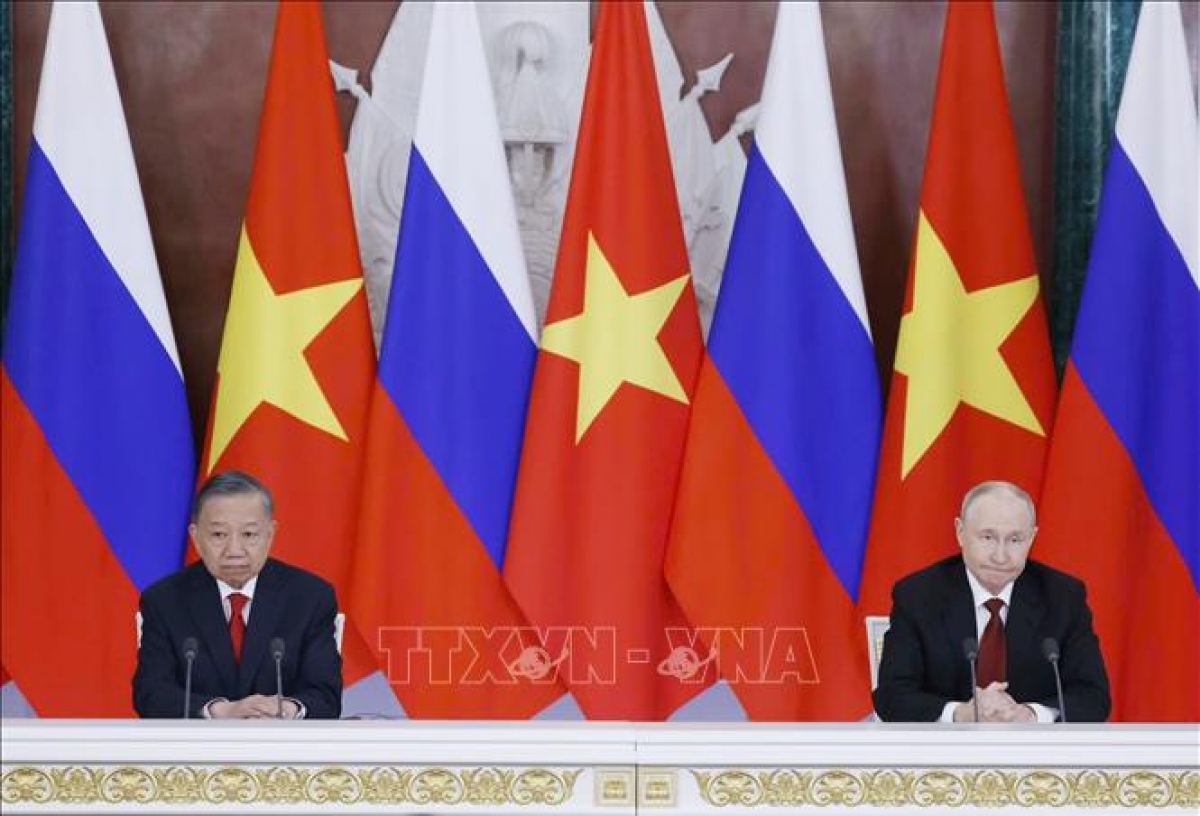
Issued on the occasion of the state visit to Russia by Party General Secretary and President To Lam, the statement affirms that consolidating and developing bilateral ties is a long-term strategic choice and a foreign-policy priority for both countries.
The two sides agreed to advance their Comprehensive Strategic Partnership in the new era on the basis of a high level of political and strategic trust, as well as balanced and sustainable economic, trade and investment cooperation.
They identified defense and security cooperation as a strategic pillar, energy and oil-and-gas cooperation as a strategic breakthrough, and science and technology, innovation, and human resource development as key drivers of future growth. The two countries also underscored the role of culture and people-to-people exchanges as a bridge connecting their peoples. The Joint Statement emphasized the importance of building a partnership capable of adapting to changes in the international environment while delivering tangible benefits to the people, localities and businesses of both countries.
The two sides agreed to step up cooperation between their respective political parties and continue strengthening parliamentary cooperation. They affirmed that defense and security cooperation is not directed against any third country and is fully consistent with international law.
The two sides plan to enhance substantive cooperation in information and communications technology, including promoting the initiative to establish an Asia-Pacific Center for Cybercrime Prevention.
They expressed readiness to expand cooperation in combating crime in all its forms and manifestations, including crimes involving the use of information and communications technology.
Vietnam encouraged Russia to invest in high-value-added projects linked to technology transfer, innovation and human resource training. Russia will explore the potential for expanding investment in Vietnam in areas such as energy; manufacturing and processing; the circular economy; information and communications technology; logistics; infrastructure development; high-tech agriculture; pharmaceuticals; healthcare; tourism; and culture.
The two sides identified fuel and energy cooperation as a strategic breakthrough in Vietnam-Russia relations. On this basis, they agreed to improve the efficiency of ongoing projects and continue expanding oil and gas cooperation in both countries.
They will accelerate cooperation in the supply of Russian crude oil and liquefied natural gas, as well as the development of infrastructure needed to receive, process, and store hydrocarbon products in Vietnam.
The two sides will continue to explore the possibility of Russian organizations participating in the modernization of existing power plants in Vietnam and the development of new power-generation facilities.
They will also continue implementing the project to build a Nuclear Science and Technology Research Center in Vietnam, an important joint initiative for the peaceful use of nuclear energy.
Vietnam and Russia reaffirmed their interest in close cooperation in transport and logistics, including the construction of metro systems in Vietnam, railway modernization, and the expansion of multimodal transport between Vietnam, China, and Russia, involving rail and maritime services. They will also explore opportunities to participate in the International North-South Transport Corridor initiative and cooperate in the use of the Northern Sea Route.
The Joint Statement also affirmed the two sides’ commitment to promoting cooperation in culture, labor, and tourism.
On international issues, Vietnam and Russia expressed support for the development of a more equitable and sustainable multipolar world order.


