In Quang Tri mountains, villagers face the risk of landslides, isolation, and severe life disruptions caused by prolonged heavy rains. A population scattered over vast areas and outdated loudspeaker systems made it difficult to deliver timely warnings to every household. Smartphones have made warning people much easier.
Ka Tang hamlet in Tuyen Lam commune consists of 125 households scattered on a mountainside. Hoang Van Thuan, the hamlet’s head, says he once had to climb steep hills and cross streams and knock on every door to ask villagers to evacuate. Today the internet has put a rapid-response communication network at people’s fingertips.
“During the storm season, digital technology saves a lot of time. I used to have to walk to every single house, but now people get the news instantly through the hamlet’s Zalo and Facebook groups. If someone hasn’t read the message, I call them on the phone. Only if they are unreachable do I go to their house in person. It’s fast, and no one gets left behind,” said Thuan.

Following recent administrative mergers, Tuyen Lam commune has doubled in size, and residential clusters are spread across a much wider area. But after recent heavy rains, it proved to be effective to use digital technology to deliver timely warnings to residents.
According to Tran Manh Luc, Deputy Chairman of the Tuyen Lam People’s Committee, after the merger, the area under the commune’s management doubled, so digital transformation became the key to natural disaster management.
“We have digitized household information in landslide-prone and flood-prone areas and made it available to the rapid-response teams. As a result, response measures are taken more accurately and effectively,” said Luc.
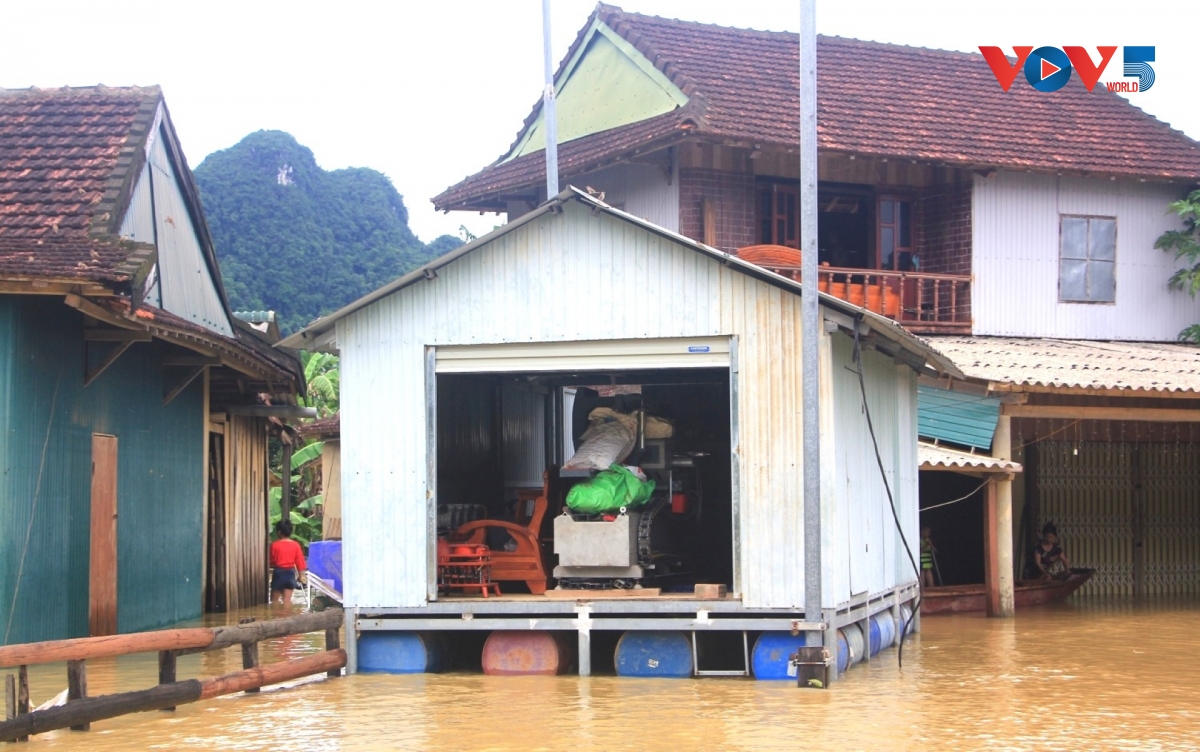
Tan Hoa hamlet, the flood epicenter of Kim Phu commune, survived the 2010 historic floods. The locals learned that early preparation is the best way to avoid being caught off guard. Combining local ingenuity with support from authorities and organizations, 600 floating houses have been put into operation to provide safe shelter whenever floodwaters rise.
Each floating house covers 20 square meters and has 8 to 12 empty drums underneath it. The roof and walls are made of insulated corrugated iron, with emergency escape windows and 6-to-8-meter poles fixing it to the ground. When floodwaters rise, the house floats upward with the water; as the water recedes, it settles back into place.

Dinh Xuan Vu, a Tan Hoa resident, said, “Every family stocks up on food beforehand. When the water starts rising, food is already stored in the floating house, and belongings are moved up so nothing gets damaged. Living in the floating house makes life easier. My old house used to get submerged up to the roof.”
Nguyen Hong Phuong, Deputy Director of the provincial Department of Agriculture and Environment, said, “The floating house models in Tan Hoa represent one of several creative solutions developed by the local community to adapt to natural disasters. We consider them a testament to the community’s adaptability, resilience, and creativity.”
Natural disasters can’t be stopped but preparing for them can make a crucial difference. Timely text messages and floating houses help people in Quang Tri cope with severe weather and flooding.