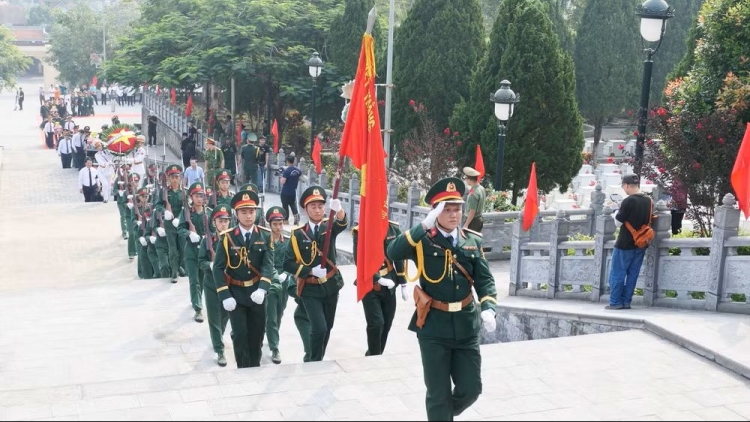




The A1 National Martyrs Cemetery in Dien Bien Phu ward, with its rows of trees, grassy lawns, and clean stone-paved paths, remains green and cool even on sunny days. In this solemn setting, quiet words mingle with the sound of shovels digging as some searchers take measurements while others carefully remove layers of soil from graves.
Lieutenant Colonel Dang Xuan Hoa, Deputy Head of Logistics and Technical Affairs of the Dien Bien provincial Military Command, said: “One challenge is that the graves here are covered with stones. A stone grave cover is very heavy, about 650 to 700 kilograms, making it extremely difficult to lift by hand. After studying the problem and testing different approaches, we used rollers to slide the covers out so we could proceed with the excavation.”
At martyrs’ cemeteries in Da Nang, the search teams work tirelessly, in all weather and through weekends and holidays. At the Martyrs’ Cemetery in Duy Nghia commune, they carefully remove the soil with one shovel at a time, sometimes finding bone fragments, a pen, a ring, a handkerchief. Every movement is gentle to avoid damaging any sample they might find.
Lieutenant Colonel Nguyen Huu Dung, a member of the search team of the Da Nang municipal Military Command, said: “Throughout the operation, we take every precaution to prevent sample mix-ups. We must also ensure that strands of hair from team members don’t accidentally blow into the samples and affect the DNA testing of the remains.”
At Đức Cơ Martyrs’ Cemetery in Gia Lai province, military personnel, medical workers, and local authorities coordinate closely in excavating graves, collecting samples, keeping records, digitizing data, and restoring the graves. Every sample collected and every DNA profile successfully decoded is a tribute to those who sacrificed their lives for the independence and freedom of the Fatherland.