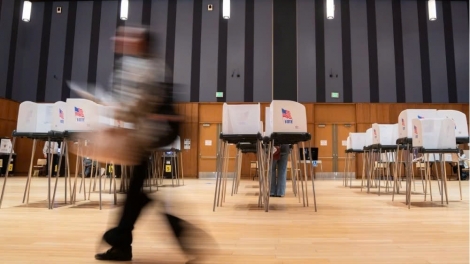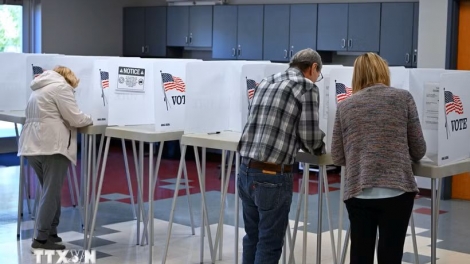




The Democratic Party won a majority in both chambers of Congress, giving it effective control of the legislative branch for the final two years of President Donald Trump’s term.
Foreign policy legacy
In his first remarks outlining the party’s agenda following the victory, House Democratic Leader Hakeem Jeffries, who is widely seen as likely to become the next Speaker of the House in early 2027, said that Democrats plan to push a War Powers Resolution to restrict military action against Iran and pass legislation to undo Trump’s tariffs.
The international community is anxious to see how Washington may change its approach to the US-Iran conflict, the Russia-Ukraine conflict, and its relations with other major powers like China and Russia. Some observers say mounting domestic challenges in the next two years could prompt Trump to focus on building his foreign policy legacy.
Wu Xinbo, Director of the Center for American Studies at Fudan University, China, said Trump will need greater cooperation from Russia and China.
“In next two years, Trump would be crippled domestically. He may just turn to foreign policy to leave his legacy. And in that case, stable relationship with China would be his priority. So, that will help stabilize China-US relations. And Democrats are going to constrain Trump on the issue of tariff,” Wu said.
Some think Washington might become less erratic in its economic policies. Liz Miller, founder and president of US financial advisory firm Summit Place, said that, although an immediate reversal of Washington’s trade and tariff policies is unlikely, uncertainty over policy among investors and businesses has eased considerably.
Carsten Brzeski, Head of Macro Research at Dutch bank ING, said, “I think the election results will be positive for the global economy. In the medium run, the Trump administration will focus more on the legacy it will leave behind and the legacy will definitely not be to have a fully disrupted global economy. I think in the end, these election results will lead to a calmer last two years in office for Donald Trump.”
Uncertainty
Along with many relatively optimistic assessments, some observers urged caution considering the US’s complex and uncertain political situation. The US-Iran conflict, in particular, involves many unpredictable factors.
In their post-election remarks, President Trump and Vice President J.D. Vance said the conflict with Iran was one of the factors behind the Republican Party’s defeat.
But Joseph McMonigle, President of the Global Center for Energy Analysis, said this acknowledgement and the prospect of congressional constraints does not guarantee that the US and Iran will quickly reach an agreement to end instability in the Middle East.
“The change in control of the Congress doesn't really change that. The President still has enormous autonomy on foreign policy, on military affairs. The Congress has an ability to change spending power, but it's unlikely they would do anything like that when the US is in a military conflict. The President still has great autonomy on what to do,” said McMonigle.
German Chancellor Friedrich Merz said he doesn’t anticipate a fundamental shift in US policies over the next two years, as Trump still has extensive powers despite any theoretical constraints from Congress.
“Over the last two years, Trump has largely governed by bypassing Congress. Why should that be any different now? He has relied primarily on executive orders, and he will certainly continue to do so,” said Merz.
Still, most observers think the Trump administration will make some adjustments to its foreign policy, which might show up in upcoming trilateral US-Russia-Ukraine talks, the G20 Summit, and a possible high-level meeting between the US, China, and Russia.