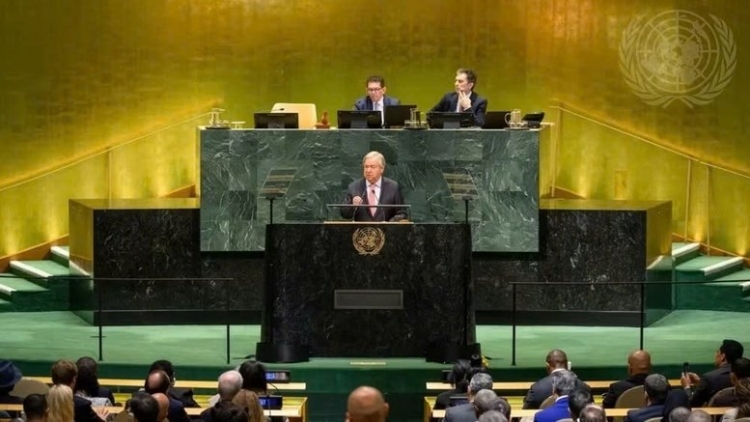



Although no clear front-runner has emerged, the just concluded 81st session of the UN General Assembly underlined two striking trends in the nomination process – gender and geography.
Two trends
On September 18, prior to the high-level week of the 81st UN General Assembly (UNGA-81), the UN Security Council held a third straw poll for candidates. Costa Rica’s former Vice President Rebeca Grynspan, who serves as Secretary-General of the UN Conference on Trade and Development (UNCTAD), received 9 “encourage” votes, 5 “discourage” votes, and 1 “no opinion”. She was followed by Carolyn Rodrigues-Birkett, Guyana’s Ambassador to the UN.
Shortly after the straw poll, Chile’s former President Michelle Bachelet announced her withdrawal from the race. There are now 7 formal candidates: Ivonne A-Baki (Ecuador), María Fernanda Espinosa (Ecuador), Rafael Grossi (Argentina), Rebeca Grynspan (Costa Rica), Olara Otunnu (Uganda), Carolyn Rodrigues-Birkett (Guyana), and Macky Sall (Senegal).
Although additional candidates could enter the race in the coming months, the current results suggest that two factors are shaping this year’s contest – gender and geographical rotation.
Since its establishment in 1945, the UN has never had a female leader. Under the principle of regional rotation, it is now the turn of Latin America and the Caribbean to hold the post.
In his address to UNGA-81 last week, Spanish Prime Minister Pedro Sanchez expressed his support. “Nine men have served as Secretary General of this organization in its 80 years of existence. Now it's time for a woman to serve, a Latin American woman. How can an organization that claims to speak on behalf of the whole of humanity never have had a woman leading the organization? How can we represent all of the continents if for three decades we haven't let the third most populated continent have this role?”
Annalena Baerbock, President of the 80th session of the UN General Assembly, said the selection of the next UN Secretary-General will send a message about whether the UN is truly committed to renewal. “The choice UN makes about the 10th Secretary General will send a message about whether this organization truly represents the people it it is meant to serve, of whom are half women and girls. Who leads this organization matters not only to the people in this building, but to billions of people around the world.”
Decisive votes of the five permanent members
Although those voting trends are clear, even if a clear favorite emerges, the five permanent members of the Security Council (the US, the UK, France, Russia, and China) can veto the popular choice. A veto by any one of those five members would end anyone’s candidacy. They must unanimously agree to formally nominate a candidate to be voted on by the General Assembly’s 193 members. At that point the General Assembly’s approval is really just a formality.
The selection of the UN Secretary-General will have a crucial effect on the global geopolitical landscape. Rivalry between the US and China, and tensions between Russia and the West over Ukraine, make for a complicated negotiating environment in the Security Council. Washington and Moscow reportedly want a candidate who is focused on security, while Beijing seems to want a greater emphasis on development. France and the UK have maintained a low-key stance and could perhaps play a mediating role in the negotiations.
No major power is likely to support a candidate who they believe runs counter to their strategic interests, so candidates with moderate views, a low political risk profile, and a strong background in economics or technology could have an advantage, particularly since the UN is looking to strengthen its engagement with emerging technologies.
Professor Dirk Druet, senior non-resident adviser at the International Peace Institute (IPI) in New York and a lecturer at McGill University’s Max Bell School of Public Policy in Canada, said: “That involves new types of profiles, new types of expertise, and new types of partnerships with those sectors that are the locus of rapid change. That is changing our world in meaningful ways and in ways in which the UN needs to be involved.”
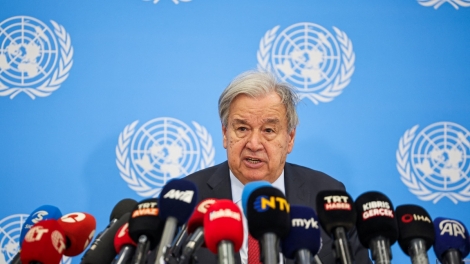
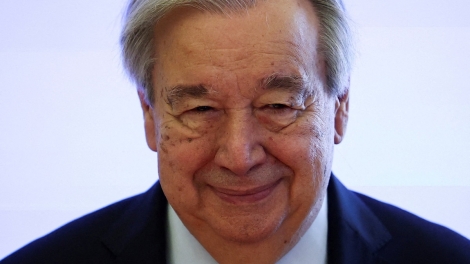
The successor to Antonio Guterres, who will take office on January 1, 2027, will need to strengthen the UN’s peacemaking capacities and lead the global response to increasingly complex crises like the rapid development of artificial intelligence, despite growing constraints on the UN budget.