



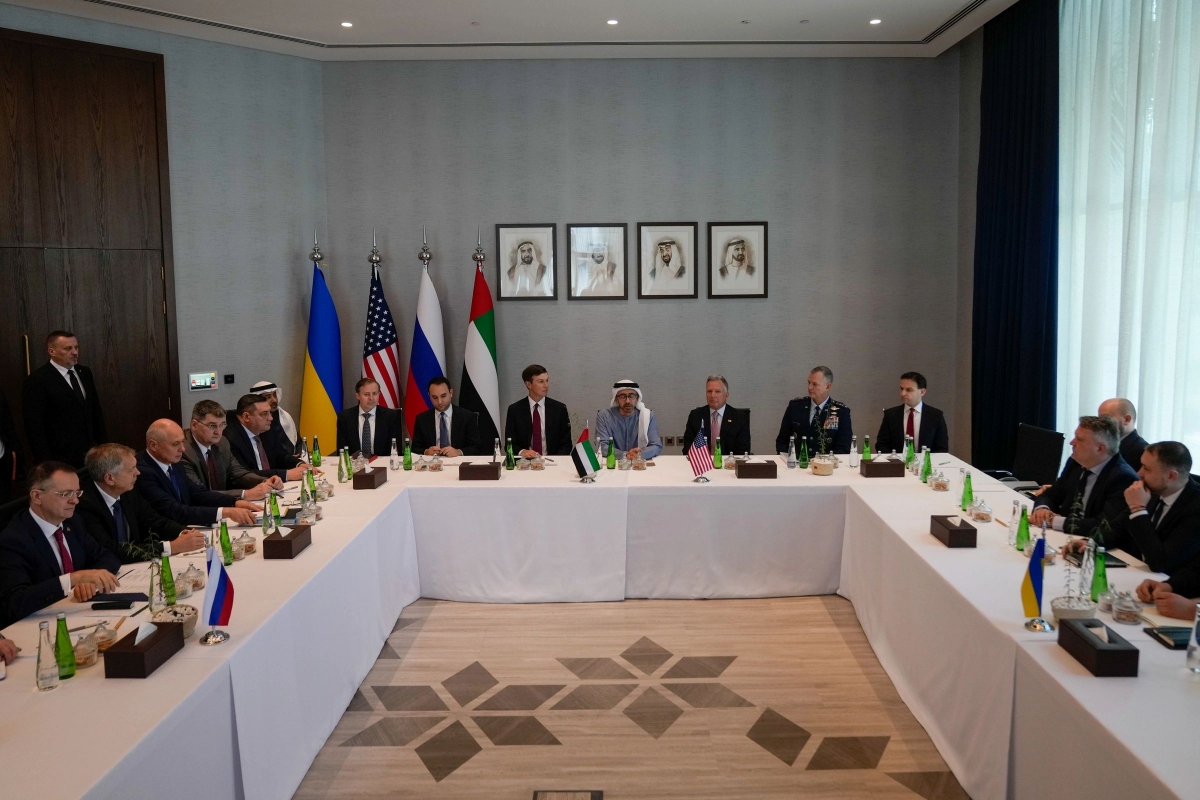
This is the first face-to-face trilateral meeting between the US, Russia, and Ukraine since negotiations in Geneva ended in a deadlock in February.
Fresh momentum from the US
Attending the Abu Dhabi meeting are familiar figures. The US is represented by Steve Witkoff, President Trump’s special envoy, and Jared Kushner, Trump’s son-in-law. Russia’s delegation is headed by Vladimir Medinsky, an aide to President Putin. And Ukraine’s delegation is led by Rustem Umerov, the head of Ukraine’s Foreign Intelligence Service.
The situation has changed considerably for all sides since the Geneva meeting. Over the past nine months, Washington has shifted its relationship to Russia, from a hard line to a more conciliatory attitude, including the signing of a diesel fuel agreement in early October, and a decision to waive sanctions on Russia under the Lindsey Graham Act.
The Republican Party’s defeat in the US midterm elections on November 3 is expected to have a significant impact on Washington’s foreign policy as Trump seeks to shape his foreign policy legacy during the final two years of his term. President Trump has repeatedly said ahead of the Abu Dhabi talks that a peace agreement is within reach.
“It's going to be a bigger agreement, and it's going to involve more than Ukraine. It's going to be a very big—it's going to involve more than Ukraine, and I could even say it might involve all of Europe. It's going to be a big, beautiful agreement, and everyone's going to be thrilled,” Trump said.
In contrast to Trump’s optimism, Russia and Ukraine are more cautious. Observers say Moscow and Kyiv remain far apart in their negotiating positions, leaving little room for concessions.
Dmitry Trenin, Chairman of the Russian Council on International Affairs, said: “These are consultations, not negotiations. The discussions are focusing on important issues, in principle, they are technical topics. They will not discuss Ukraine’s territory, political system, or Ukraine’s domestic regulations concerning the Russian language and culture.”
Before the talks, Ukraine held consultations with several European allies and NATO partners. Kyiv has continued to insist that it will not make major concessions, particularly on territory or its security autonomy, under pressure or demands from other parties.
Toward a new security architecture
The 2-day trilateral talks in Abu Dhabi have generated some positive momentum. First, the three sides returning to a direct dialogue after a nine-month hiatus has revived hopes, however fragile, of a diplomatic solution to the conflict. Second, a major issue under discussion this time is a US proposal for a broader European security architecture, with security guarantees designed to address the concerns of all parties, including Russia.
On the sidelines of the G7 Foreign Ministers’ Meeting in Paris earlier this week, US Secretary of State Marco Rubio said: “The entirety of the time we've been talking about Russia-Ukraine, the one thing that's repeatedly come up is the need for security guarantees. What is the post-war security infrastructure of Ukraine, and more broadly, of the European continent going to look like? It's one of the key topics that's been raised repeatedly in every conversation, anytime negotiations have been discussed. I think what the President's alluding to is that there's been some advances made in what that architecture could look like post-conflict.”
Washington’s new approach has made Europe decide it needs a seat at the negotiating table. Having been sidelined during the previous two rounds of talks in Abu Dhabi and Geneva, Europe is unwilling to accept the same scenario.
A delegation comprising representatives from Germany, France, Italy, the UK, and the European Union traveled to Abu Dhabi and held preliminary discussions with the Ukrainian and US delegations. But they will not take part in the trilateral talks due to Russian objections. EU High Representative for Foreign Affairs and Security Policy Kaja Kallas said: “We can’t say how and when Ukraine and Russia will strike a peace deal. But we can say what is needed to put one into effect. Any agreement, to be implemented, will need the European Union to be part of it.”
It appears that discussions on ending the Russia-Ukraine conflict are expanding into a broader strategic framework aimed at preventing any new conflicts in Europe in the foreseeable future.