(VOVWORLD) - European Commission (EC) President Ursula von der Leyen said the EU is in a fight for its future, as the global geopolitical and economic environment increasingly poses challenges to the bloc. Delivering her State of the Union address to the European Parliament on Wednesday, she drew attention to the EC’s handling of EU trade policy, particularly the trade agreement signed with the United States in August.
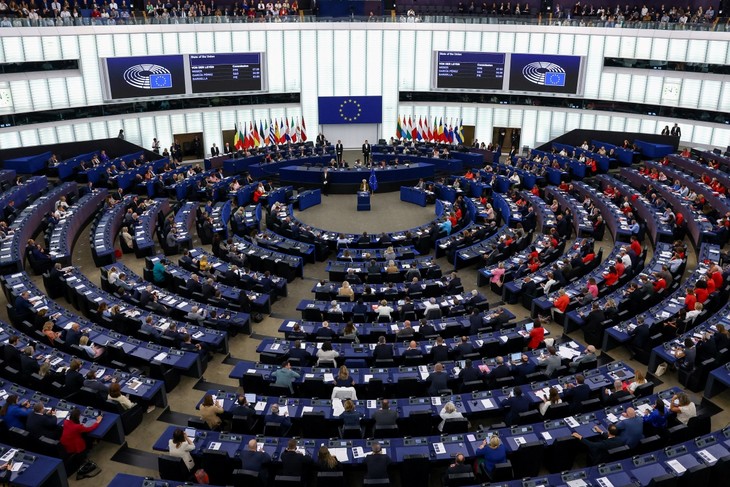 A European Parliament meeting in Strasbourg, France, September 10, 2025. (Photo: REUTERS/Yves Herman) A European Parliament meeting in Strasbourg, France, September 10, 2025. (Photo: REUTERS/Yves Herman) |
Fighting for the future
In this year’s speech, the EC President outlined new policy orientations, with foreign affairs taking center stage. Von der Leyen said the EU is in a fight for a continent that’s whole and at peace, for a free and independent Europe, and for its place in a world in which many major powers are either ambivalent or openly hostile to Europe.
Regarding tariffs and the trade agreement signed with the US last month, under which the EU agreed to a 15% export tariff to the American market, the EC President made it clear that the deal provides crucial stability in relations with the US at a time of grave global insecurity.
She warned of the chaos of a full-fledged trade war with the US, implicitly acknowledging a trade-off between economic interests and political stability, and pointed out what the EU needs to do.
“We need to do is double down on diversification and partnerships. 80% of our trade is with countries other than the US. So we need to capitalize on new opportunities. At a time when the global trading system is crumbling, we are securing global rules through bilateral agreements, like with Mexico or Mercosur, and finalizing negotiations on a historic deal with India by the end of this year,” von der Layen said.
Her “diversification” stance has won support from many European leaders. Earlier, German Chancellor Friedrich Merz said Europe must reassess its interests independently from its most important ally, the United States.
“Europeans can no longer expect the US to bear the main burden of security in Europe. We must acknowledge the fact that our relationship with the US is changing. The US is also reassessing its interests. We need a new approach to Europe's relations with the US without misplaced nostalgia,” said Merz.
Not all political forces in Europe support the EC’s new strategy or Ursula von der Leyen herself. Immediately after her State of the Union address, the “Patriots for Europe” (PfE) group, the third-largest political group in the European Parliament, submitted a motion of no confidence against the EC, arguing that its pursuit of controversial trade agreements undermines the EU’s strategic autonomy.
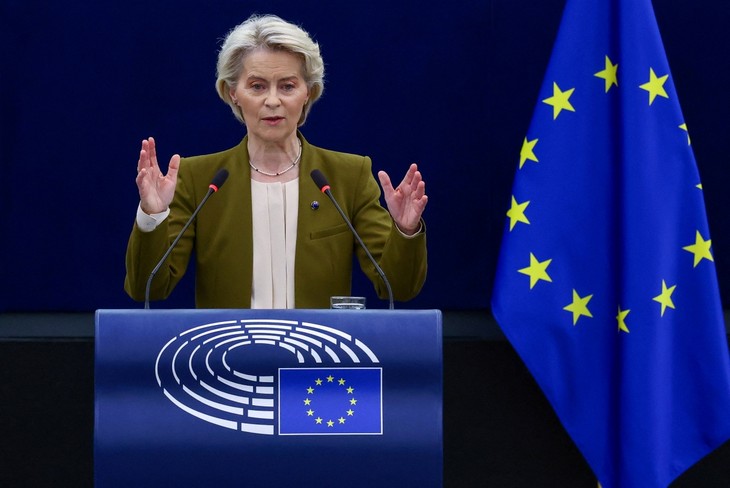 European Commission President Ursula von der Leyen delivers the State of the European Union address to the European Parliament, in Strasbourg, France, September 10, 2025. (Photo: REUTERS/Yves Herman) European Commission President Ursula von der Leyen delivers the State of the European Union address to the European Parliament, in Strasbourg, France, September 10, 2025. (Photo: REUTERS/Yves Herman) |
Uncertain economic outlook
The EU’s economic picture remains unclear. The Governing Council on Thursday decided to keep the three key ECB interest rates unchanged at 2%. It explained that inflation is currently at around the 2.1% medium-term target and its assessment of the inflation outlook is broadly unchanged. ECB President Christine Lagarde said that despite stable inflation indicators and growth forecasts, negative factors remain that require vigilance.
“Higher tariffs, a stronger euro, and increased global competition are expected to hold growth back for the rest of the year. However, headwinds on growth should fade next year," said Lagarde.
Observers say recent figures reinforce the ECB’s forecast that eurozone growth could reach 1.2% this year, up from the previous projection of 0.9%. However, at least four unpredictable factors may affect this outlook –the long-term impact of US tariffs, higher public spending by Germany (the EU’s largest economy), the prospect of a Federal Reserve interest rate cut, and political instability in France(the EU’s second-largest economy).
Ms. Lagarde said Europe’s priority at this time is to closely monitor and draw lessons from its recent trade case with the US, and to prepare for future challenges. Analysts believe the ECB will continue its cautious approach to monetary policy, and interest rates are likely to remain at current levels for an extended period.