(VOVWORLD) - The European Union and India announced a landmark free trade agreement on Tuesday. It’s the latest move showing that major economies worldwide are racing to diversify their economic partners, as global economic and trade relations are roiled by geopolitical tensions and unpredictable policies from certain major powers.
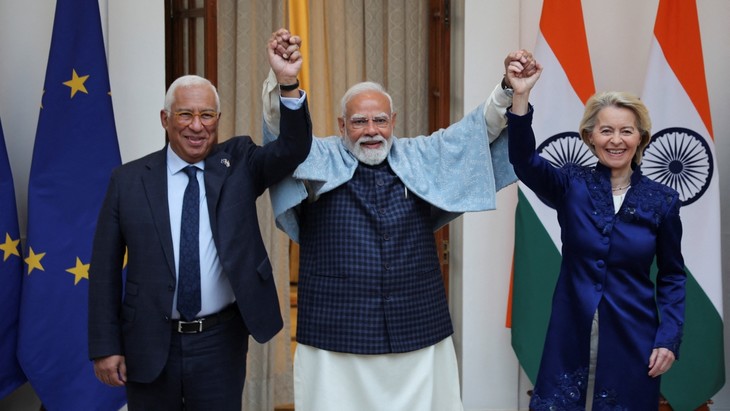 (From left) European Commission President Ursula von der Leyen, Indian Prime Minister Narendra Modi, and European Council President Antonio Costa pose during a photo opportunity ahead of their meeting at the Hyderabad House in New Delhi, India, January 27, 2026. (Photo: REUTERS/Altaf Hussain) (From left) European Commission President Ursula von der Leyen, Indian Prime Minister Narendra Modi, and European Council President Antonio Costa pose during a photo opportunity ahead of their meeting at the Hyderabad House in New Delhi, India, January 27, 2026. (Photo: REUTERS/Altaf Hussain) |
The EU and India concluded negotiations on a historic, ambitious and commercially significant free trade agreement after nearly two decades of talks. Earlier this year, the EU signed an FTA with the Southern Common Market (Mercosur). Economic relations between China and Canada and the UK have also recorded notable developments.
A historic agreement
Following the announcement of the FTA at the 16th EU-India Summit in New Delhi, both European Commission President Ursula von der Leyen and European Council President Antonio Costa described the pact as a major turning point in bilateral relations. The agreement, characterized by the EU and India as the “mother of all deals,” establishes a free trade area covering nearly two billion people.
It is projected to double EU goods exports to India by 2032 by eliminating or reducing tariffs on nearly 97% of trade value and will lead to savings of 4.75 billion USD in duties for European companies. The EU will cut tariffs on 99.5% of goods imported from India over seven years, with duties reduced to zero on products such as marine goods, leather and textile items, chemicals, rubber, base metals, gems, and jewellery.
Analyst Varg Folkman of the European Policy Centre said that the main impetus for the EU at present is to diversify its trade relationships, as it is becoming increasingly difficult to engage with the United States, which is closing its market to trade partners.
“This shows that the EU is taking its geopolitical situation seriously and is seeking to build new friendships and partnerships abroad. It demonstrates that the EU is moving forward decisively and responding to the situation with a sense of urgency.”
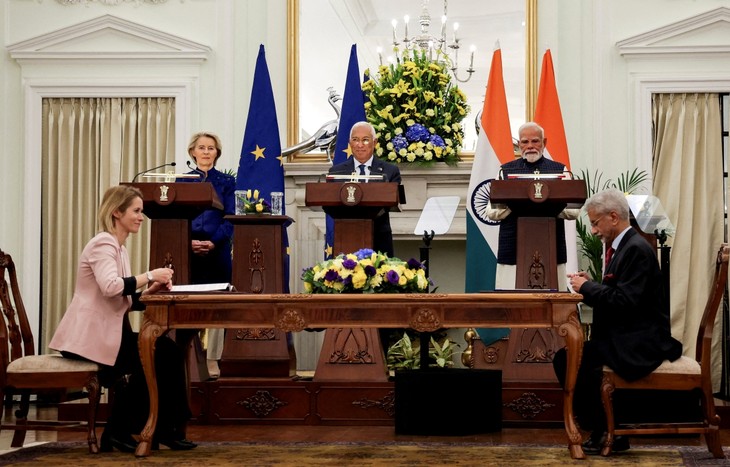 European Union High Representative for Foreign Affairs and Security Policy and European Commission Vice-President Kaja Kallas and India's Foreign Minister Subrahmanyam Jaishankar sign an EU-India Security and Defence Partnership agreement at the Hyderabad House in New Delhi, India, January 27, 2026. (Photo: REUTERS/Altaf Hussain) European Union High Representative for Foreign Affairs and Security Policy and European Commission Vice-President Kaja Kallas and India's Foreign Minister Subrahmanyam Jaishankar sign an EU-India Security and Defence Partnership agreement at the Hyderabad House in New Delhi, India, January 27, 2026. (Photo: REUTERS/Altaf Hussain) |
Reint Gropp, President of Germany’s Halle Institute for Economic Research, said that while India cannot yet replace the US in EU trade relations, it’s a fast-growing market of over one billion people. The two sides also signed a Security and Defence Partnership agreement, the EU-India Strategic Agenda toward 2030, and disaster risk management, finance, and digital trade agreements.
“This is an important step in the right direction. The EU needs to address the challenges it faces in trade relations with the United States, and India represents a significant market with a population of 1.4 billion. It may also become an important source of rare earths and other raw materials. For these reasons, this move is very welcome, especially in the context of the difficulties the EU is experiencing in other regions of the world,” Gropp elaborated.
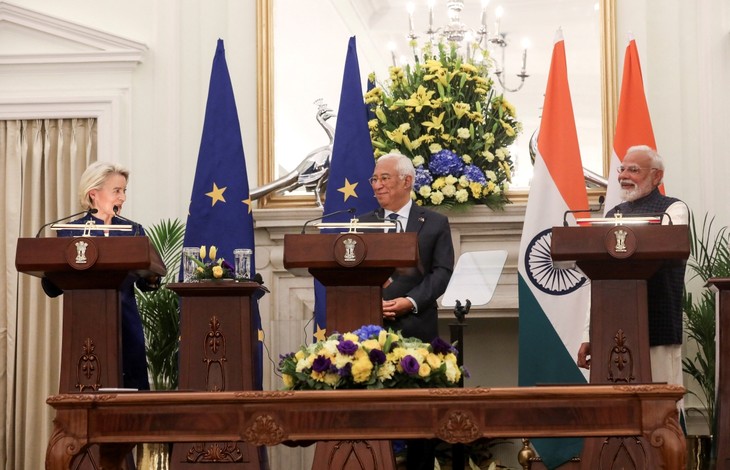 Indian Prime Minister Narendra Modi, European Council President Antonio Costa and European Commission President Ursula von der Leyen hold a joint press statement at the Hyderabad House in New Delhi, India, January 27, 2026. (Photo: REUTERS/Altaf Hussain) Indian Prime Minister Narendra Modi, European Council President Antonio Costa and European Commission President Ursula von der Leyen hold a joint press statement at the Hyderabad House in New Delhi, India, January 27, 2026. (Photo: REUTERS/Altaf Hussain) |
Reshaping partnerships
The EU and India are not the only economies seeking to diversify economic and trade partnerships amid rising geopolitical tensions and global economic uncertainty. Positive shifts in relations between China and the UK and Canada have drawn attention, even though their political, security, and economic relations with China have been turbulent in recent years.
On Thursday, British Prime Minister Keir Starmer visited China with the immediate goal of starting a dialogue on bilateral relations and a longer-term goal of establishing economic and trade ties for mutual benefit. He has become the first UK prime minister to visit China in eight years.
On January 16, Canadian Prime Minister Mark Carney visited China, reaching a preliminary trade agreement with the world’s second-largest economy and establishing what he described as a “partnership for a new order.”
Martin Cauchon, Vice Chairman of the Canada-China Business Council, said Carney’s visit took place as Canada prepares to review the North American Free Trade Agreement (NAFTA) with the US. Given current frictions in US-Canada relations, it’s a major question whether NAFTA can maintain its existing provisions.
Prime Minister Carney said Canada wants to double its exports to non-US markets over the next decade, giving it a strong reason to approach a major economic and technological partner like China.
For the UK, warming up relations with China is pragmatic diplomacy. Kerry Brown, Professor of China Studies at King’s College London, said that European countries are currently facing a geopolitical dilemma because the United States has become unpredictable and less friendly.
While this does not amount to a full pivot, it does require diversification and the pursuit of alternative opportunities, he said. “European nations need a degree of strategic autonomy, and they are increasingly beginning to recognize that the global landscape is no longer straightforward. In this context, the economy has become the most important strategic and security asset, and China inevitably factors into this equation because of the sheer size of its economy.”
Observers believe the reshaping of economic and trade partnerships, and possibly security and defense ties also, will be a dominant trend in international relations in the coming months, as geopolitical and global trade uncertainties show no sign of easing anytime soon.