(VOVWORLD) - Minister Pham Minh Chinh has written an article, highlighting economic diplomacy’s strong imprint in the country’s development and strategic integration.
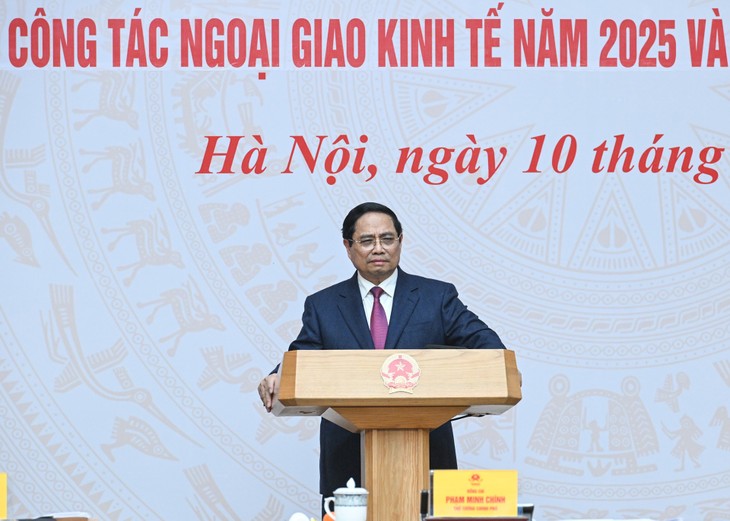 PM Pham Minh Chinh PM Pham Minh Chinh |
In the article “Economic diplomacy under strong transformation for the nation’s powerful development,” published ahead of the 14th National Party Congress, the PM emphasized the particularly important role of economic diplomacy in “leading the way and opening the path,” mobilizing resources, creating opportunities, and expanding development space for Vietnam’s rapid and sustainable growth in the new era.
The draft documents of the 14th National Party Congress emphasize the need to “promote comprehensive diplomacy in service of development, with economic diplomacy and technology diplomacy as focal areas,” the article said.
Innovation in economic diplomacy is no longer an option, but has become an objective requirement of reality, an urgent demand, a strategic choice, and one of the top priorities to realize the nation’s aspiration for powerful development and prosperity. In that context, economic diplomacy in the coming period will shoulder three major responsibilities.
First, it must contribute to shaping a strategic space for the country to enter an era of strong development, civilization, and prosperity.
Second, it must bring into play its role as an important driving force in attracting resources, removing bottlenecks and addressing major challenges in order to create breakthroughs in national growth and development, particularly in promoting science and technology, innovation, digital transformation and green transition.
Third, it must contribute to building an independent and self-reliant economy while proactively and actively advancing international integration.
With the motto “resources stem from thinking and vision; motivation stems from innovation and creativity; strength stems from the people and enterprises,” economic diplomacy and technology diplomacy in the next phase need to thoroughly grasp “three important lessons,” while adhering to the “five mores” principle.
The first important lesson is to persist in the path of national independence associated with socialism; remain steadfast in pursuing a foreign policy of independence, self-reliance, multilateralisation and diversification, proactive and active international integration, being a friend, a reliable partner and a responsible member of the international community.
The second lesson is to be resolute yet flexible, firmly protecting national interests while remaining highly adaptable in implementation to achieve set objectives.
The third lesson is to have a thorough understanding of the situation, and to provide timely, flexible, appropriate and effective policy advice.
The first of the “five mores” calls for more strategic and agile thinking to promptly identify new trends, proactively seize opportunities, and enhance the economy’s adaptability.
Second, economic diplomacy needs to be more focused and targeted in building objectives and solutions, closely aligned with national development goals in each period.
Third, it is necessary to further expand and deepen overall relations with partners as well as cooperation in each field, particularly in science and technology, innovation and digital transformation.
Fourth, economic diplomacy should be more resolute and creative in implementation, ensuring clear task assignment and substantive effectiveness in the spirit of “six clarities: clear person, clear task, clear responsibility, clear authority, clear timeline and clear results.”
Fifth, it must be more proactive and responsible in participating and contributing to international economic cooperation mechanisms and forums, as well as international and regional issues of strategic importance, in line with national requirements, capacities and conditions, especially in global economic governance.
Above all, foreign affairs, particularly economic diplomacy, must fully embody the spirit of “loyalty and dedication;” “confidence and creativity;” “resilience and flexibility;” “negotiation and persuasion;” “effectiveness as the top priority;” and “placing the Fatherland above all else.”
With far-sighted vision, deep thinking, and bold action - valuing time, intellect, and timely decisiveness - the diplomatic sector must continue to serve as a pioneering and core force in generating new opportunities, new momentum, and new external resources for rapid and sustainable national development, while enhancing Vietnam’s prestige and standing in the international arena.