(VOVWORLD) - Most of us remember English class as chalkboards and irregular verbs. But in a classroom in Lao Cai, things sound a little different—and a lot louder. Shidaun Campbell, an American instructional designer and professional popper, is teaching English not just through words, but through movement. As an English Language Fellow, he brings hip-hop and street dance into the classroom, helping students connect language with lived experience. In “That’s Life” this week, we explore how one teacher is swapping textbooks for dance breaks to bridge cultures—from the mountains of Northern Vietnam to the streets of California.
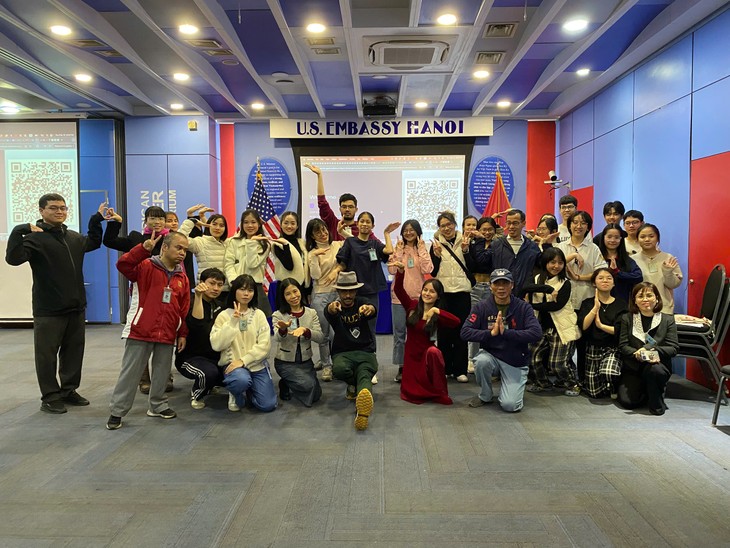 Shidaun Campbell introduces popping dance during a workshop: Experience American Culture Through Dance, Music & Stories! at The American Center in Hanoi (Photo credit: Shidaun Campbell)"Popping dance... when you see it, you know it. Think Michael Jackson. A lot of the popular dances... when you hear someone say ‘the robot’... usually that’s popping," Shidaun told VOV. Shidaun Campbell introduces popping dance during a workshop: Experience American Culture Through Dance, Music & Stories! at The American Center in Hanoi (Photo credit: Shidaun Campbell)"Popping dance... when you see it, you know it. Think Michael Jackson. A lot of the popular dances... when you hear someone say ‘the robot’... usually that’s popping," Shidaun told VOV. |
Popping, which originated in California in the late 1960s and 70s is a physical manifestation of the Post-Industrial American experience. It mimics the mechanical movements of the era while dancers prove that they are the one operating the controls, rather than being controlled by the system.
For many in Vietnam, American culture is just something read about in books or seen in Hollywood movies. But Shidaun wants to make it a "lived experience".
He believes that to truly understand a language, for example, one must feel the heartbeat of the culture it comes from.
He explains why music and dance are more effective than books in teaching culture, "Anything cultural... should be taught in the context of people. And what better way to connect directly with someone’s heart and mind and body than dance or music? It’s a direct experience that you get to have, that you get to connect with, instead of just reading about it."
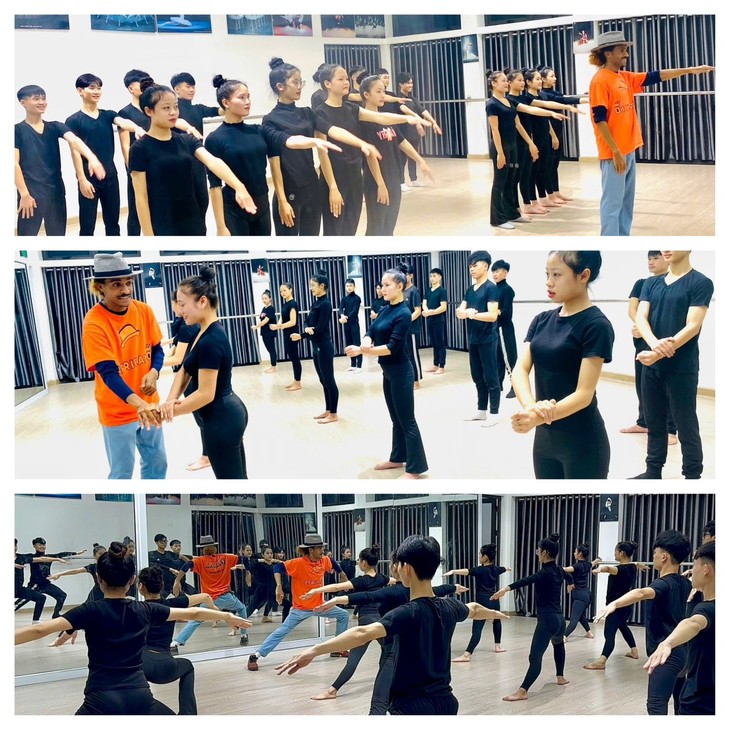 Teaching popping dance to major students at Lao Cai College (Photo credit: Shidaun Campbell) Teaching popping dance to major students at Lao Cai College (Photo credit: Shidaun Campbell) |
The context that Shidaun mentioned is rooted in the American narrative of “Marginalization and Metamorphosis”. Jazz dance and hip hop weren't born in a ballroom; they were born in the streets and nightclubs of communities that were denied a seat at the table. These dances are "survival turned into art".
By understanding the "fight for a voice" in a hiphop break, students in Vietnam aren't just learning English vocabulary, they’re learning about American culture.
“African American music and dance is essentially American music and dance. It started in the US and it grew within that space. Even though it came from diverse backgrounds... we all came together and created something."
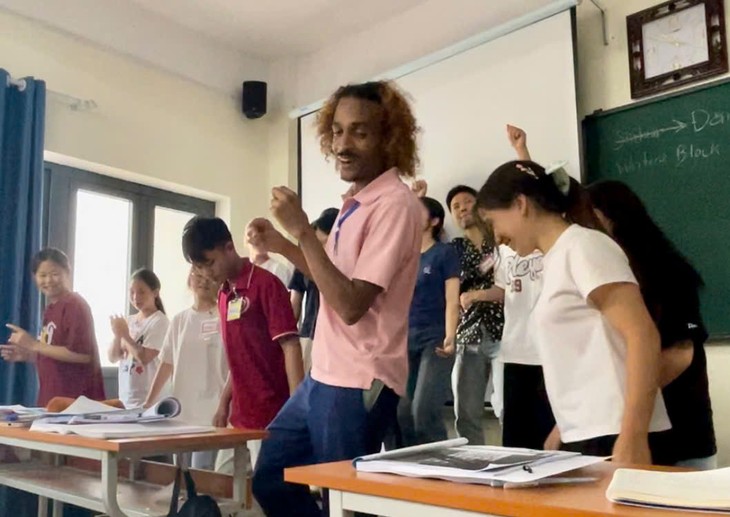 Shidaun Campbell and his English major students take a “dance break” in an English class at Lao Cai College (Photo credit: Shidaun Campbell) Shidaun Campbell and his English major students take a “dance break” in an English class at Lao Cai College (Photo credit: Shidaun Campbell) |
In his classes in Lao Cai, Shidaun doesn't just lecture, he moves. He uses "dance breaks" and "dance warmups" to change the energy of the room. He says that, while students might be shy individually, they transform when dancing as a group. Interestingly, he has found a parallel between his American roots and his students in northern Vietnam, many of whom belong to ethnic minority groups.
"It’s been interesting seeing how my students, especially in northern Vietnam, who belong to ethnic minority groups, have found ways to connect with the shared experience of ethnic minority groups in the United States,” said Shidaun, adding, “When it comes to embracing diversity within a certain space, within the space where we’re all living together and we're all sharing our cultures in one space, it's really cool to see."
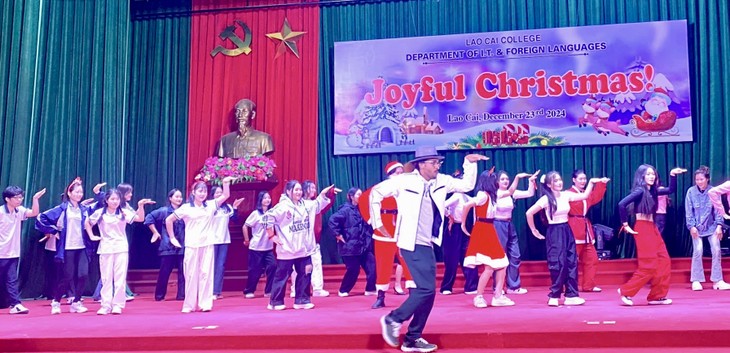 Shidaun Campbell performs with his students in 2024 for Lao Cai College’s Christmas event (Photo credit: Shidaun Campbell) Shidaun Campbell performs with his students in 2024 for Lao Cai College’s Christmas event (Photo credit: Shidaun Campbell) |
In Shidaun’s lesson, culture isn't static. Whether it’s a traditional Mong circle dance or a hiphop line dance, the core is building communal empathy. Shidaun uses "dance breaks" to dismantle the hierarchy of a traditional classroom and create a space where the shared experience of the group overcomes the shyness of the individual.
"So, it gives greater insight, and with that insight comes understanding, and with that understanding comes empathy and even ownership, you might say. So, if you're learning a language... for example, if you're learning English... and now you understand why we say something and what feeling we need to say it with and why, then you become a part of it and that connects you to something greater."
As Shidaun Campbell continues his fellowship in Lao Cai, he is showing that the best way to learn about a neighbor across the ocean might not be by reading or listening to words, but by dancing to their songs to feel their heartbeat.
Shidaun Campbell teaching popping dance during a workshop at The American Center in HCMC (Photo credit: Shidaun Campbell)
|
Shidaun Campbell is showing that language is more than vocabulary, it is rhythm, emotion and connection. Through each beat and movement, students are not only learning English, but also experiencing the culture behind it in a personal way.
In a classroom where shyness gives way to shared energy, dance becomes a bridge, linking distant cultures through common human expression. Because sometimes, understanding does not begin with words, but with a feeling. And in that moment, when music plays and bodies move together, the distance between Vietnam and America feels just a little bit smaller.