



(Photo: Cam Thi)
From a historic mission to a new book
"Five, four, three, two, one… launch!"
With those unforgettable words, retired Lieutenant General Pham Tuan recalled the moment he blasted into history on a space mission in 1980 under the Soviet Union’s Intercosmos program, becoming the first Vietnamese and the first Asian to travel into space. His remarkable journey was not only a personal triumph but also a milestone for Vietnam, a nation striving at that time to rebuild after years of war.
"July 31, 1980, was a truly historic day. Forty-six years ago, the spacecraft carrying Vietnam's first astronaut and the first Asian to venture into space returned safely to Earth after 8 days in orbit, completing 142 revolutions around the planet. Today, we mark that remarkable anniversary with the launch of a new book that revisits this milestone in Vietnam's history.”
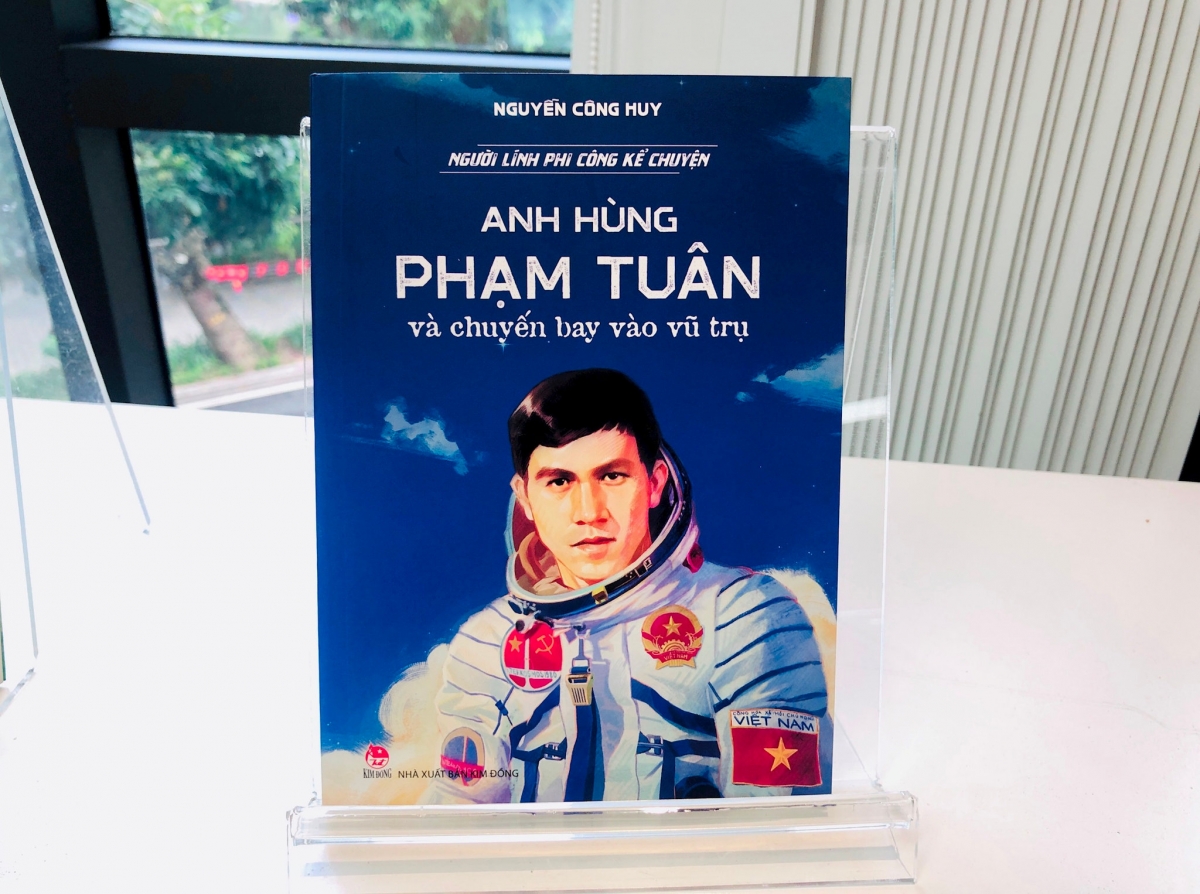
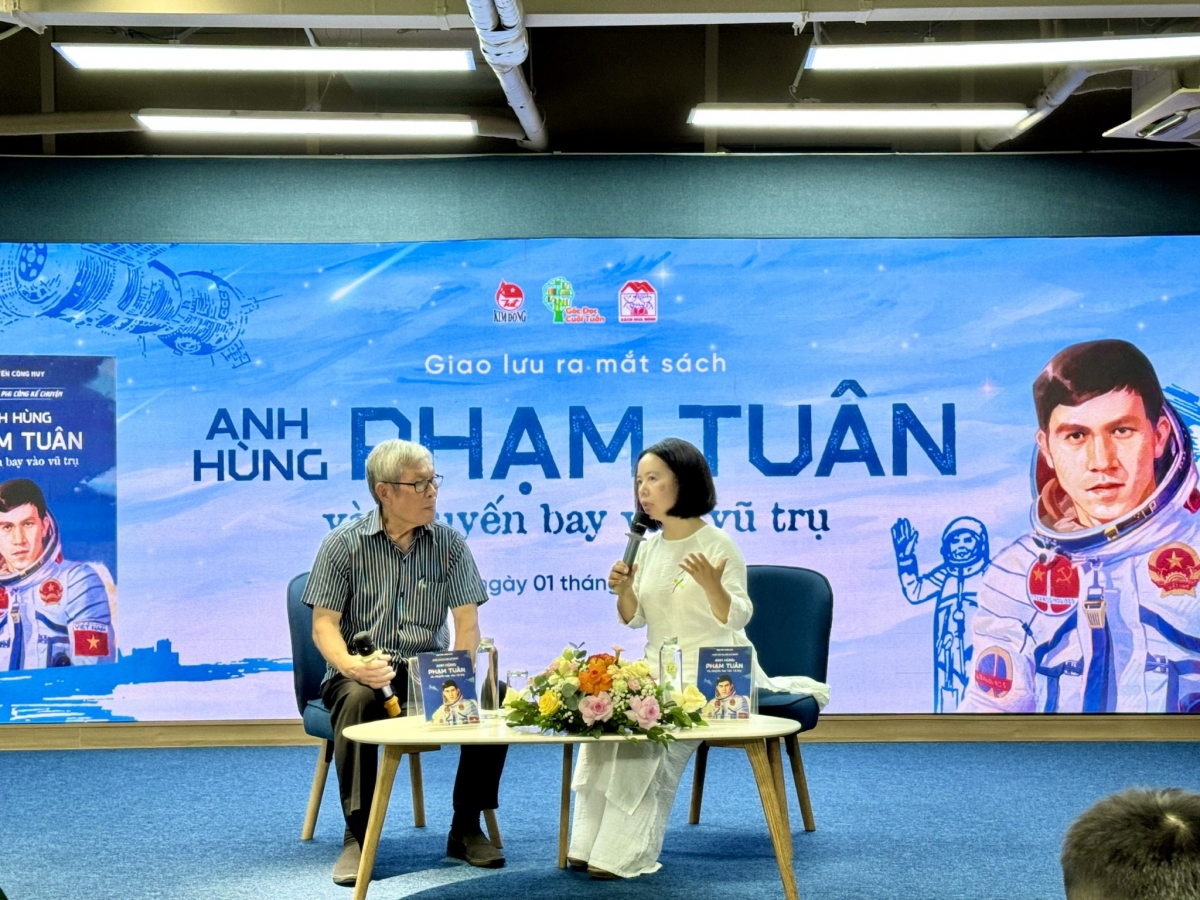
Drawing on extensive historical documents and interviews with key figures involved in the event, writer Nguyen Cong Huy, a former MiG-21 fighter pilot and Pham Tuan's wartime comrade, reconstructs the extraordinary journey behind the historic mission in his book “Hero Pham Tuan and the journey into space", the latest in his series chronicling the lives and achievements of Vietnam’s legendary pilots and heroes.
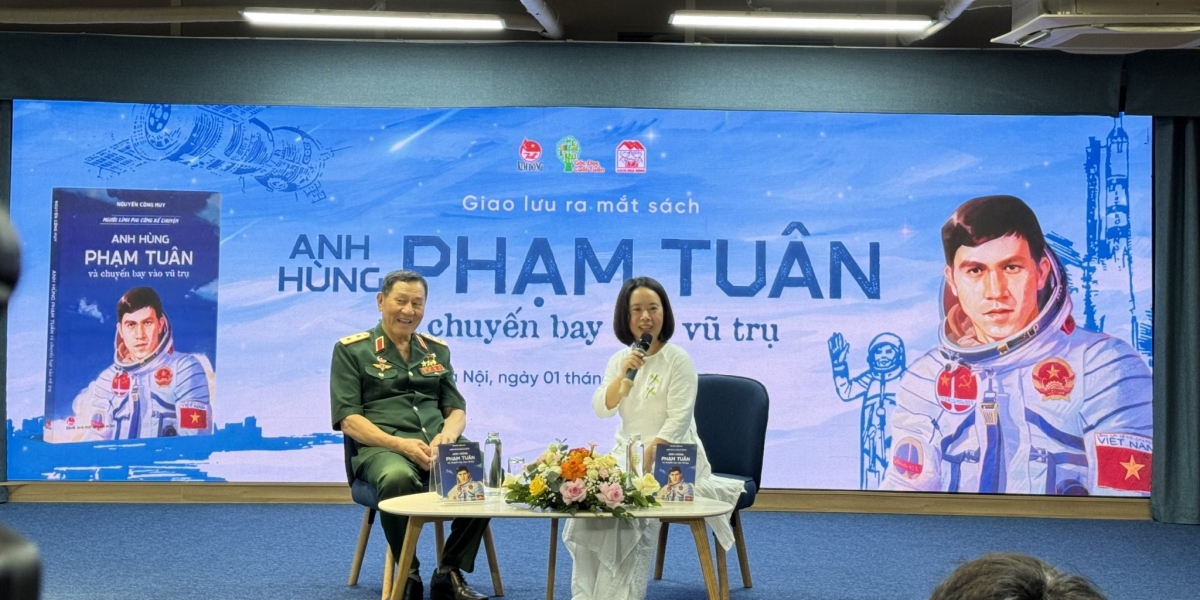
Mr Huy said at the book launch ceremony in Hanoi on August 1 this year. "Pham Tuan possesses qualities that set him apart from other pilots. He was the first Asian to travel into space and, to this day, the only Vietnamese to have been honored with three Hero titles – Hero of the People's Armed Forces, Labor Hero, and Hero of the Soviet Union – for his achievements in space. I wanted to record his life and his journey into space to send a message to young people that Vietnamese people are fully capable of conquering, not only the skies, but also outer space. We have the ability to master science and technology and stand alongside the world's most advanced nations."
The 172-page book takes readers through the demanding selection process, the gruelling astronaut training, the tense countdown to lift-off, the crew's daily work and scientific experiments in orbit, and the dramatic yet safe landing on the vast Kazakh steppe that brought the mission to a successful conclusion.

writes 4 books about Vietnamese pilots.
From fighter pilot to astronaut
On July 23,1980, from the Baikonur Cosmodrome in Kazakhstan, pilot Pham Tuan and Soviet cosmonaut Viktor Gorbatko lifted off aboard Soyuz 37, embarking on a landmark mission in the history of Vietnamese science and space exploration. At a time when Vietnam was only beginning to recover from the devastation of war and faced immense economic hardship, sending a Vietnamese into space was a remarkable achievement.
Even today, travelling into orbit remains an extraordinary mission reserved for only a handful of people. At the book launch, Lieutenant General Pham Tuan, 79, energetic and in good health, recounted his remarkable journey from military service in the Vietnam Air Defence and Air Force to becoming a fighter pilot and eventually an astronaut. While this part of his life was not included in the book, his reflections captured many historic milestones of Vietnam.
"When I applied to become a pilot in 1965, I failed the medical examination because doctors detected a heart condition. Instead, I was recruited into the military as an aircraft radar maintenance technician. During a training course in the Soviet Union, some Vietnamese pilot trainees did not meet the medical requirements and had to be replaced. Soviet doctors selected 10 candidates from about 300 Vietnamese aircraft mechanics to begin pilot training. I was fortunate to be one of them," Lieutenant General Tuan said.
After passing the medical assessments, Pham Tuan was admitted to the Krasnodar Military Aviation School in early 1966. The academy trained cadets from many countries. Although the Vietnamese trainees faced a language barrier and had less academic preparation than some of their foreign counterparts, their determination and hard work enabled them to achieve impressive results in both classroom studies and flight training.
(Photo: Cam Thi)
By the end of 1967, Pham Tuan had graduated as a fighter pilot, earning a reputation for his exceptional night-flying skills. After returning to Vietnam, he joined the Red Star Air Regiment, where he took part in combat operations to defend the skies over northern Vietnam. In the middle of 1972, he was one of 12 elite pilots selected for specialized training in night operations and B-52 interception under conditions of intense electronic jamming.
"In December 1972, I took part in all 12 days and nights of the campaign against the US’s B-52 bombers over the skies of Hanoi. Of course, there were many close calls. My aircraft crashed more than once, overturned in bomb craters, and I had to crawl out of the cockpit and carry on fighting," Mr Tuan recalled.
On December 27, 1972, the tenth day of Operation Linebacker II, the strategic bombing campaign conducted by the US against Northern Vietnam, Pham Tuan flew a MiG-21 armed with two missiles. He closed in on a B-52 bomber and fired both missiles, bringing it down. Pham Tuan became the first pilot in the world to shoot down a B-52 and return safely from the mission. A second B-52bomber was brought down by martyr Vu Xuan Thieu. Flying his MiG-21 to within close range of the bomber, he fired both of his missiles, but the badly damaged B-52 did not immediately crash. Thieu made the ultimate sacrifice by deliberately ramming his aircraft into the enemy bomber, destroying it at the cost of his own life.
After Vietnam's reunification in 1975, Pham Tuan returned to the Soviet Union in 1977 to study at the Gagarin Air Force Academy before being selected for the joint Soviet-Vietnamese space program. At the book launch, he revealed little-known details about the rigorous astronaut selection process in both Vietnam and the Soviet Union in 1979.
“Initially, my name was not included on the shortlist because of the heart condition noted in my medical records when I first applied for pilot training years earlier. However, after further assessments, Soviet doctors selected me and fellow pilot Bui Thanh Liem to undergo parallel training for the space mission. The medical screening was exceptionally thorough, and the training itself was both physically and mentally demanding,” Mr Tuan said.
The selection process involved rigorous psychological and clinical tests to identify candidates with strong mental resilience, sharp concentration, good memory, and the ability to react quickly and accurately. Candidates also underwent specialised aviation tests, as well as assessments of their ability to endure prolonged isolation in confined, poorly lit conditions and extreme heat and cold. They also went through tests on their general education and aviation knowledge. In short, becoming a cosmonaut required, not only exceptional physical and psychological resilience, but also the intelligence, technical skills,and determination to cope with the extreme challenges of spaceflight.
Lieutenant General Pham Tuan recalled: "At that time, neither Mr Liem nor I knew who would eventually fly. We trained in parallel, each assigned to a separate team with our own instructors. We simply focused on our training. We were never told how we were performing, good or bad, or what scores we had achieved. Everything was kept confidential. To avoid creating a sense of a 'primary' astronaut and a 'backup', we underwent exactly the same training. It was only three days before the launch that the Soviet State Commission announced I would be the primary crew member, while Bui Thanh Liem would be the backup. It was only at the very last moment that I knew for certain I would fly on July 23, 1980."
During his space mission, Pham Tuan took several items symbolising Vietnam with him into space, including President Ho Chi Minh's Testament, a copy of the Declaration of Independence delivered by President Ho Chi Minh on September 2, 1945, a handful of soil from Ba Dinh Square, where the Declaration was read, the national flag of Vietnam, and two badges bearing portraits of Vietnam's national leaders.
A view of Earth without borders
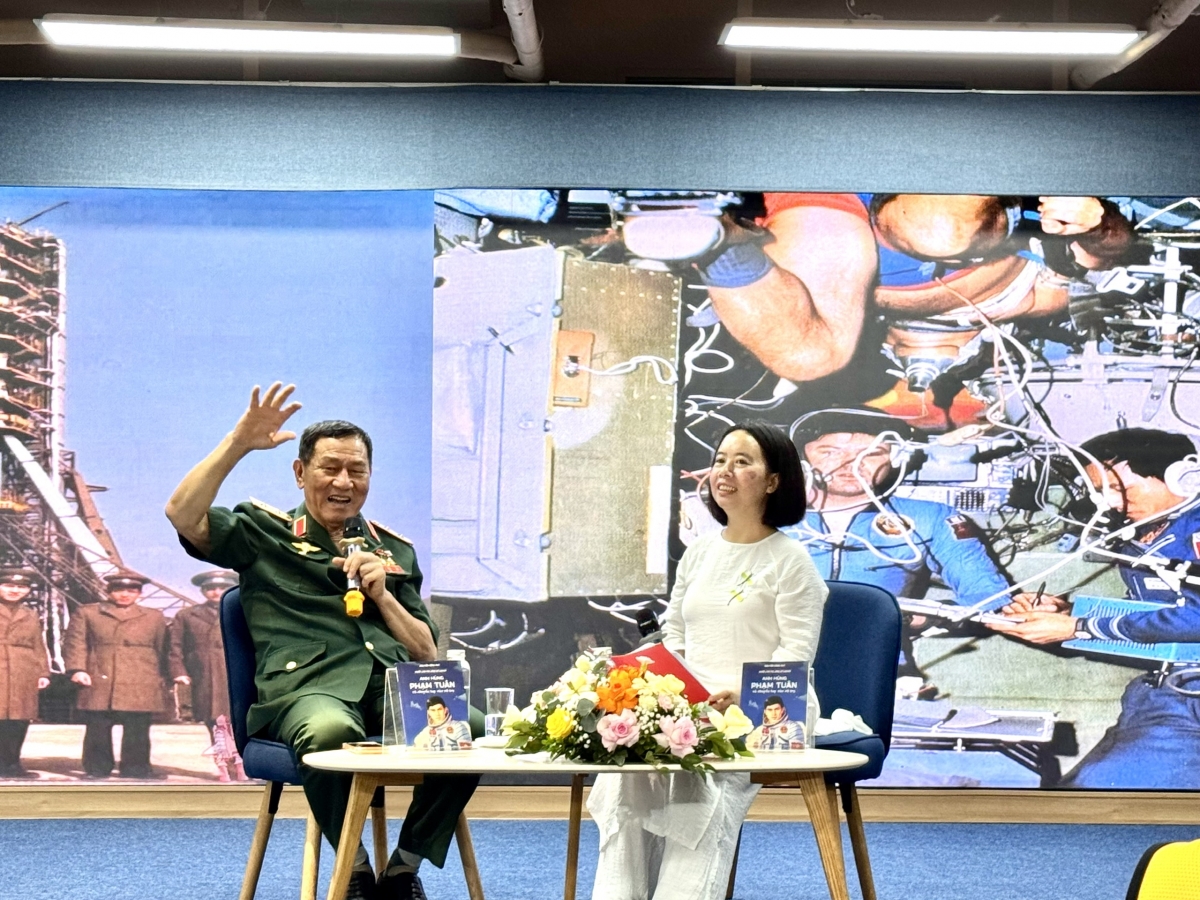
Space exploration sparked tremendous curiosity among the audience at the book launch, especially children, as it is something most of them have only encountered through films and documentaries. But listening to Lieutenant General Pham Tuan describe his own experiences – from communicating with Mission Control and following instructions from Earth to eating, drinking, attending to personal needs, and carrying out scientific experiments in orbit –made the reality of spaceflight far more vivid.
“After the Soyuz 37 spacecraft docked with the Salyut 6 space station, three Soviet cosmonauts and I carried out around 30 scientific experiments in the fields of space physics, biomedicine, and metallurgy under weightless conditions. The research aimed to deepen scientists' understanding of the Earth as a celestial body.”
A major focus of the mission was to observe the complex interactions between natural phenomena and human activity, contributing valuable data to scientific research on the Earth and outer space. One of Pham Tuan’s most unforgettable memories was the first time he looked out the spacecraft's window. "Looking straight down, I could see the clouds, the oceans, the continents and the countries below. I could even recognise Vietnam because it’s so distinctive. Our country has the shape of the letter 'S' and stretches along the coastline, where the waves trace its outline so clearly that it’s easy to identify from space. Of course, you can't make out individual villages, but by comparing what I saw through the window with the maps and navigation charts on board, I could clearly tell when we were passing over Vietnam."
At that moment, Pham Tuan remembered the words of Russian astronaut Yuri Gagarin, the first human to fly into space, “Our Earth is so beautiful. Let us preserve and protect this beauty together.” "We had only one thought: the Earth is our home. From space, there are no borders separating one country from another. Looking back at our planet, I thought about the people below – our fellow Vietnamese, and people all over the world – living their lives in peace. It was a deeply moving moment. I felt incredibly honored to have experienced something so extraordinary."
Pham Tuan’s journey into space brought a range of emotions unlike anything he had experienced during his long career as a pilot—from anxiety and excitement to the intense sense of danger during lift-off and landing. Sitting inside the spacecraft, with tons of rocket propellant beneath him, was an experience he could hardly put into words.
"Returning safely to Earth was the greatest joy of all. The mission was full of pressure and there were many situations that could have led to danger. So, completing the mission and making it safely back to Earth was a tremendous relief. It was the success of science and technology, the collective achievement of the entire team, not just the astronauts. Our safe return was made possible by the engineers, technicians, and all those who worked on Earth to support the mission," Mr. Tuan said.
Some children at the event said: "Hearing him share his story today, I’ve learned much more about him. His example has inspired me to work hard to achieve my own dreams."
"Before coming here, I didn't know much about Hero Pham Tuan. Today, I heard him talk about how he initially failed the pilot selection but continued to train hard and pursue his dream. I learned that we need to keep trying if we want to succeed."
"My family always encourages us children to read books about historical figures and events like this. Having a good knowledge of history will be very useful for our studies."
Forty-six years after he looked back at Earth from orbit, Pham Tuan continues to inspire new generations to dream boldly, work tirelessly, and believe that no goal is beyond their reach. "No one is born perfect, either physically or intellectually. But with determination, perseverance, and the right direction, we can all achieve great things in life."