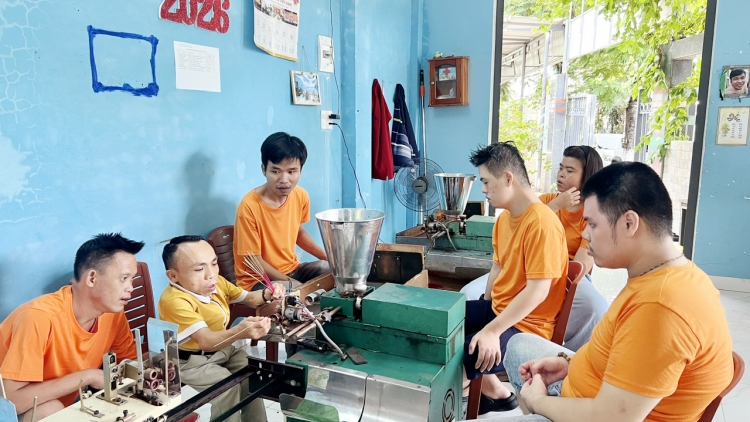





Vietnam has paid special attention to addressing the consequences of Agent Orange/dioxin exposure, with policies aimed at supporting victims and their families. In 2026, these efforts took a further step, when a nationwide program to replace substandard housing was extended to the biological children of war veterans affected by chemical toxins.
As of the end of July, construction had begun on more than 2,000 houses, and 900 had been completed. Military personnel had spent 44,000 man days building safe, secure homes for families of Agent Orange/dioxin victims.
Duong Thi Thanh, a resident of Gia Lai province, and Le Thanh Thuy of Can Tho city, are two beneficiaries.
"The State provided funding to help my mother and me build a house. When I heard that soldiers were coming to build houses for people like us, I hoped they would finish soon so my mother and I would have a home of our own."
"I never got married. I live with my younger sibling. We live day to day, so there’s no way we could afford to build a house like this. Now that the State has provided us with one, we’re very happy."
Previous support focused on financial assistance, healthcare, and employment, but improving living conditions for Agent Orange/dioxin victims is now being added as a more fundamental solution.
Lieutenant General Nguyen Huu Chinh, Chairman of the Vietnam Association for Victims of Agent Orange/dioxin, said the Association has replaced 3,400 substandard houses for Agent Orange/dioxin victims.
Mr. Chinh said: "Based on our recommendations concerning second- and third-generation victims, the Prime Minister directed local authorities and our Association to review their housing situation and replace temporary and dilapidated houses. These are concrete results, reflecting the Party and State's attention to the victims."
A new home can’t erase the lasting consequences of war, but it can give an affected family a way to stabilize their life and build a better future.