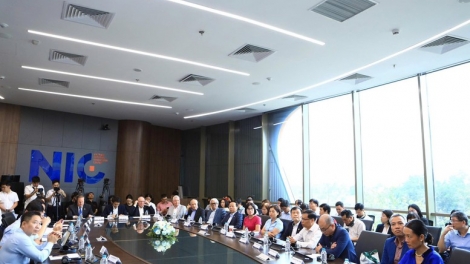




The report, compiled with contributions from domestic and international partners, reflects investment trends shifting toward emerging technology sectors and improvements in Vietnam’s investment and business environment.
Businesses placed at the center of reform
Amid intense global competition, many countries have prioritized investment in strategic sectors like artificial intelligence, semiconductors, big data, and green technology. Vietnam has joined this trend.
Instead of continuing to compete through low labor costs and tax incentives as in the past, Vietnam is looking to greater institutional transparency, a more favorable investment environment, and a more dynamic innovation ecosystem. This is reflected in the major policies and resolutions issued recently, including the Politburo’s Resolution 57 on breakthroughs in science, technology, innovation, and national digital transformation, the Politburo’s Resolution 68 on private sector development, and laws related to science, technology, digital transformation, and artificial intelligence. The Government is promoting sandbox mechanisms for financial technology, AI, semiconductors, and new business models to create more room for innovation.
On April 29, the Government adopted 8 resolutions abolishing 184 administrative procedures and 890 business conditions. These moves have been positively received by the business community and investors.

Max-F. Scheichenost, founding member of the Vietnam Private Capital Agency and founder and CEO of NGF Partner, said: “I’ve invested in North America, in Europe, and now since 2011, in Asia. And I've set up different companies in Singapore, Hong Kong, and now also in Vietnam. So I think one of the key factors as an international investor is really the ease of doing business. The first time I invested in Vietnam was in 2014, and it took us like months to get the investment done, to get like all of the paperwork done. I was just impressed about the improvement just over this short period of time. So we had international quality service providers.”
Another notable shift is that innovation is becoming more open and practical. While startups were once viewed as experimental models, the startup ecosystem is now recognized as a growth driver for the economy.
The establishment of national innovation centers, startup investment funds, and collaboration programs between technology firms and international investors demonstrates Vietnam’s determination to build an innovation ecosystem capable of competing regionally.
Michael Driol, the CEO of Mekong Partner, said: “Vietnam must now transition from a cost economy to a capability economy. That means more engineers, more R&D, more services integration, and stronger domestic enterprises that can compete globally.”

Vietnam affirms commitment to reform and supporting investors
At a time when international investment flows are becoming more cautious and demanding higher levels of transparency, stability, and sustainability, Vietnam has affirmed its commitment to reform and partnership with investors.
The release of the Vietnam Technology and Innovation Investment Report 2026 goes beyond statistics and market analysis, it reaffirms Vietnam’s aspiration to build an economy based on knowledge, technology, and innovation, where the private sector, technology firms, and startups are key growth drivers.
Le Hoang Uyen Vy, CEO of Do Ventures and co-organizer of the Vietnam Innovation and Private Capital Summit 2026, said: “We want to inform global investors that Vietnam is introducing major policy changes to mobilize investment flows in strategic technology sectors. As a result, both investors and the investment receivers can become strong growth drivers, helping Vietnam become a leading nation in innovation and science and technology.”
Reforms in the investment and business environment are creating a foundation for stronger trust on the part of international businesses and investors. This will increase Vietnam’s competitiveness, attract high-quality resources, and foster rapid, sustainable growth.