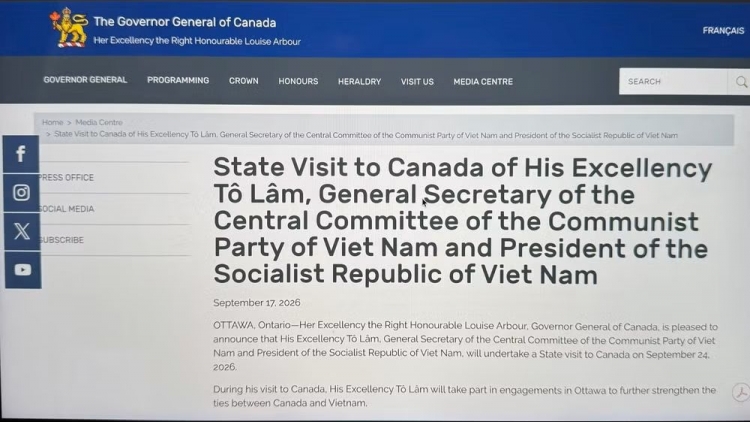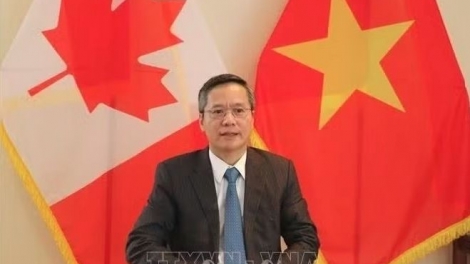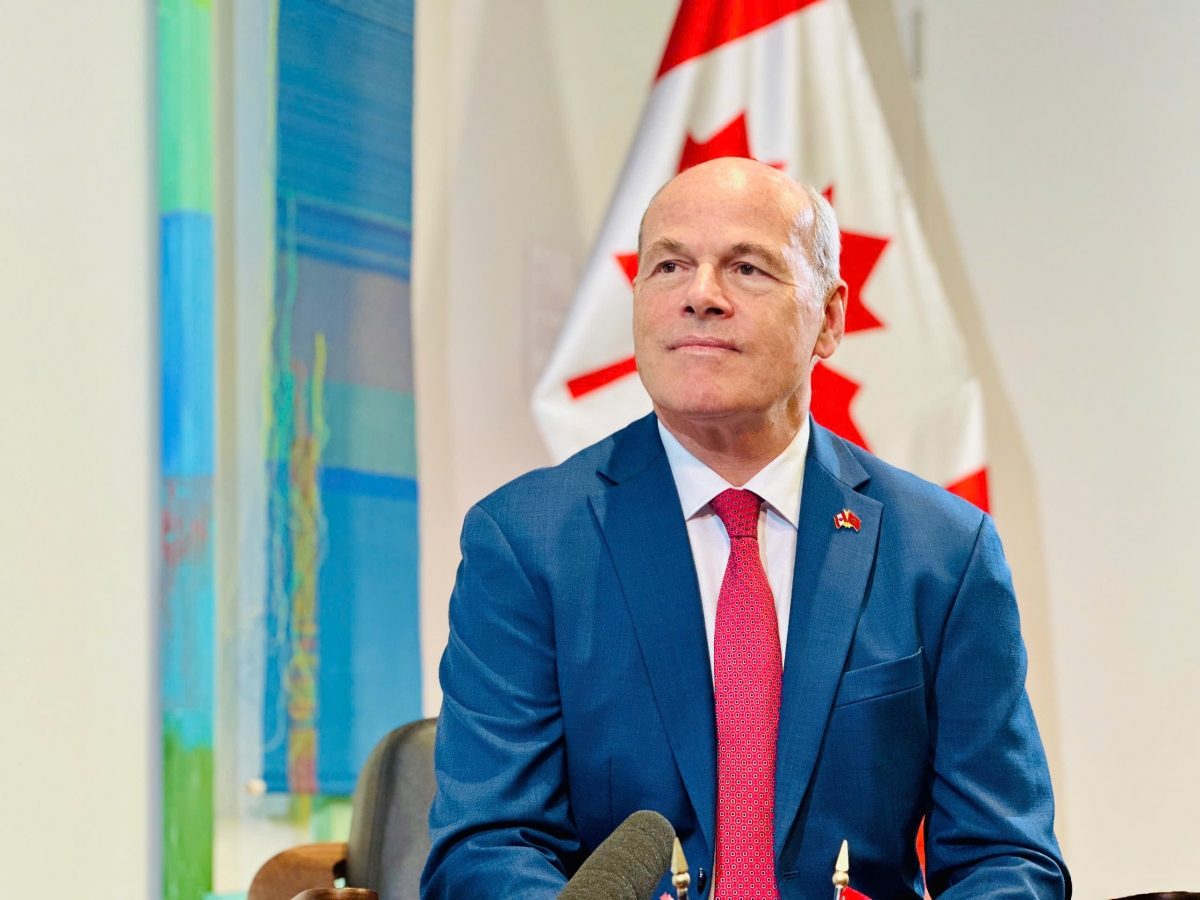
Reporter: Thank you for giving us your time, your excellency. Party General Secretary and President To Lam is making a historic visit to Canada. What is the strategic significance of this visit?
Ambassador Jim Nickel: Thank you very much. It’s my pleasure. Canada is very much looking forward to this historic visit by Party General Secretary and President of the Socialist Republic of Vietnam to Canada. This will be the first such visit in our bilateral relations in more than 50 years of diplomatic relations. That in itself is an important milestone in the bilateral relationship. We have had diplomatic relations since 1973, and in 2017 we established a Comprehensive Partnership which brought our relationship to another level. It's been a very fruitful, productive relationship. But we believe that this visit will have an important impact on the relationship, taking it to an even higher level.
Reporter: Vietnam-Canada trade has achieved strong momentum in recent years. What has been driving this growth and what targets have been set for the years ahead?
Ambassador Jim Nickel: The economic relationship between Vietnam and Canada has grown significantly over the past several years. We've doubled our trade and economic relationship over the past 5 years. Two-way trade investment increased another 30% over the past year, from 15.7 billion Canadian dollars to 20.6 billion Canadian dollars. The vast majority of that is Vietnamese exports to Canada. A lot of that has been in the agriculture and agrifood sector, servicing both Vietnam's and Canada's food security needs, but also supplying our food processing area. Other areas, such as aviation, are growing rapidly and Canada has a number of aviation capabilities.
Our intention over the next five or more years is to double again the two-way trade between our two countries if we can develop energy cooperation, agriculture and agrifood, science-technology innovation, and aviation. In those areas, if we can further develop cooperation between our countries, I believe we can easily double the two-way trade investment relationship over the next five years.
Reporter: Investment remains an under-performing area relative to trade. Which sectors offer the greatest investment potential, and what lessons can Vietnam draw from Canada regarding International Financial Centers?
Ambassador Jim Nickel: I think you're correct that investment is an under-performing area of our relationship and we would like to see greater investment ties both ways.
Canada is very interested in what Vietnam is doing with the international financial centers in Ho Chi Minh City and Da Nang. We'll be watching that very closely to see if there are opportunities for Canadian investors to participate in the international financial centers, as those will be entry points to access many different areas of activities in Vietnam. But we also see a lot of infrastructure development, energy infrastructure growth, and agricultural transformations in Vietnam that can all be driven by investment.
Canada has very robust financial institutions, major banks, and pension funds that are globally recognized as having very high standards, one of the key things making Canada attractive as a place for investment. But you ask me, the key things are political stability (which Vietnam has), transparency, and predictability. Transparency and predictability can be achieved through good regulation, a good judicial system, and regulatory reform. The regulatory framework around financial institutions is key for a lot of investors.
Reporter: Both Vietnam and Canada have committed to net-zero targets. How can they deepen cooperation in energy transition and clean technology?
Ambassador Jim Nickel: Canada and Vietnam have the same net zero targets that we're obliged to meet. Canada is quite fortunate in that 82% of our energy production is currently clean green energy. In some provinces of Canada, it's close to 100% green energy and that's given the hydroelectricity and other capabilities we have.
As Vietnam develops its advanced manufacturing, data centers, international financial centers, and semiconductor industry, that will require a lot of energy.
Canada has a lot of conventional energy, renewable energy technologies, and a lot of capabilities in the energy space related to energy grids, the electricity grid, power plants, all of these technologies, including nuclear technology. Canada has a very strong nuclear energy sector. That combination creates opportunities for Vietnamese companies and the government of Vietnam to work closely with Canadian companies and the government of Canada to have a partnership in energy that could be very useful for both Vietnam and Canada going forward.
We would encourage Vietnam to invest in Canada's energy sector to secure your own energy supply. If Vietnam were to take an equity stake in Canadian energy projects or long-term offtake agreements with Canada, it would be a very good way to secure Vietnam's energy future.
Reporter: As Vietnam shifts toward a high-tech, innovation-driven development model, how can Canada support advanced technology sectors and workforce development?
Ambassador Jim Nickel: Science, technology, and innovation will be the area that will really transform the economy and ensure continued economic growth and prosperity into the future. Canada has very strong capabilities in information communications technologies, satellite technologies, technologies applied to the energy transition, and digital transformation—whether involving AI, quantum computing, or semiconductors— and these are evolving areas in Vietnam.
Human resource development is important for every country to secure its economic growth going forward. If we don't have the talent, then we can't continue to have our industries grow. Through our education partnerships we can help each other develop the workforce for the future.
Over the past five years, 233 Vietnamese students have received scholarships from Canada to study STEM subjects in Canada. This year alone, another 66 Vietnamese students will receive scholarships to study and do research in Canada. We will be giving 40 scholarships to Canadian researchers to pursue research with academic institutions in Vietnam to help develop the innovation ecosystem.
Reporter: Thank you so much, Ambassador Jim Nickel, for your insights. We look forward to seeing the continued growth of the partnership between Vietnam and Canada.