



In this edition of Doctor at Home, our guest is Dr. Nguyen Binh Duong, Head of the Center for Reproductive Medicine and Infertility at Hong Ngoc–Phuc Truong Minh General Hospital. He will explain how mini IVF approach fits into today’s IVF practice, and how doctors tailor treatment choices to each patient’s medical condition, emotional readiness, and family goals.
Reporter: Hello doctor, thank you for joining us today. The term “Mini IVF” is gaining attention lately. For listeners who may be unfamiliar with it, how would you describe mini IVF in simple terms?
Doctor Duong: Mini IVF is a kind of IVF where we use mild stimulation protocols. This is a protocol with less medication compared to conventional IVF. We usually get 3 or 4 oocytes, or eggs, per cycle and therefore 1 or 2 embryos. The mini IVF is friendlier and cheaper, and has a reasonable success rate compared to others. The mini IVF usually has around 5 days of oral medications and 5 days of injections compared to conventional IVF, which has about 10 days of injections on average. So the mini will reduce the time patients need to come to the hospital for medication applications. Like if you need to do 10 days of injections, some people must come to the hospital every day for 10 days. So we reduce the time the patient must appear in the hospital. And second, because we use a maximum of only 5 days of injections, so it reduces the pain for the patients. So overall it improves the patient experience during the treatment.
Reporter: In what situations or for which patients does mini IVF tend to be a more suitable or thoughtful option?
Doctor Duong: We usually recommend the mini IVF for patients. First is the patient who has a lower ovarian reserve because with conventional IVF or mini IVF, we only get the same number of eggs, like 3 or 4 eggs. So if at the start of the cycle you have only 4 or 5 follicles, the mini is good for you. The second one is the patient who is seeking only one more child. Some patients who are Christians, they don't want to discard embryos, for example. Or patients who don't want to generate too many embryos because in the future they will face a dilemma of whether they should keep or discard the embryos later. So the mini IVF which generates only one or two embryos is good for them. The third one is the patient who wants to have a more economical infertility treatment because when we do the mini IVF, the price reduces to around one half or one third compared to conventional IVF. So it will be a good choice for them.
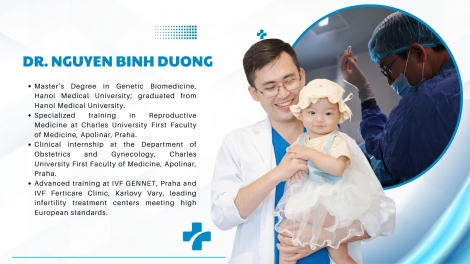
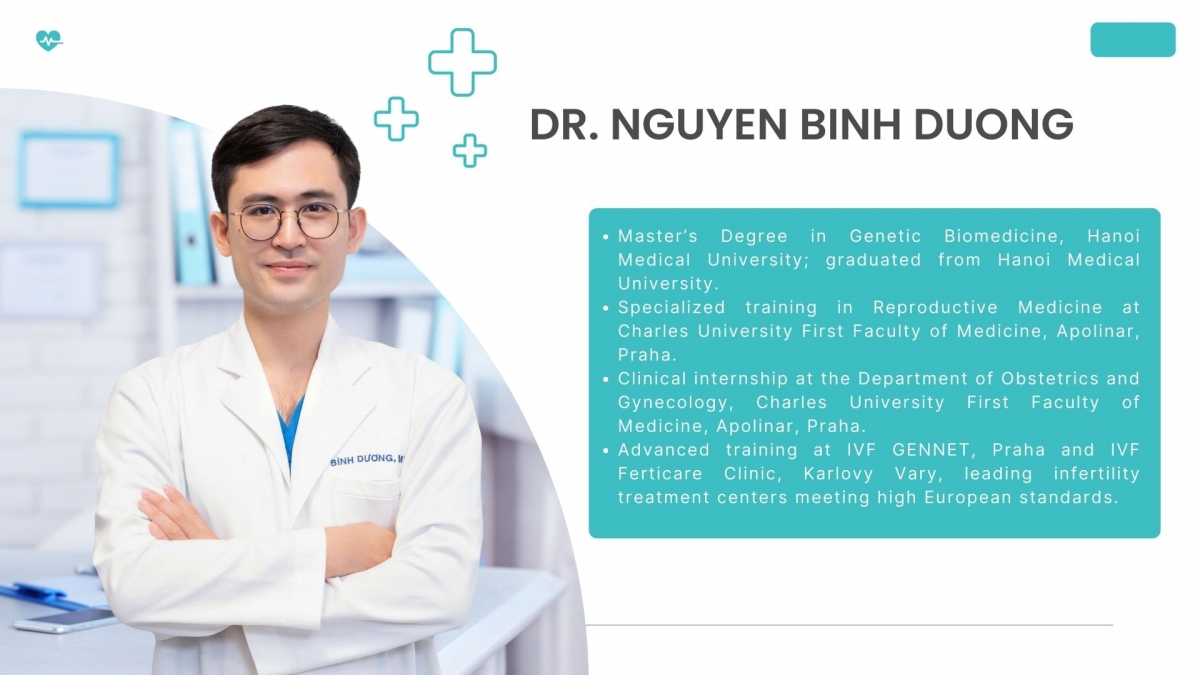
Doctor Nguyen Binh Duong is a reproductive medicine specialist with more than ten years of experience in infertility treatment. He holds a Master’s degree in Genetic Biomedicine and is a graduate of Hanoi Medical University. His professional training includes reproductive medicine studies at the First Faculty of Medicine, Charles University in Prague, where he also completed a clinical internship in obstetrics and gynecology. Dr. Duong has further advanced his expertise at leading European IVF centers, including IVF Gennet in Prague and IVF Ferticare Clinic in Karlovy Vary. His work focuses on developing IVF approaches that are medically sound while remaining attentive to patients’ physical comfort, emotional well-being, and long-term family goals.
Reporter: That was some brief information about Dr. Nguyen Binh Duong. Now, let’s get back to our conversation. Beyond physical effects, does mini IVF make a difference in how patients feel emotionally during the IVF journey?
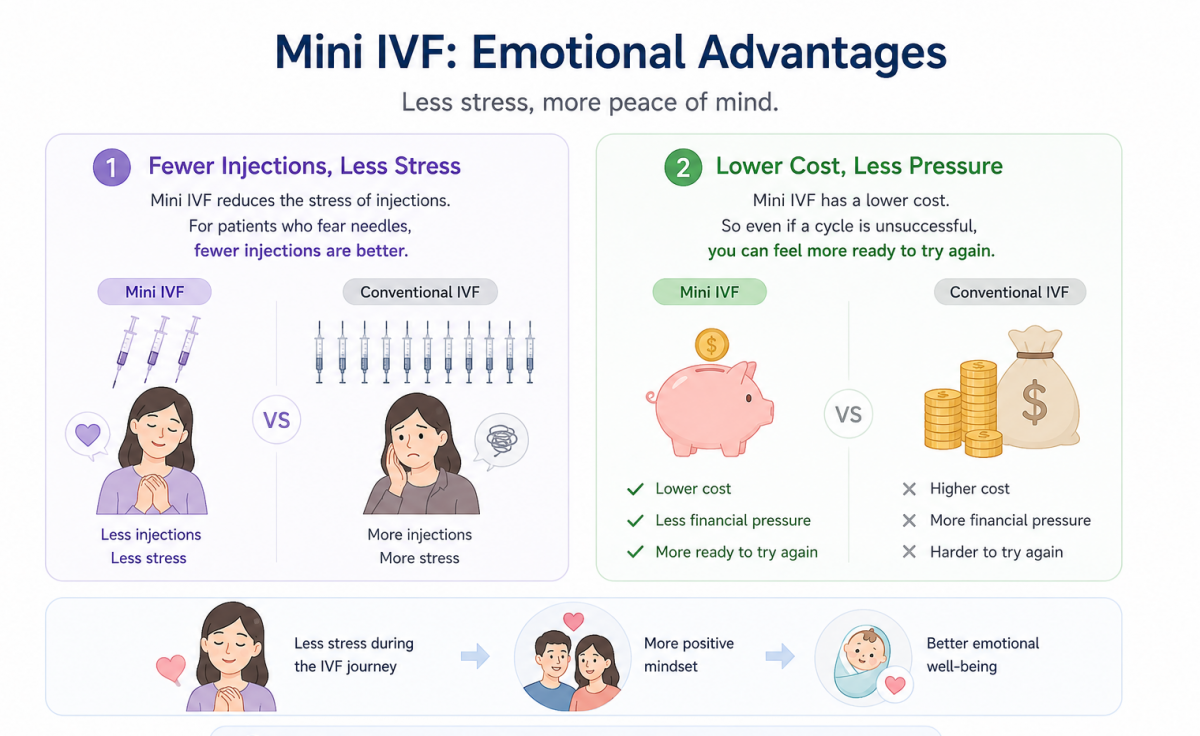
Doctor Duong: Emotionally, mini IVF has two advantages compared to the conventional IVF. The first is that it reduces the stress of injections. Some patients who don't want to do injections, they fear the needles. So fewer injections are better. The second one is the price. Because of the lower price, the stress generated by the IVF process will be less compared to the conventional IVF which is two or three times more expensive. So even when they have unsuccessful cycles, they are more ready to do another IVF cycle and the economic pressure will be lessened.
Reporter: When choosing between conventional IVF and mini IVF, what key factors do doctors usually consider to ensure the treatment remains effective?
Doctor Duong: The most important aspect is the current conditions and the fertility goals of the patients. We give the patient information based on their situations so they can make an informed choice. For example, if the patient needs to do genetic screening for a rare disease, we expect only about half of the embryos will be usable. So if the woman is 38 years old, with a pregnancy rate of 55% per cycle, we need at least around 3 embryos to have a good chance of success. And to have 3 embryos, we need around 10 mature eggs. So the conventional IVF should be considered more than the mini. So it's a case that you can see how we calculate it in our minds and to have the most suitable approach for each case.
Reporter: As mini IVF is sometimes described as a “gentler” approach, what misconceptions do you most often encounter among patients?
Doctor Duong: Mini IVF uses less medication, so it is a gentler approach compared to the conventional IVF. Then, the conventional IVF is a harsher approach. No. Now, with new medical literature, even the conventional IVF is much friendlier. We use it with the principle we call ALARA, which means as low as reasonably achievable. Compared to just 10 years ago, the dosage of conventional IVF is now only half. We use now an average of 200 IU a day. So with fewer complications and considered very safe for the patients.
Reporter: Finally, for couples considering mini IVF as a path to parenthood, what advice would you like to share with them?
Doctor Duong: The mini IVF is an IVF cycle with the dosage of a stimulation drug like IUI and a success rate comparable to conventional IVF. So don't be scared by its IVF label. It's very safe and it's very friendly.
Reporter: Mini IVF is one of several fertility options doctors may consider today, and as we’ve heard, the choice always depends on each couple’s situation and goals. Thank you, Dr. Nguyen Binh Duong, for joining us and for sharing your time and experience. That’s all for this edition of Doctor at Home. Thank you for listening, and goodbye until next time.