(VOVWORLD) - The latest scientific data show that the Earth’s climate is more out of balance than at any time in observed history. The impacts of climate change have exceeded previous projections and become increasingly worrisome amid global economic and geopolitical instability.
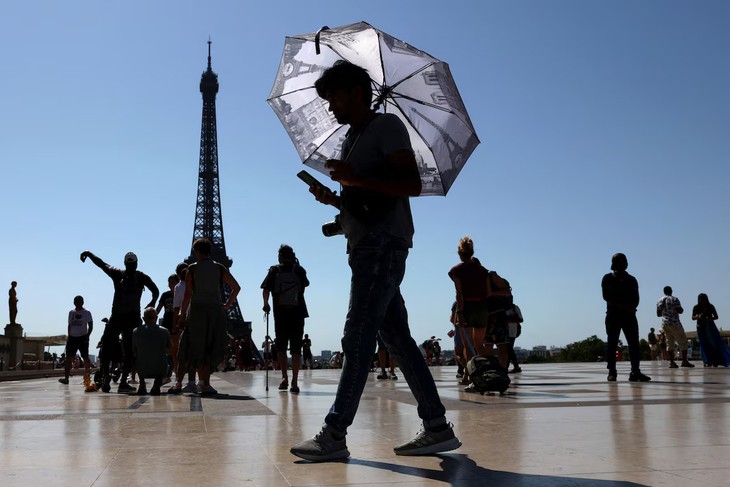 Heat at Trocadero Garden beside the Eiffel Tower, Paris on July 1, 2025 (Photo: REUTERS/Tom Nicholson) Heat at Trocadero Garden beside the Eiffel Tower, Paris on July 1, 2025 (Photo: REUTERS/Tom Nicholson) |
In the State of the Global Climate Report released on Monday, the World Meteorological Organization (WMO) said that every key climate indicator is flashing red with no clear signs of improvement.
Record-breaking temperatures
The WMO report confirms that 2015-2025 were the hottest 11 years on record, and 2025 was the second or third hottest year on record at 1.43°C above the 1850-1900 average. Extreme events around the world, including intense heat, heavy rainfall, and tropical cyclones, caused disruption and devastation and highlighted the vulnerability of our inter-connected economies and societies.
For the first time, the report includes the Earth’s energy imbalance as one of its key climate indicators. The Earth’s energy balance measures the rate at which energy enters and leaves the Earth system. In a stable climate, incoming energy from the sun is about the same as the amount of outgoing energy. However, increasing concentrations of heat-trapping greenhouse gases – carbon dioxide, methane and nitrous oxide – to their highest level in at least 800,000 years has upset that equilibrium. The Earth’s energy imbalance has increased since its observational record began in 1960, and particularly in the past 20 years. It reached a new high in 2025. The rate of ocean warming over the past two decades is about 18 times the annual human energy use.
Ocean warming has far-reaching consequences, such as degradation of marine ecosystems, biodiversity loss, and reduction of the ocean carbon sink. It fuels tropical and subtropical storms and exacerbates ongoing sea-ice loss in the polar regions.
WMO Deputy Secretary-General Ko Barrett said: “Let's just be honest here. This is a bit of a dire picture and, you know, we just, it's our job to kind of provide the evidence that we're seeing with the hope that this information will encourage people to take action. But there's no denying that these indicators are not moving in a direction that provides for a lot of hope.”
Even before the WMO released this year’s report, most climate experts worldwide had already warned that the global climate is in a state of emergency, as the Earth is being pushed beyond its limits. At the same time, signs of slowing climate commitments in recent years have worsened the situation.
Samantha Burgess, a climate strategy expert at the EU’s Copernicus Climate Change Service (C3S), said: “I think in a decade's time when we're this time in the 2030s, our background level of warming will be warmer. The number of extreme events around the world will increase. The cost associated with the damages and impacts of those extreme events will be worse. And we will look back to the mild climate of the mid-2020s with nostalgia. That's the concern.”
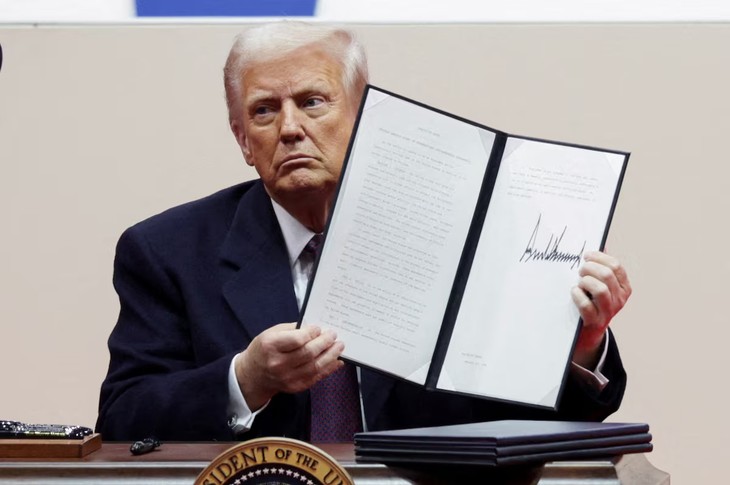 US President Donald Trump signs a series of executive orders to boost fossil fuel use and reverse the United States’ progress on climate change and clean energy. (Photo: REUTERS/Mike Segar) US President Donald Trump signs a series of executive orders to boost fossil fuel use and reverse the United States’ progress on climate change and clean energy. (Photo: REUTERS/Mike Segar) |
Conflicts harm the environment
Recent geopolitical and economic incidents are adding significant challenges to the fight against global climate change. Many governments have scaled back, or even abandoned green industrial policies. Under economic competition pressures, the US has withdrawn electric vehicle subsidies, expanded the use of fossil fuels, and stepped back from several climate commitments. In Europe, in an effort to support the automotive industry, the European Commission has softened its commitment to phase out internal combustion engine vehicles by 2035.
Recent conflicts in Ukraine, Gaza, Iran, and other places are damaging the environment with long-term consequences. Attacks on oil and gas facilities in Iran and neighboring Gulf countries have released large amounts of toxic emissions into the atmosphere.
UN spokesperson Stéphane Dujarric said: “We're particularly concerned by the number of reports of recent strikes on oil facilities, which could have serious environmental consequences across the region, with immediate possible impacts on safe water, on air that people need to breathe and on food. This comes on top of strikes on water desalination plants reported in several countries.”
Economists say another consequence of ongoing conflicts is that dependence on fossil fuels is likely to persist longer than expected. The largest disruption in history to the global energy supply, caused by Iran’s blockage of the Strait of Hormuz, will have lasting impacts, forcing many countries to accelerate the building of strategic oil and gas reserves in the short and medium term.
In the longer term, this energy crisis has warned countries they need to push ahead in developing renewable energy sources. According to UN data, renewable energy is now the cheapest source of electricity in most countries. Every dollar invested in renewable energy generates three times as many jobs as the same investment in fossil fuels. This will be a priority that the UN will promote in the next period of the global fight against climate change.