(VOVWORLD) - Vietnam is accelerating the development of strategic technologies, considering them a key driver to achieve its goal of becoming a developed country by 2045. As the world enters an era of unprecedented technological competition, advancing strategic technologies is a trend and also a practical solution to Vietnam’s most pressing challenges of boosting labor productivity, reducing external dependence, strengthening resilience to shocks, and moving toward a more sustainable growth model.
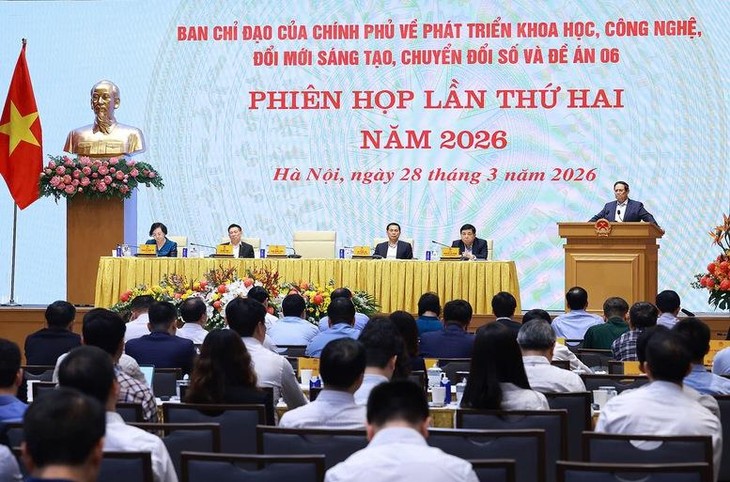 At the 2nd meeting of the Steering Committee on Science and Technology Development and Project 06 (Photo: Duong Giang/VNA) At the 2nd meeting of the Steering Committee on Science and Technology Development and Project 06 (Photo: Duong Giang/VNA) |
For many years, Vietnam’s economic growth has relied on low-cost labor, foreign investment, and export-oriented processing. While this model has delivered significant achievements, global shocks such as pandemics and geopolitical conflicts have exposed the economy’s vulnerability, particularly when supply chains are disrupted.
In this context, developing strategic technologies has become an inevitable requirement for Vietnam to stand firm in an increasingly uncertain world and, more importantly, to address its internal economic bottlenecks.
Catching up, keeping pace, and moving ahead
In recent years, Vietnam has recorded initial progress in strategic technology development. This includes rapid digital infrastructure expansion supporting digital transformation; widespread application of technology throughout society; initial participation in high-tech value chains such as electronics and semiconductors; the emergence of an innovation ecosystem; a growing tech workforce; and improvements in institutions and policies.
However, to move from technology adoption to mastery, from processing to value creation, and to participate in and lead in certain sectors, Vietnam must make strong breakthroughs, said Deputy Prime Minister Nguyen Chi Dung.
Mr. Dung said: “Knowledge, technology, talent, and forward-looking institutions lay the foundation for achieving breakthroughs. More importantly, we must demonstrate our capacity to participate in all stages of global value chains, grasp international standards, engage deeply in these chains, and integrate with the global technology. Vietnam must move faster and act more decisively and resolutely. In other words, we need our own approach to narrow the gap with the world, following the principle of catching up, keeping pace, and eventually moving ahead.”
Resolution 57 of the Politburo, along with key laws on science and technology, has established a legal framework to promote strategic technology development in Vietnam. The Government has also set up a national steering committee on science, technology, innovation, and digital transformation, headed by the Prime Minister.
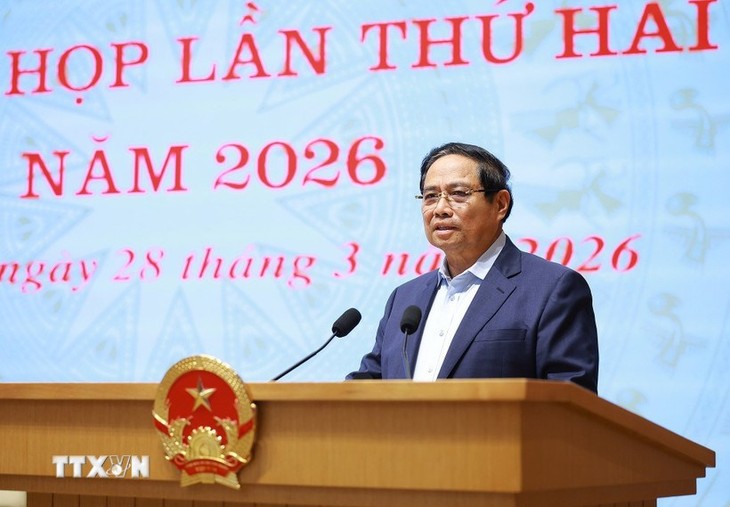 Prime Minister Pham Minh Chinh speaks at the meeting. (Photo: Duong Giang/VNA) Prime Minister Pham Minh Chinh speaks at the meeting. (Photo: Duong Giang/VNA) |
At an online meeting with 34 provinces and cities held in Hanoi last Saturday, Prime Minister Pham Minh Chinh stressed that developing strategic technologies is a key political task.
“It is necessary to establish a unified mechanism for direction and management at the government level to implement the strategic technology development program. A list of strategic technologies and products must be finalized for submission to the Prime Minister by April this year. A government task force on strategic technology development, led by a Deputy Prime Minister, should be established,” said Prime Minister Pham Minh Chinh.
A practical approach
Digital technologies including artificial intelligence, big data, and cloud computing form the foundation for improving governance and production efficiency. Energy technologies, particularly renewable energy and storage, play a crucial role in ensuring energy security. Manufacturing technologies such as automation and robotics, as well as deeper participation in semiconductor value chains, are key to upgrading industrial capacity. Meanwhile, biotechnology opens up vast opportunities in agriculture and healthcare.
Vietnam’s current approach to developing strategic technologies places businesses at the center, links technology with concrete economic challenges, and leverages international cooperation to narrow the development gap. Human resource development remains a top priority.
During a recent visit to the Military Technical Academy, Party General Secretary To Lam said: “It is crucial to strongly innovate training content and programs toward modernity, practicality, and connectivity, closely linked with real-world needs and the advancement of science and technology, while promoting international integration. In particular, we should continue expanding high-quality and talent training models in new, foundational, core, and strategic technologies, with the goal of mastering advanced technologies.”
Developing strategic technologies is an inevitable requirement for Vietnam at this stage. It is the key to transforming the country from a processing-based economy into a more innovative and self-reliant one in the new era.